When one outlet, counter or branch closes and the business carries on, the money to wrap up sits in stock, customers, the last day's cash, deposits you paid, connections, equipment, shared costs, staff claims, suppliers, card and UPI settlements, and the accountant's records. Make one closing list with one owner and one date, and write each item against the register that already holds it. End with a three-box closing money summary and two later looks: one about a week after the last day, and one at the next month end.
Counting and moving stock, moving customers' orders to another outlet, asking for final bills and getting deposits back are already covered in published closure guides. This page covers the records side of closing one outlet while the others keep trading: each line points to the register that already holds it, a closing summary also shows what moved, and there are two dated looks afterwards.
Who owns the list, and when to start
One person owns the list: whoever keeps the books, or the owner. Start it on the day the decision is made, not on the last trading day, while the people who know each item are still there.
"It's one small counter. We'll shut it on Saturday and sort out the rest as it comes." The rest can keep coming for months: the last electricity bill, a deposit nobody asked to have back, a customer who paid an advance at the old counter. If nothing is written in one place, a bill or a missing deposit can turn up three months later.
Illustrative example: a fictional children's clothing retailer in Kakinada, Andhra Pradesh, with the owner and 9 staff across three outlets: the main shop on Main Road, the bus-stand shop, and a small counter in a market complex that the owner decides to close. Amounts invented; verify independently; every legal, lease, tax and staff-settlement step is the accountant's and adviser's, and is not shown. The owner decides on Mon 2 Nov 2026, the accounts person owns the list, and the last trading day is Sat 28 Nov.
Stock: the last count, and what moves
Count everything at the outlet after the last day's close, at cost, with the same sheet your monthly count uses. Each piece either moves to another outlet on a transfer list signed by both outlet heads, or is kept apart for a decision. The transfer list is the record that the stock left one outlet and arrived at the other; the receiving outlet's next count should include it.
In Kakinada, after close on Sat 28 Nov:
| Stock at the counter | Pieces | At cost (₹) |
|---|---|---|
| Moved to the main shop on the signed transfer list | 1,240 | 3,10,000 |
| Damaged, kept apart for the owner's decision | 18 | 2,700 |
| Counted | 1,258 | 3,12,700 |
The 18 damaged pieces, ₹2,700 at cost, were moved separately and kept apart at the main shop for the owner's decision.
Follow the counting method in the monthly stock count for a small trader. Then look again at the receiving outlet's reorder levels.
Customers: advances, open orders, credit and queries
List every customer with something open at the outlet: an advance paid against an order, an order not yet delivered, an amount owed on account, or a query about a bill. Move each open order and its advance to another outlet's orders book, and tell each customer where to collect. Amounts owed stay in your receivables follow-up, and open queries stay in the query log until each is answered.
In Kakinada, four orders with advances moved to the main shop's orders book, and each customer was told by phone. Separately, two regular customers on account owe ₹14,500 between them.
| Order with an advance | Advance (₹) |
|---|---|
| Order 1 | 1,200 |
| Order 2 | 1,500 |
| Order 3 | 1,400 |
| Order 4 | 1,500 |
| Moved to the main shop | 5,600 |
The ₹14,500 is followed up in the customer receivables follow-up list. Queries go in the customer invoice query log.
The last day close, the float and petty cash
Close the last day as you close any day: cash, UPI and card takings against the day's sales, with the count signed. Then count the cash float and the petty cash, write both on the closing list, and carry them to another outlet or to the main cash on the same day, with the receiving person's signature. Any petty cash vouchers go with the float, so the last week's small spends are not lost when the counter's drawer is emptied.
In Kakinada, the counter's ₹2,000 float was counted and carried to the main shop on the last day, Sat 28 Nov, and written on the list as moved.
The day close follows matching cash, UPI and card takings to sales. The float and petty cash are counted and handed over as in the petty cash float and weekly reconciliation.
Deposits you paid: getting them back
List every deposit the outlet paid: rent, electricity connection, any equipment or service deposit. For each one, write the amount, the date paid, who holds it, and the condition for its return exactly as the agreement or receipt words it. Ask for each one on the date that condition allows, write the date you asked, and keep it on the list until the money is in the bank statement.
In Kakinada, the deposits register showed two deposits:
| Deposit paid | Return condition | Amount (₹) |
|---|---|---|
| Rent deposit | "returned after the keys are handed back", copied as written in the agreement | 60,000 |
| Electricity connection deposit | As on the receipt | 8,000 |
| To come back | 68,000 |
The keys went back on Mon 30 Nov, so the rent deposit could be asked for from that day.
Each deposit's line comes from the security deposits register.
Connections, rentals and the last settlements
List everything that runs or bills at the outlet's address: electricity, internet, phone and any service contract. For each, write the last date you need it, the date you asked for it to stop or for a final reading, and whether a device has to go back. File the return receipt for each device. Contracts that run past the closing date go on the list with their terms copied as written, for the owner to act on.
Card and UPI takings from the last days settle into the bank after the outlet has closed. Write the expected settlements on the list and tick each off against the bank statement when it arrives.
Stop or return rented card machines and soundboxes as part of closing.
In Kakinada, the card terminal was returned on Mon 30 Nov (receipt filed), the soundbox was returned, and the internet stopped from 30 Nov. The CCTV service contract runs to Wed 31 Mar 2027; its notice terms were copied as written from the renewals list. The last card settlements, and any terminal charge after 30 Nov, are looked for on the December statement at the month-end look.
Contracts come from the annual renewals list. The settlements are matched as in the bank reconciliation workflow.
Equipment, fixtures and tools
List every rack, counter, computer, printer and tool at the outlet, and write one of three things against each: moved (to which outlet), sold (to whom, for how much, on which date), or left behind. Update the asset register with the new location or the sale on the day it happens. Tools issued to staff at the outlet are checked back in against the tools register before the last day.
In Kakinada, two display racks and the billing computer moved to the bus-stand shop, and the asset register was updated with their new location. Nothing was sold or left behind.
Write each item's new location or sale in the fixed asset register, and check tools back in against the tools register.
Shared costs after the outlet closes
Some costs were split across the outlets: a shared accounts person, a delivery rider, a godown. When one outlet closes, its share falls on the outlets that remain. Write the new split down, with the month it starts from, so the remaining outlets' figures are read on the new basis.
In Kakinada, the accounts person and delivery rider cost ₹54,000 a month.
| Outlet | Share to November (₹) | Share from December (₹) |
|---|---|---|
| Main shop | 18,000 | 27,000 |
| Bus-stand shop | 18,000 | 27,000 |
| Market-complex counter | 18,000 | 0 |
| Total | 54,000 | 54,000 |
These costs were split equally across the three outlets (₹18,000 each, the owner's own written basis); from December the counter's ₹18,000 falls on the other two, so each carries ₹27,000 (₹9,000 more).
How to choose a basis is in the guide to splitting shared costs across outlets.
Staff: last claims and advances
For each person who worked at the outlet, list what is open on the records side: expense claims not yet paid, any advance given, tools issued, and which outlet they move to, if any. Claims are paid through your usual claims process before the last day where possible, and any still open go in the "still to pay" box with a name and a date.
In Kakinada, one counter staff member moves to the main shop and one leaves. Two claims, ₹1,250 between them, were still open on the last day and went into "still to pay".
Which registrations, licences, agreements and staff dues have legal or tax steps when an outlet closes depends on your state, your agreements and your business; ask your accountant and adviser which apply to you.
Claims follow the staff expense claims and reimbursement process.
Suppliers: deliveries, last bills and statements
Tell every supplier who delivers to the outlet its last day and the address deliveries go to from then. Match the last deliveries to their purchase orders and bills as usual. Ask each supplier for a statement after the last bill, and check it against your books, so that any credit or unpaid bill for the closed outlet is found while the people who placed the orders still remember them.
Payments run on the supplier payment schedule. Deliveries are matched as in matching purchase orders, deliveries and bills. Statements are checked as in reconciling a supplier statement with your books.
Records: what to keep, and what the accountant needs
Keep the outlet's papers together in one closing file: the closing list, the stock count sheet and signed transfer list, the deposits list and return receipts, device return receipts, final bills, the staff claims, the supplier statements, and the closing money summary. Send it to the accountant with that month's records, and agree who asks for anything still missing.
What goes to the accountant each month is in the monthly records for your accountant. Who does what is in owner and accountant monthly responsibilities.
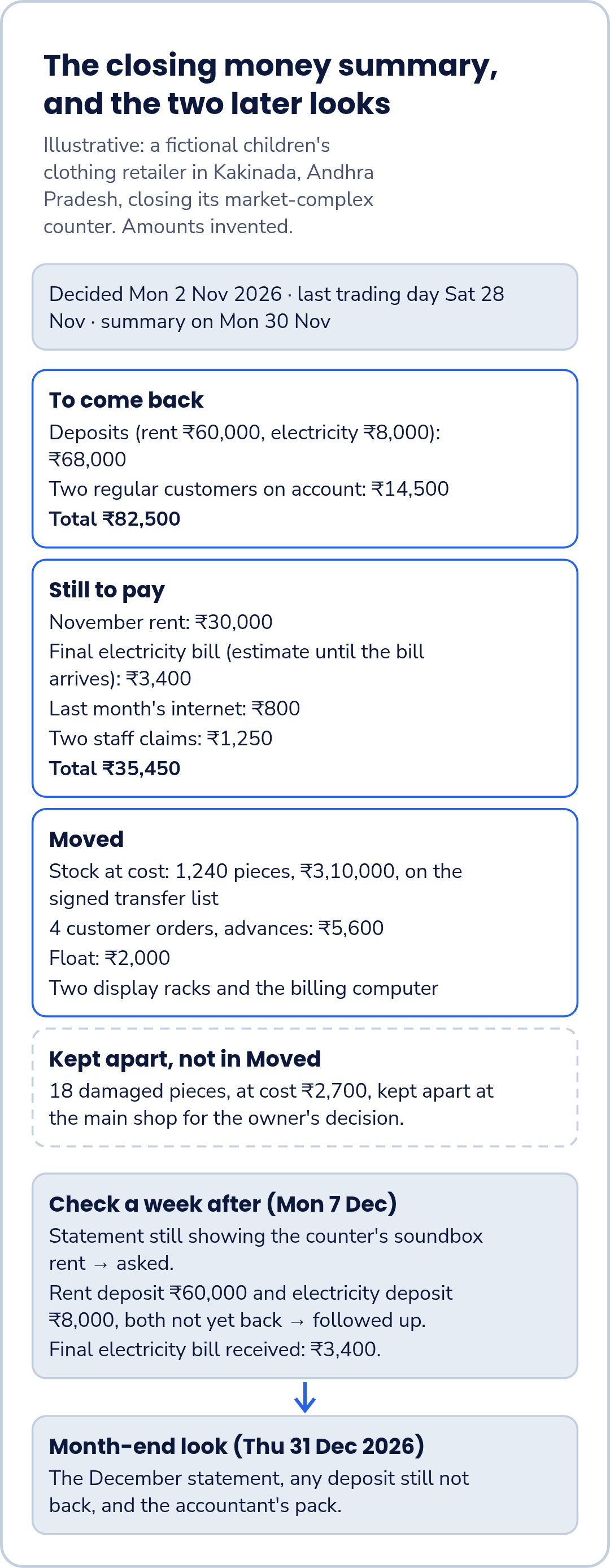
The closing money summary and the two later looks
The closing money summary has three boxes: to come back (deposits, amounts customers owe), still to pay (last rent as the agreement says, final utility bills, last connection charges, staff claims), moved (stock at cost, customer orders and their advances, float, equipment), each with a date and a name.
Kakinada's summary on Mon 30 Nov:
| Box | Item | Amount (₹) |
|---|---|---|
| To come back | Deposits (rent 60,000, electricity 8,000) | 68,000 |
| To come back | Two regular customers on account | 14,500 |
| To come back, total | 82,500 | |
| Still to pay | November rent | 30,000 |
| Still to pay | Final electricity bill (estimate until the bill arrives) | 3,400 |
| Still to pay | Last month's internet | 800 |
| Still to pay | Two staff claims | 1,250 |
| Still to pay, total | 35,450 | |
| Moved | Stock at cost | 3,10,000 |
| Moved | 4 customer orders, advances | 5,600 |
| Moved | Float | 2,000 |
| Moved | Two display racks and the billing computer | – |
| Kept apart | 18 damaged pieces, at cost | 2,700 |
- Check a week after (Mon 7 Dec): statement still showing the counter's soundbox rent → asked; rent deposit ₹60,000 asked for after the keys went back on Mon 30 Nov and electricity deposit ₹8,000, both not yet back → followed up (see tracking deposits you have paid); final electricity bill received ₹3,400 (as estimated, for the example). Month-end look (Thu 31 Dec 2026): the December statement, any deposit still not back, and the accountant's pack.
The month-end look runs with the month-end accounting checklist. Read the remaining outlets with questions for your monthly profit and loss. Then put both totals into the 13-week cash flow forecast.
A printable closing list
Fill "Where it is recorded" with your own register's name.
When you decide
| Item | Where it is recorded | Who | By when | Done | Amount (₹) |
|---|---|---|---|---|---|
| List owner named; last trading day set | Closing list |
The last week
| Item | Where it is recorded | Who | By when | Done | Amount (₹) |
|---|---|---|---|---|---|
| Stock count date set | Stock count sheet | ||||
| Customers with orders, advances or queries told | Orders book, query log | ||||
| Suppliers told the last day and new address | Supplier list | ||||
| Deposits listed, with return conditions as written | Deposits register | ||||
| Connections, devices and contracts to stop listed | Renewals list |
The last day
| Item | Where it is recorded | Who | By when | Done | Amount (₹) |
|---|---|---|---|---|---|
| Day close done and signed | Day-close sheet | ||||
| Float and petty cash counted and handed over | Petty cash book | ||||
| Stock counted; transfer list signed by both outlet heads | Transfer list |
The week after
| Item | Where it is recorded | Who | By when | Done | Amount (₹) |
|---|---|---|---|---|---|
| Keys handed back; deposits asked for | Deposits register | ||||
| Devices returned; receipts filed | Renewals list | ||||
| Final bills expected, listed | Closing list | ||||
| Closing money summary made | Closing file |
The month end
| Item | Where it is recorded | Who | By when | Done | Amount (₹) |
|---|---|---|---|---|---|
| Statement checked for debits still running | Bank statement | ||||
| Deposits back, or followed up | Deposits register | ||||
| Final bills received | Closing list | ||||
| Closing file sent with the accountant's pack | Closing file |
Talk through your books in a demo
If you would like to talk through how your business keeps its books, request a demo and choose "Book a demo" on the form. FastComply Books is in an invitation pilot in India, so the demo is where we confirm what is available for your business.