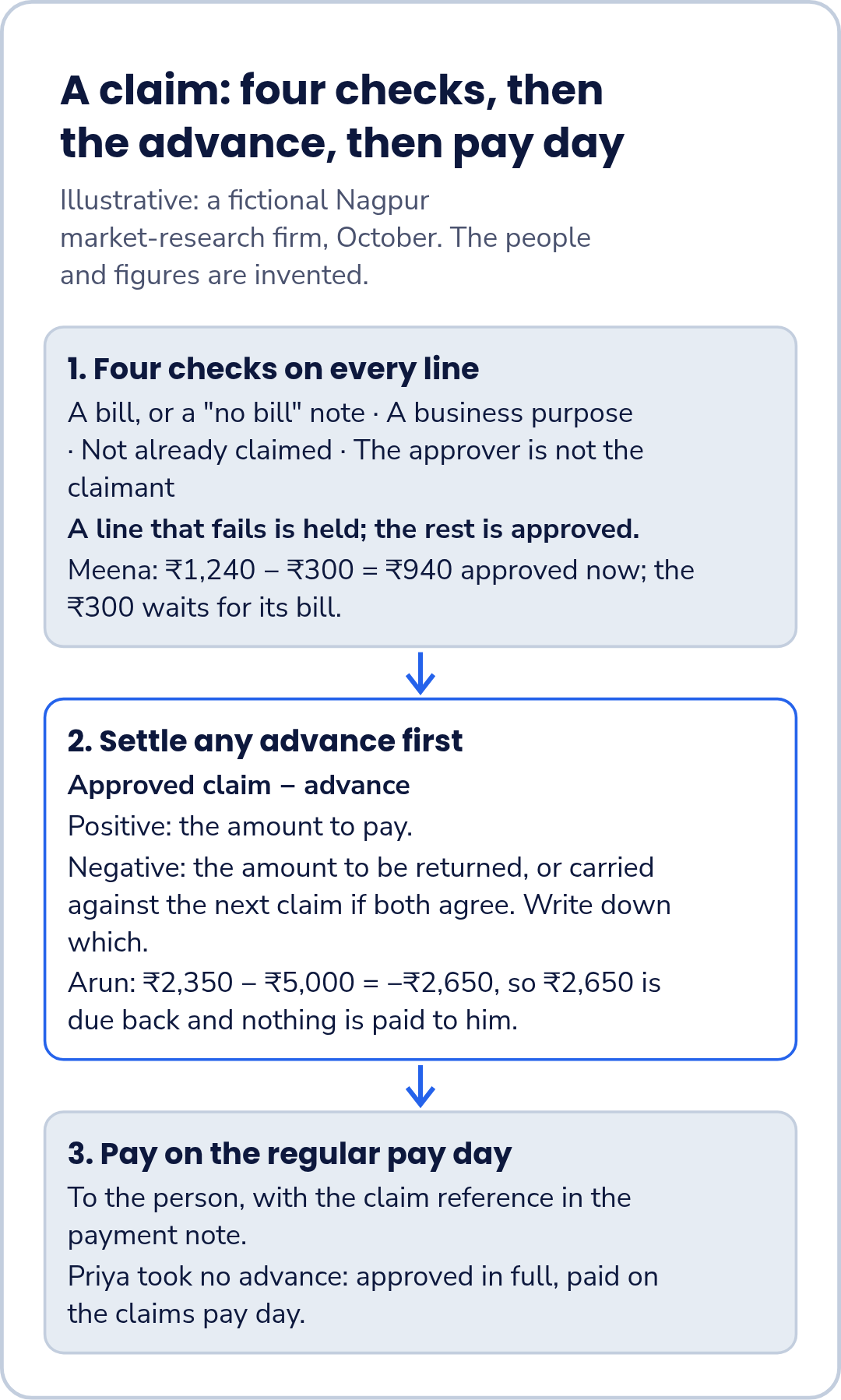
Give each person one claim voucher for the month, or for a trip, listing every expense with its bill attached. Before approving it, run four checks: every line has a bill or a "no bill" note, every line says what it was for, nothing has been claimed before, and the person approving is not the person claiming. Settle any advance the person took before paying anything. Then pay approved claims on a regular day, by bank transfer or UPI, with the claim reference in the payment note.
This works on paper or in a spreadsheet. It is about getting people paid correctly and on time, and making sure each bill is paid once.
Why claims get messy
Staff spend their own money on local conveyance, client meetings and small purchases, and send photos of the bills on WhatsApp whenever they remember. The photos sit in different chats, a claim arrives weeks after the spend, an advance given for a trip is never settled, and the same bill can turn up in two claims. None of this needs bad intent. It happens because there is no single place where a claim is written down, checked and marked paid.
One claim voucher
Use one sheet per person, per month or per trip:
| Date | What for | Amount | Bill | Notes |
|---|---|---|---|---|
| Attached / no bill |
At the bottom:
Total claimed               ₹[ ]
Approved                    ₹[ ]
Advance taken (if any)      ₹[ ]
To pay / to be returned     ₹[ ]
Claimed by: [ ]    Approved by: [ ]    Date: [ ]
- What for should say enough for someone else to understand it later: "auto to client office, Dharampeth" rather than "travel".
- A phone photo of the bill is fine. Name and file the bill the same way as your other purchase bills, so it can be found later. Ask your accountant if they also need the paper bill.
- Your policy sets any rates or limits, for example for local conveyance. This sheet only records what was spent.
Four checks before you approve
- A bill, or a "no bill" note. Each line has a bill attached. If there is no bill, for example for an auto fare, the line says "no bill" and the approver decides whether to accept it, in writing.
- A business purpose. Each line says what the expense was for.
- Not already claimed. Check for the same bill, or the same amount on the same date, in this claim, in earlier claims and in petty cash vouchers.
- The approver is not the claimant. Nobody approves their own claim. For the owner's own expenses, which no one else in the business approves, one option is to send the claim to your accountant to look over.
If a line fails a check, approve the rest and hold that line until it is sorted out. Tell the person which line is held and why.
Settle advances first
If the person took an advance, settle it before anything is paid:
Approved claim − advance = amount to pay (if positive) or amount to be returned (if negative)
If the approved claim is less than the advance, the balance is returned, or carried against the person's next claim if you both agree. Write down which, so the advance does not stay open without anyone noticing.
Pay on a regular day
Pick a day for paying claims, such as once a month or once a fortnight, so people know when to expect their money and know when to get their claims in. Pay by bank transfer or UPI to the person, with the claim reference in the payment note, so the payment can be matched to the claim later. Whether reimbursements can be paid with salary, and how, is for your accountant.
Keep a claims register with one row per claim, so you can see at a glance what was claimed, approved and paid.
Small amounts and petty cash
Small out-of-pocket amounts can be repaid from the petty cash box against a voucher. Mark the bill as repaid from petty cash so it cannot turn up in a claim later. Everything else goes through this process.
Ask your accountant how reimbursements and any advances should be recorded, and whether any tax or GST point applies.
Worked example: a market-research firm's October claims
Illustrative example: a fictional Nagpur market-research firm, October. The people and figures are invented.
Three people submit claims for October.
Priya claims travel ₹3,200, a client lunch ₹1,180 and parking ₹480: ₹3,200 + ₹1,180 + ₹480 = ₹4,860. Every line has a bill and a purpose. She took no advance. Approved in full, and paid on the claims pay day.
Arun took a ₹5,000 advance for a client visit and claims ₹2,350 against it. All four checks pass. Approved claim − advance = ₹2,350 − ₹5,000 = −₹2,650, a negative figure, so ₹2,650 is due back from Arun. Nothing is paid to him. He returns the ₹2,650, or, if he and the owner agree, it is carried against his next claim.
Meena claims ₹1,240, but the bill for one ₹300 line is missing. The other lines pass, so ₹1,240 − ₹300 = ₹940 is approved now. The ₹300 waits until she finds the bill, or the approver accepts it in writing as a "no bill" line.
On the pay day, the firm pays Priya ₹4,860 and Meena ₹940: ₹5,800 in total. Arun's ₹2,650 is due back and is not set off against anyone else's claim.
The claims register for October:
| Claimant | Claimed | Advance | Approved | Paid | Paid on | Reference | Status |
|---|---|---|---|---|---|---|---|
| Priya | ₹4,860 | — | ₹4,860 | ₹4,860 | Pay day | [ref] | Closed |
| Arun | ₹2,350 | ₹5,000 | ₹2,350 | ₹0 | — | — | ₹2,650 due back |
| Meena | ₹1,240 | — | ₹940 | ₹940 | Pay day | [ref] | ₹300 held for bill |
| Total | ₹8,450 | ₹5,000 | ₹8,150 | ₹5,800 |
Totals: claimed ₹4,860 + ₹2,350 + ₹1,240 = ₹8,450; approved ₹4,860 + ₹2,350 + ₹940 = ₹8,150; paid ₹4,860 + ₹940 = ₹5,800.
The claims register (blank)
| Claimant | Claimed | Advance | Approved | Paid | Paid on | Reference | Status |
|---|---|---|---|---|---|---|---|
Claims routine in place? Explore early access
If you would like to hear about FastComply Books for your business, you can request early access. FastComply Books is in an invitation pilot in India and public sign-up is not open yet.