Give petty cash a fixed amount, called the float, and one person who looks after it. Every rupee that leaves the box gets a voucher. Once a week, count the cash and add up the vouchers: together they should equal the float. Then top the box back up to the full float, so every week starts from the same amount. If the count was short or over, write the difference on its own line, separate from the vouchers, and keep it on a list until it is explained. Tell your accountant about any difference; how it is recorded in the books is their decision.
Why petty cash drifts
The payouts are small and frequent: a courier, an auto fare, tea for a client meeting, a pack of printer paper. Slips get lost, someone pays from the box and means to write it down later, and staff top the box up from their own pockets and take it back the next day. None of it is large, but by the end of the month the box and the paperwork may no longer agree, and the gap can end up labelled "misc. expenses". A fixed float and a weekly count make any difference show up within the week it happened, while people still remember what they paid for.
Set up a fixed float
- Choose the float. Pick an amount that covers a normal week's cash payouts with some margin. The amount is your choice; there is no standard figure.
- Name one custodian. One person holds the key and pays out from the box. A second person, the approver, checks the count each week.
- Keep it separate. Use a locked box only for business payouts. It is not the owner's wallet, and personal spends do not come out of it.
- Keep a voucher pad and the count sheet with the box.
Ask your accountant whether any limits on cash payments apply to you.
A voucher for every payout
Every payment from the box gets a voucher, filled in when the money goes out:
- date
- paid to
- purpose
- amount
- signature of the person who received the cash
- the bill or receipt attached, where there is one
If there is no bill, for example for an auto fare, write "no bill" on the voucher and have it approved by someone other than the custodian. Small out-of-pocket amounts a staff member has already spent can be repaid from the box against a voucher; larger amounts or travel claims go through your staff-claims process.
The weekly count and top-up
On the same day each week, the custodian and the approver:
- Count the cash by denomination and write it on the count sheet.
- Add up the vouchers for the week.
- Work out the expected cash: float − vouchers.
- Compare the expected cash with the cash counted. Write the difference on the sheet, even if it is zero.
- Top up to the full float, by a recorded bank withdrawal, so the top-up appears on the bank statement as well. The top-up is the voucher total plus any shortage (or minus any surplus). Write those two parts as separate lines on the count sheet.
- Both sign the sheet. The vouchers and the sheet go to your accountant with the month's records.
Topping up to the full float means every week's count starts from the same figure, so the arithmetic stays simple. The difference does not disappear: it is a separate line on the count sheet and stays on a running list of differences, with what was found and who approved it, until it is explained. It is never folded into the voucher total or called "misc.".
When the count does not match
- Look first. Check for a voucher not yet written, a payout recorded twice, a note stuck to another, or a staff member who paid for something and has not yet been repaid.
- Record it. Write the difference on the count sheet and on the running list of differences, with what you found. Do not add a voucher for it or call it "misc.".
- Get it approved. The approver signs off the difference once it has been looked into, whether or not it was explained.
- Tell your accountant. How the difference is recorded is your accountant's decision.
- Keep it impersonal. A small difference may well be a missed slip, so treat it as a figure to explain, not as a sign that someone took money.
Worked example: a dental clinic's week
Illustrative example: a fictional dental clinic in Chennai. The business and figures are invented.
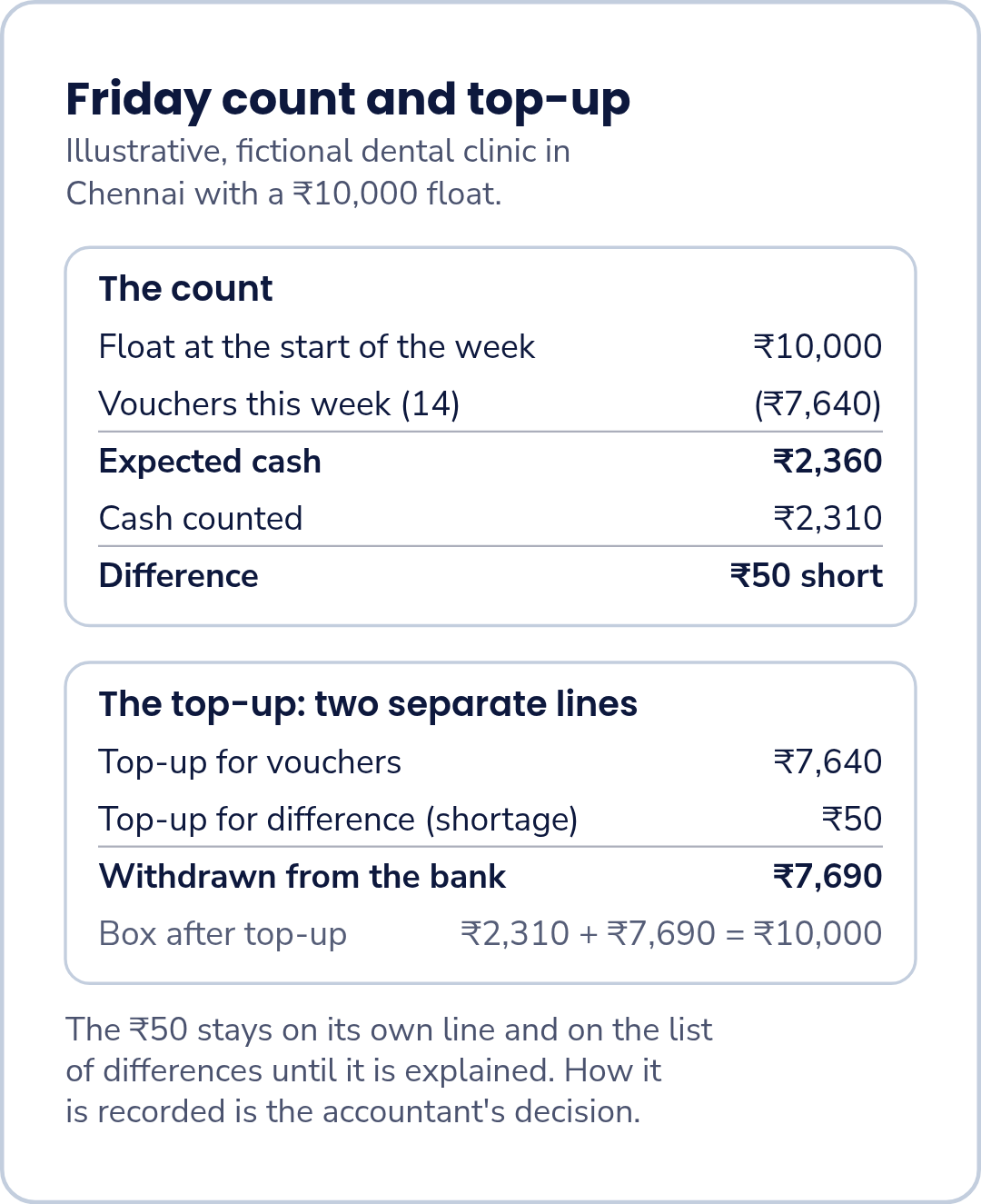
The clinic keeps a ₹10,000 float. At the end of the week, on Friday, the box holds 14 vouchers:
| Purpose | Vouchers | Total |
|---|---|---|
| Courier | 3 | ₹1,280 |
| Tea and snacks | 4 | ₹1,960 |
| Local travel | 4 | ₹2,150 |
| Stationery | 2 | ₹1,450 |
| Minor repair | 1 | ₹800 |
| Total | 14 | ₹7,640 |
Expected cash: ₹10,000 − ₹7,640 = ₹2,360. The count comes to ₹2,310, so the box is ₹50 short (₹2,360 − ₹2,310).
The custodian and the approver look for a missing voucher and do not find one. They write "short ₹50, no voucher found" on the count sheet and on the list of differences, both sign it, and the note goes to the accountant with the week's vouchers.
The top-up is ₹7,690: ₹7,640 for the approved vouchers plus ₹50 to cover the shortage, shown as two separate lines and withdrawn from the bank. The box now holds ₹2,310 + ₹7,690 = ₹10,000, and next Friday's expected cash is ₹10,000 minus next week's vouchers.
The ₹50 stays on the list of differences until it is explained, for example if a forgotten slip turns up. How the ₹50 is recorded is for the accountant to decide.
The count sheet
One sheet per week, kept with the vouchers:
| Denomination | Count | Amount |
|---|---|---|
| ₹500 | 3 | ₹1,500 |
| ₹200 | 3 | ₹600 |
| ₹100 | 1 | ₹100 |
| ₹50 | 2 | ₹100 |
| ₹10 | 1 | ₹10 |
| Coins | 0 | ₹0 |
| Cash counted | ₹2,310 |
| Line | Amount |
|---|---|
| Float at the start of the week | ₹10,000 |
| Vouchers this week (14) | ₹7,640 |
| Expected cash | ₹2,360 |
| Cash counted | ₹2,310 |
| Difference | ₹50 short |
| What we found | No voucher found |
| Top-up for vouchers | ₹7,640 |
| Top-up for difference | ₹50 |
| Box after top-up (the float) | ₹10,000 |
| Counted by / Checked by | [Custodian] / [Approver] |
The figures above are from the fictional clinic example. Leave the amounts blank on your own sheet and fill them in each week.
Getting your everyday records in order?
If you would like to hear about FastComply Books for your business, you can request early access. FastComply Books is in an invitation pilot in India and public sign-up is not open yet.