Bank reconciliation compares the bank's record of an account with your own record of the same account (the bank ledger in your books) at the same date. Done properly, it finds entries that are missing, duplicated or wrongly matched, and it separates those from genuine timing differences. A reconciliation is finished when every rupee of difference between the two closing balances has an explanation, not just when most lines are ticked.
The example below uses fictional amounts for an ordinary current account with money in it (no overdraft, no foreign currency, no tax effects). Decisions about what to correct and how to record it are for your accountant; this guide covers how to find and document the differences.
1. Gather the right records
Work on one bank account and one statement period at a time. You need:
- the complete statement for the period, with every page or exported row
- the bank ledger from your books for the same dates
- the list of items left outstanding at the last reconciliation
First check that this period's opening balances agree with last period's reconciled position. If they do not, fix that first; matching more transactions will not repair a wrong starting point. When importing a statement file, check that the date range does not overlap an earlier import, or the same transactions will appear twice.
Bank statements are sensitive. Share them only with the people who prepare or review the accounts.
2. Match on evidence, not just the amount
Compare the amount, the reference, the counterparty and the date. Dates often differ: a cheque written on the 28th may clear on the 3rd. Amounts can mislead: two payments of ₹10,000 are not necessarily the same payment.
Some matches are not one-to-one. A card or payment-gateway settlement may combine several sales and deduct a fee; one customer transfer may pay three invoices. Record the breakdown and check that the parts add up to the bank amount. If they do not, keep the gap visible rather than absorbing it into the match.
A transfer between two of your own accounts should appear in both bank ledgers. Find the other side before treating it as income or an expense.
3. Sort what is left
| Unmatched item | What to check | Usual next step |
|---|---|---|
| Bank charge or interest not in your books | Statement line and bank's charge advice | Give it to your accountant to record |
| Payment in your books, not yet on the statement | Cheque or transfer details and date issued | Keep on the outstanding list until it clears |
| Deposit in your books, not yet on the statement | Deposit slip or transfer confirmation | Keep on the outstanding list and check it arrives |
| Same receipt or bill entered twice | References and entry history | Flag the duplicate for correction |
| Credit on the statement you cannot identify | Counterparty name, remittance advice | Ask the payer or bank before allocating |
An unmatched item is a question, not automatically a mistake. For each one, note the explanation, the evidence, who is handling it and when you expect it to be resolved.
4. Fictional example: explaining the closing balance
At 30 June, the bank statement shows ₹1,48,500 and the bank ledger shows ₹1,60,000. The difference to explain is ₹11,500. Checking the unmatched items finds:
- a ₹1,500 bank charge on the statement that is not yet in the books
- a ₹20,000 cheque issued and recorded on 28 June that the bank has not yet paid
- a ₹30,000 deposit paid in on 30 June and recorded, which the bank credited on 1 July
| Reconciliation | Amount |
|---|---|
| Balance per bank statement | ₹1,48,500 |
| Add: deposit recorded, not yet credited by the bank | ₹30,000 |
| Less: cheque recorded, not yet paid by the bank | (₹20,000) |
| Adjusted bank balance | ₹1,58,500 |
| Balance per bank ledger | ₹1,60,000 |
| Less: bank charge not yet recorded | (₹1,500) |
| Adjusted ledger balance | ₹1,58,500 |
Both sides agree at ₹1,58,500, and the three items account for the whole ₹11,500 (₹30,000 − ₹20,000 + ₹1,500). The bank charge is the only item that needs an entry in the books. The cheque and the deposit stay on the outstanding list until they appear on the statement; recording them again would double-count them.
A deposit belongs on the outstanding list only if you have evidence the money was actually paid in, such as a stamped slip or a transfer confirmation. If you cannot show that, do not treat it as a timing difference; raise it with your accountant. The same applies to anything outside this simple case, such as an overdrawn account, a returned cheque, a foreign-currency account or an outstanding cheque that has not cleared for a long time.
5. When the difference will not go away
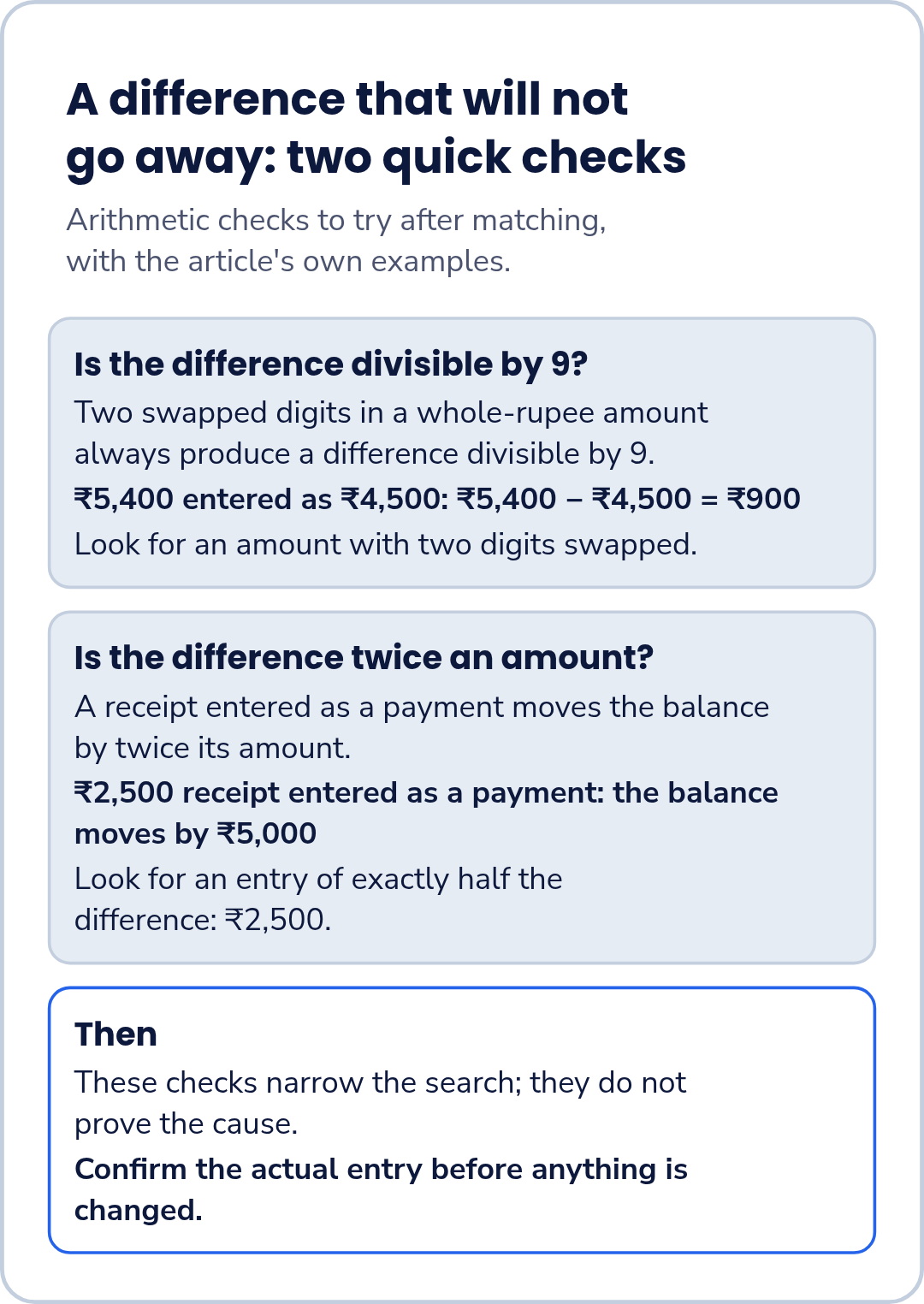
If an unexplained difference remains after matching, two quick arithmetic checks can point you to the cause:
- Difference divisible by 9. Two swapped digits in a whole-rupee amount always produce a difference divisible by 9. For example, ₹5,400 entered as ₹4,500 creates a difference of ₹900.
- Difference equal to twice an amount. A ₹2,500 receipt entered as a payment moves the balance by ₹5,000. Look for an entry of exactly half the difference.
These checks narrow the search; they do not prove the cause. Confirm the actual entry before anything is changed.
6. Document the result
Keep the statement, the ledger extract, the reconciliation summary and the outstanding list together for each account and period. For every item that needs a correction, record the evidence, the explanation and who approved the change, and check that it has not already been recorded elsewhere before a new entry is made. After corrections are posted, re-run the comparison.
Record who prepared the reconciliation and when. Add a reviewer's name only after that person has actually reviewed it.
7. Start next period from a clean list
- Confirm that next period opens from the reconciled balance.
- Check that last period's outstanding cheques and deposits cleared, and follow up any that did not.
- Investigate duplicate imports and unidentified credits promptly.
- Pass newly identified customer receipts to whoever maintains the receivables list.
- Keep every unresolved item assigned to one person.
- Reconcile more often than monthly if you have many transactions.
Up-to-date bank records also keep your receivables list accurate, so customers are not chased for invoices they have already paid. To discuss your bank reconciliation process, request a demonstration, choose 'Book a demo' on the form and ask whether FastComply Books currently supports it for your business.