A customer's total balance tells you how much is owed. It does not tell you which invoice is unpaid, why, or who is going to do something about it. Those three answers decide whom you call first and how much cash you can realistically plan on.
This guide sets up a receivables list that answers them, using a spreadsheet or any accounting software. The names and amounts are fictional, and tax is left out of the arithmetic so the steps are easy to follow. How a shortfall, credit or old unpaid balance is recorded in your accounts is a decision for your accountant; this guide covers tracking and follow-up only.
1. Keep one row per invoice
For each invoice, record:
- customer and invoice number
- invoice date and the agreed due date (from the contract, order or invoice terms; do not assume 30 days)
- invoice amount, receipts allocated to it, credit notes already issued against it, and the remaining balance
- any reference the customer needs before paying, such as a purchase-order number or a signed acceptance
- who follows it up, the current status, the last contact date and the next action
Keep a link to the invoice and to evidence that the customer received it. Note who handles payments at the customer's end, so that reminders reach the person who can release the payment.
2. Allocate receipts before you chase anyone
Match every receipt to the invoice it pays, using the payment reference, a remittance advice or the customer's written confirmation. A deposit showing only the customer's name may cover several invoices, may be an advance for future work, or may come from a related business. If the split is unclear, ask the customer for a breakdown. Until then, keep the amount as an unallocated receipt rather than applying it to the oldest invoice by default.
Fictional example, as at 30 September, after receipts and credit notes have been allocated:
| Customer / invoice | Due date | Invoice | Allocated receipts | Credit notes issued | Remaining |
|---|---|---|---|---|---|
| Cedar Studio / CS-101 | 10 September | ₹60,000 | ₹20,000 | ₹0 | ₹40,000 |
| Northline Services / NS-204 | 25 September | ₹35,000 | ₹0 | ₹5,000 | ₹30,000 |
| River Works / RW-310 | 10 October | ₹25,000 | ₹0 | ₹0 | ₹25,000 |
| Total | ₹1,20,000 | ₹20,000 | ₹5,000 | ₹95,000 |
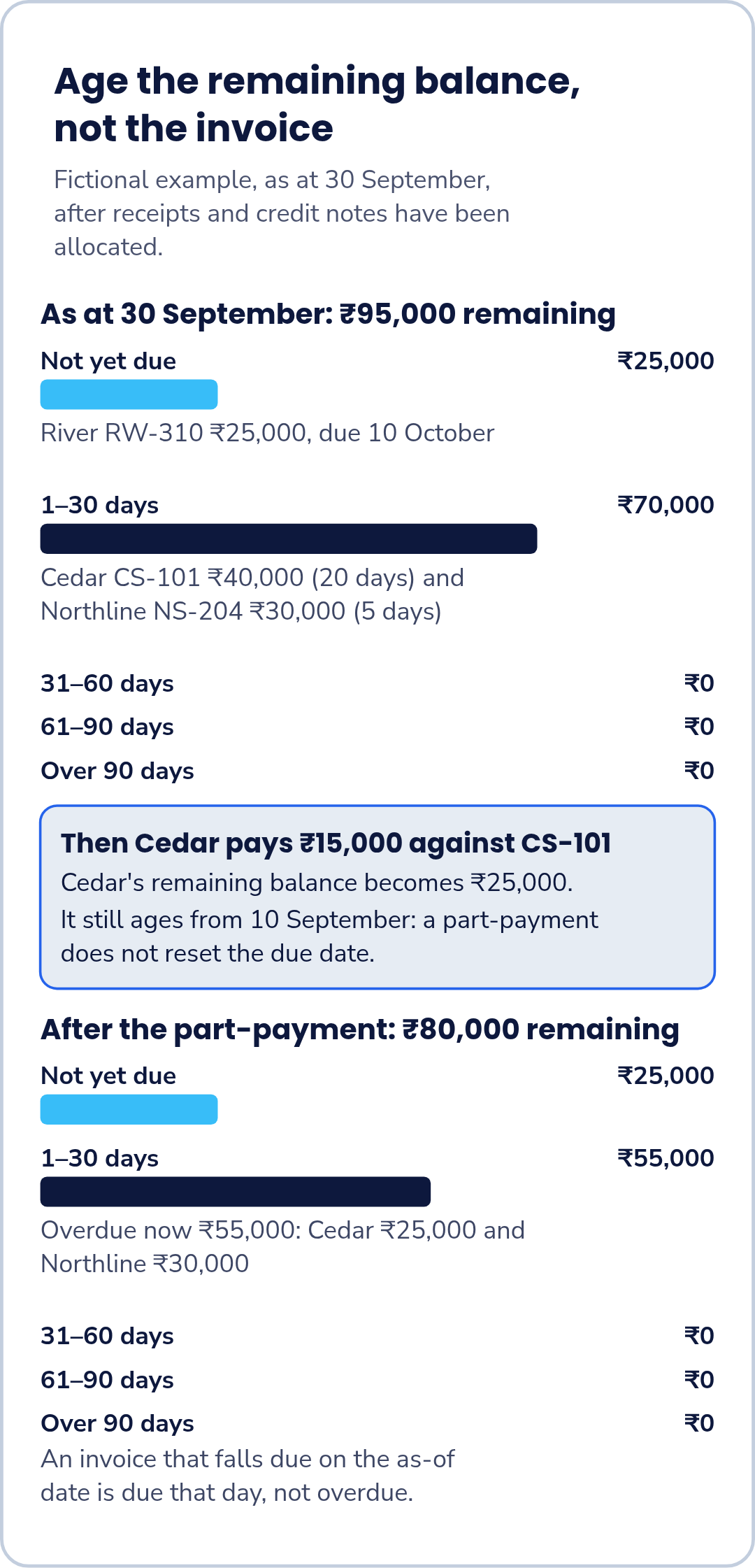
Of the ₹95,000 still owed, ₹70,000 is overdue: Cedar by 20 days and Northline by 5 days. River is not yet due. The Northline credit note is assumed to have been properly issued. A complaint on its own is not a reason to lower the balance on your list: keep the remaining amount, mark the invoice as disputed, and change the balance only when a credit note is issued or a payment arrives.
When a customer pays less than the invoice and says the difference was withheld for tax or deducted for another reason, do not reduce the balance or label the difference yourself. Keep the shortfall on that invoice's row with the customer's explanation and any document they provide, and pass it to your accountant.
3. Age the remaining balance, not the invoice
Pick an as-of date and show it on the report. Group each remaining balance by days past its due date. A common convention uses these bands: not yet due, 1–30, 31–60, 61–90 and over 90 days; other bands are fine if they suit your payment terms, as long as you use the same ones each week. An invoice that falls due on the as-of date is due that day, not overdue.
In the example, ₹70,000 sits in 1–30 days and ₹25,000 is not yet due. If Cedar then pays ₹15,000 against CS-101, Cedar's remaining balance becomes ₹25,000, total remaining falls to ₹80,000 and the overdue amount to ₹55,000. Cedar's invoice still ages from 10 September; a part-payment does not reset the due date unless a new date is agreed and documented.
Before you rely on the list, check that its total agrees with the customer balances in your books on the same date. A difference usually points to an unallocated receipt, a credit note recorded in one place but not the other, or reports run on different dates.
4. Record why each invoice is unpaid
A few statuses are enough: awaiting payment, documents missing, disputed, payment promised, and escalated. Keep the remaining balance and due date visible whatever the status.
The status decides the next action. In the example, if Cedar has promised payment on a date, the next step is to check the bank on that date. If Northline is waiting for a purchase-order reference on the invoice, the next step is a corrected document, not another reminder. Record the specific blocker and one owner for it.
Keep reminders short and factual, for example:
Our records show ₹40,000 remaining on invoice CS-101, due on 10 September. Could you confirm when this will be paid, or send the remittance details if it has already been paid?
Check the current balance just before sending, in case a payment has arrived since you last looked. Do not add late fees, change agreed terms or mention recovery action unless your agreement allows it and you have taken advice.
5. A weekly follow-up routine
- Record the week's receipts and credit notes, then allocate them.
- Re-run the ageing list with this week's date.
- Start with the largest overdue balances and any promises that were missed.
- Make sure every overdue invoice has one owner, a last-contact date and a next action with a date.
- Pass disputes and repeatedly missed promises to whoever decides credit terms for the business.
- Keep the evidence for any change to a balance or a due date.
How long a balance has been overdue does not, on its own, decide whether anything should be written off or provided for. If old balances are building up, raise them with your accountant.
6. Count only realistic receipts in your cash plan
In your cash plan, separate amounts the customer has confirmed in writing from amounts you simply hope to receive. Treating all ₹70,000 of overdue invoices in the example as next week's cash would hide a shortfall if Northline's document issue takes another fortnight. Each week, compare what actually arrived with what you expected and adjust.
Keeping this list current depends on recording bank receipts promptly. If you would like to see how FastComply Books could support your receivables follow-up, request a demonstration, choose 'Book a demo' on the form and ask which workflows are currently available for your business.