Disputed or short-paid invoices can stay unpaid for weeks when nobody writes the customer's query down. Keep one log with a row for each query, written the day it is heard by whoever hears it. Mark the invoice on your follow-up list so the person chasing asks only for the part that isn't queried, and close the row only when the customer confirms and your books show the outcome.
Why queries hold up payment
Customers of a wholesaler or distributor raise small questions all the time: a rate, a short or damaged item, a missing delivery-note copy, a PO number, "I already paid". They raise them by phone, on WhatsApp or with the delivery staff. If nobody writes them down, weeks later neither side remembers what the question was.
"These are small things; the salesman sorts them out on the phone." He may. But until the query is written down, accounts keeps asking for the full amount, the customer keeps holding it, and the same mistake comes back next month. One row per query, written the day it is heard, deals with both.
Logging a query the same day, giving it one owner and a date, collecting the part that isn't in dispute, copying the customer's own words, confirming the outcome in writing and counting queries by cause are all common practice. This page puts them into a plain routine for a small business whose queries arrive through the counter, the phone and the delivery van.
The query log
One row per query, with these columns:
- query number, date heard and who heard it
- customer, invoice number and invoice amount
- amount queried
- the customer's words, copied as said
- what we need to check, and who owns the query
- reply promised by (date)
- outcome
- customer confirmed (how and when)
- closed date
Whoever hears it writes it
The person who hears the query writes it down that day, whoever they are: counter, delivery, godown or accounts. A WhatsApp screenshot or one line in a notebook handed to accounts is enough; accounts copies it into the log that evening.
Keep asking for the part that isn't queried
Mark the queried invoice on your receivables follow-up list, using that list's own status words. Write "disputed: ₹X queried" beside it, or "documents missing" when the query is about a missing document. The balance on the list stays as it is; the mark only shows how much is queried. The person chasing then asks for the rest and doesn't argue the query.
A reply date, and keeping it
Each query gets a date by which the customer will hear back, and the owner of the query keeps it. If the check will take longer, tell the customer before that date, not after it.
Closing a query properly
The owner of the query writes down what was found. If our invoice was wrong, ask your accountant how a wrong invoice should be corrected. The row is closed only when two things are true: the customer has confirmed the outcome (a WhatsApp reply counts), and the balance in your books shows it.
An "I already paid" query is checked against the bank statement, using your bank reconciliation routine. And if a customer refuses to pay an invoice you believe is right, talk to your accountant or lawyer before taking any step.
A weekly look and a month-end count
Once a week, the owner looks at every open query past its promised date and sets a new date or steps in. Once a month, count the queries by cause: rate, quantity short, damaged, wrong item, missing document, "already paid". The cause that comes up most is the one to fix before invoices go out. Rate queries, for example, point to checking invoice rates before sending.
Worked example: a Bareilly electrical wholesaler's October
Illustrative example: a fictional electrical-goods wholesaler in Bareilly, Uttar Pradesh, with the owner and 6 staff, selling wires, switches, MCBs, fans and LED lights on credit to about 50 electrical contractors and retailers. Figures are invented; verify independently.
The Bareilly wholesaler's own rules: the owner spends 15 minutes every Monday on open queries past their promised date, and any query open more than 30 days goes to the owner to call the customer personally. These are this business's rules, not a standard.
What each customer said:
| Query | Invoice (₹) | What the customer said |
|---|---|---|
| Q1 | INV-2291, 38,400 | "Wire coil rate is ₹16,000, we agreed ₹15,200" (2 coils) |
| Q2 | INV-2304, 12,750 | "5 fans not delivered" (₹1,450 each) |
| Q3 | INV-2310, 22,600 | "Need delivery-note copy before paying" |
| Q4 | INV-2318, 9,800 | "2 MCB boxes damaged" |
| Q5 | INV-2325, 46,500 | "Paid ₹20,000 by UPI on 6 Oct" |
| Q6 | INV-2331, 15,300 | "Sent 15W panels, ordered 18W" |
| Q7 | INV-2337, 7,200 | "Our PO number is missing" |
| All seven | 1,52,550 |
Where each stood on 31 October:
| Query | Queried (₹) | Mark on the follow-up list | Status 31 Oct |
|---|---|---|---|
| Q1 | 1,600 (2 × 16,000 − 2 × 15,200) | disputed | Settled 9 Oct: our rate was wrong; rest ₹36,800 paid |
| Q2 | 7,250 (5 × 1,450) | disputed | Settled 14 Oct: fans delivered |
| Q3 | 22,600 | documents missing | Settled 15 Oct: copy sent 11 Oct, paid |
| Q4 | 2,400 | disputed | Open (godown checking) |
| Q5 | 20,000 | disputed | Open (accounts checking bank statement) |
| Q6 | 6,000 | disputed | Open (swap arranged) |
| Q7 | 7,200 | documents missing | Open (asked accountant how to correct) |
| All seven | 67,050 | 3 settled, 4 open |
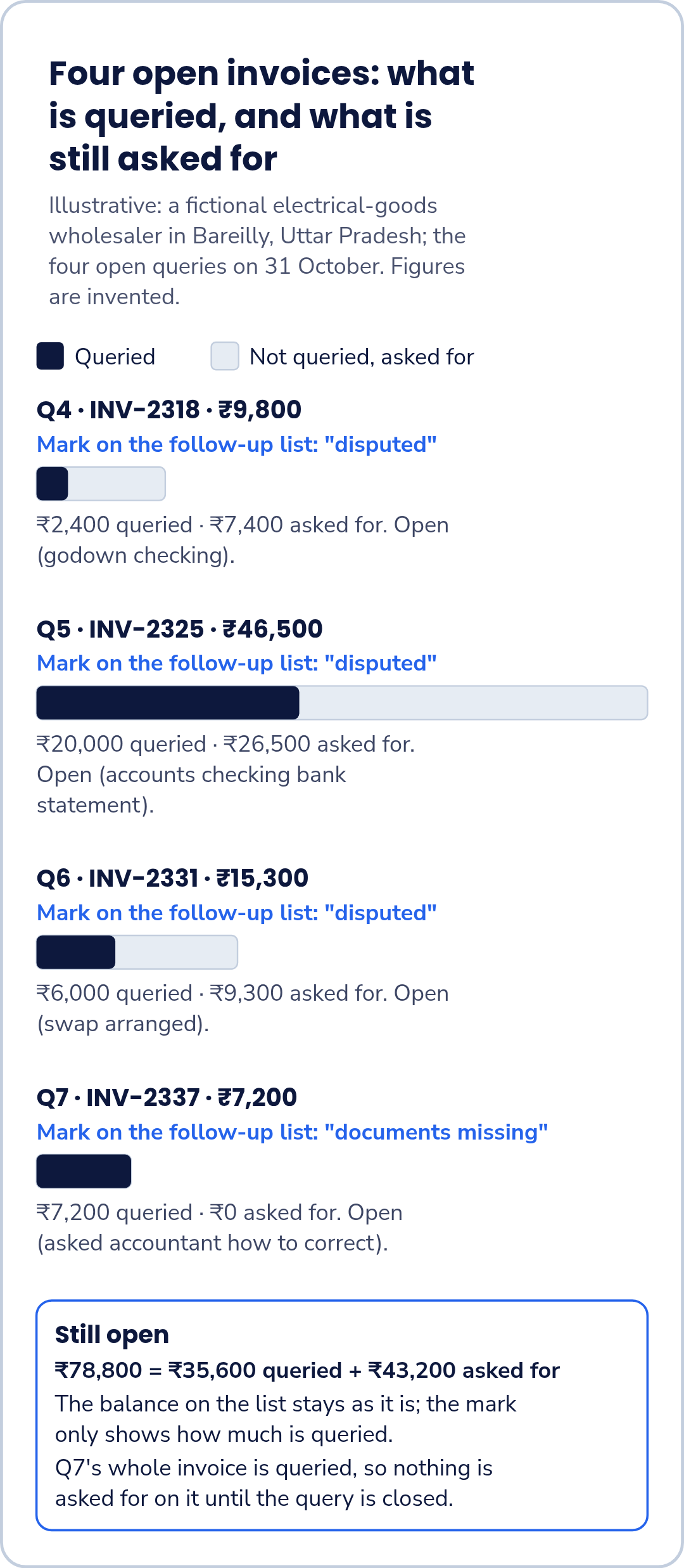
For the four open invoices, the follow-up list keeps the full balance and asks for the part that isn't queried:
| Open query | Invoice (₹) | Queried (₹) | Not queried, asked for (₹) |
|---|---|---|---|
| Q4 | 9,800 | 2,400 | 7,400 |
| Q5 | 46,500 | 20,000 | 26,500 |
| Q6 | 15,300 | 6,000 | 9,300 |
| Q7 | 7,200 | 7,200 | 0 |
| Total | 78,800 | 35,600 | 43,200 |
So ₹78,800 is still open: ₹35,600 queried and ₹43,200 that the follow-up list now asks for. Q7's whole invoice is queried, so nothing is asked for on it until the query is closed.
October's causes: rate 1, quantity short 1, damaged 1, wrong item 1, missing document 2, "already paid" 1, which makes 7. With two document queries in one month, the owner's one fix for November is to check the delivery-note copy and the PO number before an invoice goes out.
Template
Query log
When it is heard:
| No. | Date heard | Heard by | Customer | Invoice no. and amount (₹) |
|---|---|---|---|---|
What it is and who owns it:
| No. | Queried (₹) | Customer's words | To check | Owner |
|---|---|---|---|---|
How it ends:
| No. | Reply by | Outcome | Customer confirmed (how, when) | Closed |
|---|---|---|---|---|
Weekly look line: open past promised date: Q__, owner __, new date __.
Talk through your books in a demo
If you would like to talk through how your business keeps its books, request a demo and choose "Book a demo" on the form. FastComply Books is in an invitation pilot in India, so the demo is where we confirm what is available for your business.