
An open-orders book keeps one row for every customer order taken but not yet delivered. Each row carries two dates: the date the maker or supplier promised the shop, and the date the shop promised the customer. A Monday look calls the maker first wherever those dates are too close, so the customer hears about a change from the shop. A month-end look lists deliveries and invoices that don't match.
Why customers hear about delays before the shop does
Take a showroom that sells made-to-order goods from outside workshops and keeps its orders in the salesman's diary and on WhatsApp.
"My salesman knows every order; the workshop always delivers in the end." Perhaps it does, but the customer hears about a slipped date only when they call. With the workshop's date written beside the customer's, the shop sees the clash at the Monday look and tells the customer first.
A row per order with a promised date and a stage, the amount received against each order, a small buffer before the promised date, the reason written down for each late order, a call to the customer before an order runs late, and a month-end list of unbilled orders for the bookkeeper are all common practice in order registers, templates and furniture-showroom software, some of which also tracks workshop lead times. A published special-order guide also keeps the supplier's date and the customer's date as two separate dates a few days apart, one job-scheduling tool sets a gap between the customer's date and an earlier internal date, and another guide recommends a weekly list of orders past their promise. This page is the paper version for a showroom that depends on outside makers, with a Monday look that calls the maker first.
The open-orders book
One row per order (columns in the template below). Three matter most: the customer's date, the maker's date beside it, and the gap in days between them. The stage moves from 'with the maker' to 'ready in the godown' to 'delivered'.
The advance sits on the row as a fact. How an advance, including one on a cancelled order, is recorded and treated is a question for your accountant.
Two dates, and the gap between them
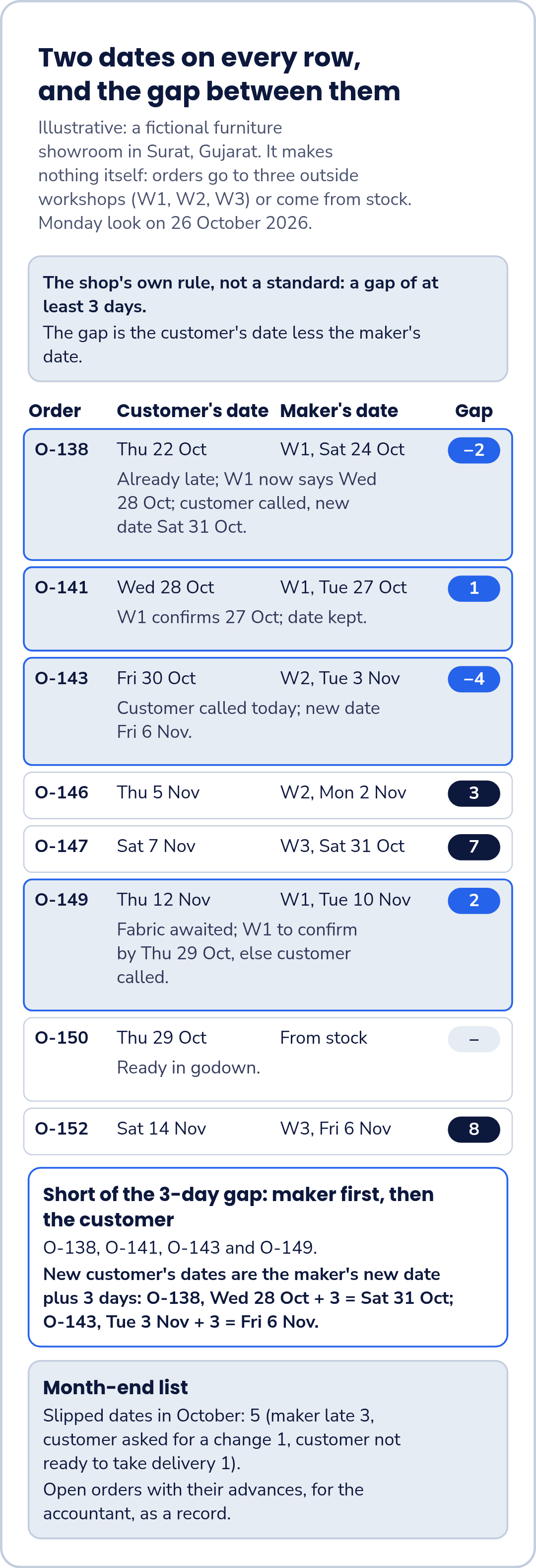
Set the customer's date from the maker's date, leaving a gap. In the example below, the shop's own rule, not a standard, is a gap of at least 3 days.
The Monday look: maker first, then the customer
Before the week's deliveries are planned, the owner picks every row where the gap is under the shop's rule, the maker's date has passed, or material is still awaited. Call the maker first. If the date moves, call the customer that day with a new date, and write the new date and the cause on the row.
Changes, and dates that slip
When a customer changes the size, colour or fabric, write it on the row with the date and the customer's WhatsApp OK, and ask the maker for a new date. Every slipped date gets its cause on the row: maker late, customer asked for a change, customer not ready to take delivery, or material not available.
The month-end look
On the last working day, accounts goes through the book and lists:
- orders delivered but not invoiced;
- orders invoiced but not delivered;
- open orders with their advances, for the accountant (as a record; see the balance-sheet guide to receivables, payables and advances);
- the month's slipped dates, counted by cause.
Where the order goes next
Once an order is invoiced, collecting the money belongs to your receivables follow-up list. The rate on the invoice is covered in checking agreed rates before invoices go out. What the shop orders from its own suppliers is a separate job: matching purchase orders, deliveries and bills.
Worked example: a Surat furniture showroom's last week of October
Illustrative example: a fictional furniture showroom in Surat, Gujarat, with the owner and five staff. It makes nothing itself: customers choose a design and size, and the order goes to one of three outside workshops (W1, W2, W3) or is filled from stock. Monday look on 26 October 2026; month-end look on Saturday 31 October. Figures are invented; verify independently.
| Order | Item | Value (₹) | Advance (₹) |
|---|---|---|---|
| O-138 | Sofa cum bed | 31,500 | 8,000 |
| O-141 | Sofa set 3+1+1 | 68,000 | 20,000 |
| O-143 | King bed with storage | 42,500 | 10,000 |
| O-146 | Wardrobe, 3-door | 56,000 | 15,000 |
| O-147 | Dining set, 6 chairs | 47,800 | 12,000 |
| O-149 | Recliner, 2 units | 39,600 | 10,000 |
| O-150 | Study table and chair | 18,400 | 5,000 |
| O-152 | TV unit | 23,900 | 6,000 |
| Total | 8 open orders | 3,27,700 | 86,000 |
| Order | Customer's date | Maker, maker's date | Gap (days) | Monday action |
|---|---|---|---|---|
| O-138 | Thu 22 Oct | W1, Sat 24 Oct | −2 | Already late; W1 now says Wed 28 Oct; customer called, new date Sat 31 Oct |
| O-141 | Wed 28 Oct | W1, Tue 27 Oct | 1 | W1 confirms 27 Oct; date kept |
| O-143 | Fri 30 Oct | W2, Tue 3 Nov | −4 | Customer called today; new date Fri 6 Nov |
| O-146 | Thu 5 Nov | W2, Mon 2 Nov | 3 | None |
| O-147 | Sat 7 Nov | W3, Sat 31 Oct | 7 | None |
| O-149 | Thu 12 Nov | W1, Tue 10 Nov | 2 | Fabric awaited; W1 to confirm by Thu 29 Oct, else customer called |
| O-150 | Thu 29 Oct | From stock | – | Ready in godown; invoiced Sat 24 Oct |
| O-152 | Sat 14 Nov | W3, Fri 6 Nov | 8 | None |
Maker's date is the workshop's latest date before the Monday call; for O-138 and O-143 it had already moved past the customer's date (cause: maker late).
The gap is the customer's date less the maker's date. Four rows were short of the shop's 3-day gap: O-138, O-141, O-143 and O-149. New customer's dates are the maker's new date plus 3 days: O-138, Wed 28 Oct + 3 = Sat 31 Oct; O-143, Tue 3 Nov + 3 = Fri 6 Nov. O-143's customer heard about the new date from the shop four days before the old one.
Balance still to come on the 8 orders: 3,27,700 − 86,000 = ₹2,41,700 (a fact on the book). O-150's ₹13,400 is already invoiced (Sat 24 Oct), so its collection belongs on the receivables follow-up list; for the other seven (₹2,28,300), collection moves to that list after each invoice. (₹18,400 − ₹5,000 = ₹13,400.)
Month-end look, Sat 31 Oct: O-141 was delivered on Wed 28 Oct but had no invoice yet; O-150 was invoiced on Sat 24 Oct but is still in the godown because the customer's flat isn't ready. O-141 and O-150 both went on the list for the accountant, with the open orders and their advances.
Slipped dates in October: 5 (maker late 3, customer asked for a change 1, customer not ready to take delivery 1). W1 accounts for two of the three late ones (O-138, and O-136, an order closed earlier in the month); the owner's next step is a conversation with W1, not a rule.
Template
Open-orders book
The order:
| Order no. | Date taken | Customer, phone | Item, size, design ref. | Value (₹) |
|---|---|---|---|---|
The dates:
| Order no. | Customer's date | Maker | Maker's date | Gap (days) |
|---|---|---|---|---|
Money and progress:
| Order no. | Advance (₹, date, how paid) | Stage | Delivered on | Invoice no., date | Slipped? (new date, cause) |
|---|---|---|---|---|---|
The shop's gap: customer's date at least ___ days after the maker's date.
Monday list: order ___: gap short / maker's date passed / material awaited → maker called ___, customer called ___, new date ___, cause ___.
Month-end list
- Delivered, not invoiced: ___
- Invoiced, not delivered: ___
- Open orders and advances sent to the accountant on ___
- Slipped dates by cause: maker late ___, customer change ___, customer not ready ___, material ___
Talk through your books in a demo
If you would like to talk through how your business keeps its books, request a demo and choose "Book a demo" on the form. FastComply Books is in an invitation pilot in India, so the demo is where we confirm what is available for your business.