Before a supplier bill goes for payment, check it against two things: what you ordered and what actually arrived. Ask three questions. Did we order this? Did we receive this quantity? Is the rate the one we agreed? If all three answers are yes, the bill can be paid in the normal way. If any answer is no, hold that bill, tell the supplier the same day, and ask for a corrected bill. For this to work you need a record of the order, which can be as simple as a saved WhatsApp message, and the delivery note or challan that comes with the goods, signed when they arrive.
Software, a spreadsheet or a paper file will all do for this.
When an order is worth it, and when it isn't
A written order helps when:
- you buy regularly from a supplier at agreed rates
- goods come in part deliveries
- the purchase is for a particular customer job or order
- the amount is above a figure you choose for your business
It may not be worth it for one-off small purchases. Those can go through petty cash or a staff expense claim.
Before you raise the PO: compare quotes on one page
When more than one supplier could supply the item, put their quotes side by side on one sheet for the same item and quantity: price per unit, what the price includes (delivery, packing, loading), delivery date offered, payment terms offered, and your own notes from past orders (for example, short deliveries on your match sheet). Choose, and write one line on why. The chosen rate becomes the agreed rate on the order, which is what the three-question match later checks. How many quotes to get, and when, is the owner's choice.
A one-line order is enough
The format does not matter. A saved WhatsApp message or an email is an order if it records:
- an order number or date
- the supplier
- the item
- the quantity
- the agreed rate
- the expected delivery date
Keep it where you keep the bills for that supplier, so the two can be put side by side later. The point is not the form. It is having something to check the delivery and the bill against.
Check at the door
When goods arrive, the person receiving them can follow a few simple habits:
- Count what arrived against the delivery note and against your order.
- Write the quantity actually received on the delivery note, or take a photo of it, and sign it.
- Note anything damaged or short on the delivery note before the driver leaves.
Keep the signed delivery note with the order. Some businesses call the signed delivery note a goods received note (GRN). Where possible, the person who placed the order is not the only person who checks the delivery.
Three questions before you pay
Put the order, the delivery note and the bill side by side. Checking all three together is sometimes called three-way matching.
- Did we order this? The item is on an order.
- Did we receive this quantity? The billed quantity matches the quantity signed for on the delivery note.
- Is the rate the one we agreed? The billed rate matches the rate on the order.
If all three are yes, the bill goes into your normal payment run. If any is no, the bill is held out of the run until it is sorted out.
When order, delivery and bill disagree
- Hold only the bill in question. Other bills from the same supplier that pass all three questions can be paid as normal.
- Tell the supplier in writing the same day, with the order, the signed delivery note and the difference.
- Record what was agreed, and keep it with the bill.
- Track anything still to come. If the delivery was short, the remaining quantity is still due against the order.
Ask your accountant how corrected bills and credit notes are recorded.
Worked example: a uniform supplier's shirt order
Illustrative example: a fictional school-uniform supplier in Dehradun; amounts before tax. The businesses and figures are invented.
The supplier orders shirts from a garment maker for a school's term order.
| Quantity | Rate | Amount | |
|---|---|---|---|
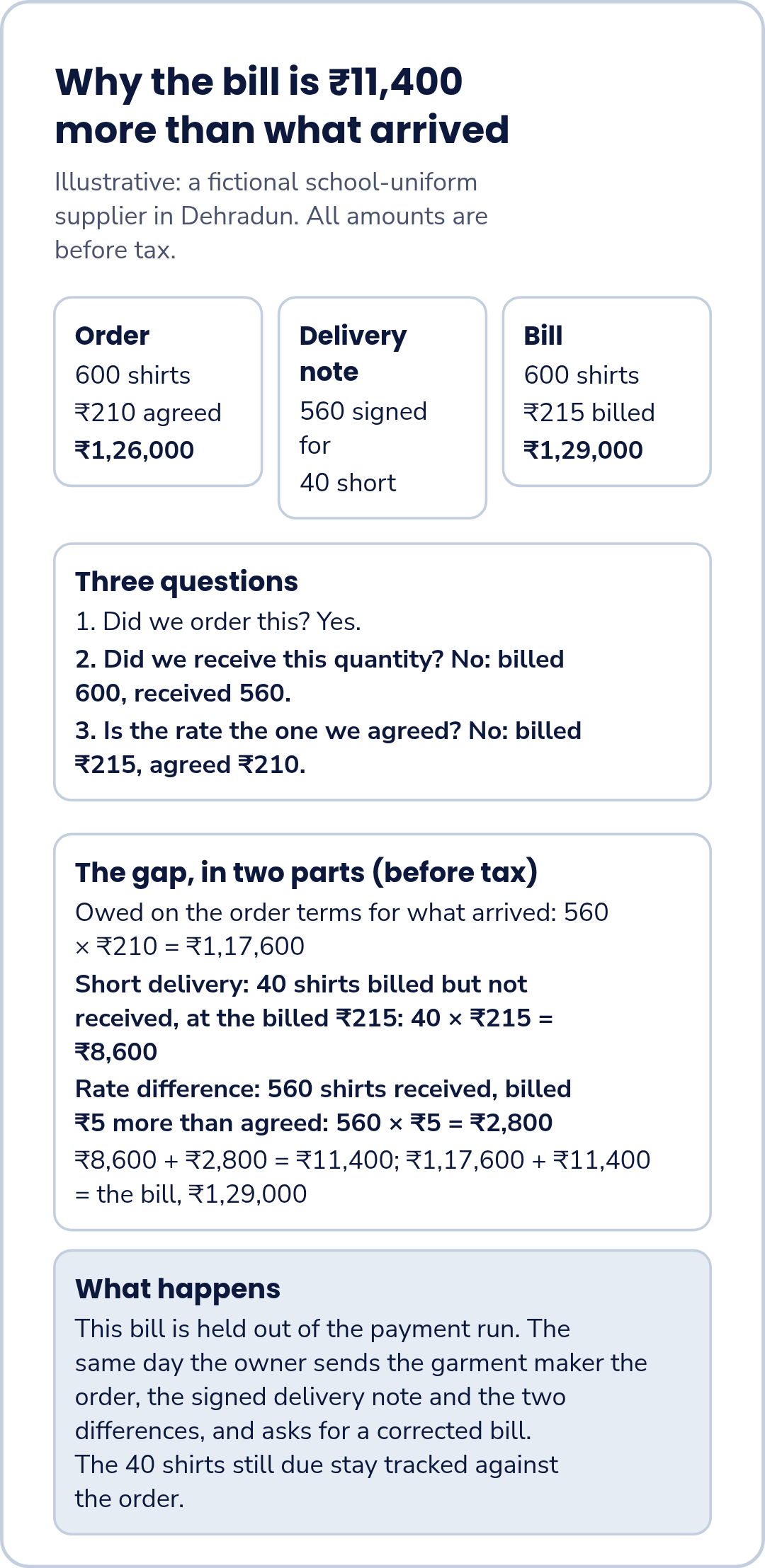
| Order | 600 | ₹210 (agreed) | ₹1,26,000 |
| Delivered and signed for | 560 | ||
| Bill | 600 | ₹215 | ₹1,29,000 |
The order was for 600 shirts at the agreed ₹210: 600 × ₹210 = ₹1,26,000. The delivery note was signed for 560 shirts, so 40 are short. The bill charges for 600 shirts at ₹215: 600 × ₹215 = ₹1,29,000.
Two of the three questions fail: the quantity billed is more than was received, and the rate is not the one agreed.
What the business owes on the order terms for what arrived is 560 × ₹210 = ₹1,17,600. The bill is ₹1,29,000 − ₹1,17,600 = ₹11,400 more than that. The difference has two parts:
- Short delivery: 40 shirts billed but not received, at the billed ₹215: 40 × ₹215 = ₹8,600.
- Rate difference: 560 shirts received, billed at ₹5 more than agreed: 560 × ₹5 = ₹2,800.
₹8,600 + ₹2,800 = ₹11,400.
The two parts are split this way so they add up exactly to the gap: the 40 missing shirts are counted at the ₹215 they were billed at, and the ₹5 rate difference is counted only on the 560 shirts that actually arrived.
The bill is held out of this week's payment run. The same day, the owner sends the garment maker the order, the signed delivery note and the two differences, and asks for a corrected bill. The 40 shirts still due are tracked against the order until they arrive.
Templates
One-line order
Order no. / date: [ ] Supplier: [ ] Item: [ ] Quantity: [ ] Agreed rate: ₹[ ] Delivery by: [ ]
Match sheet
| Order no. | Item | Ordered | Delivered | Billed | Agreed rate | Billed rate | Difference | Action | Cleared on |
|---|---|---|---|---|---|---|---|---|---|
Discuss your purchase checks in a demo
If you would like to talk through how you check orders, deliveries and bills before paying, and ask whether FastComply Books currently supports that routine for your business, request a demo and choose "Book a demo" on the form. FastComply Books is in an invitation pilot in India, so the demo is where we confirm what is available for your business.