Keep one list of approved supplier bills with their agreed due dates, and go through it on the same day each week. Before paying any bill, run six quick checks: it was approved, the goods or service arrived, it has not already been paid, any advance or credit note has been taken off, the supplier's bank details have not changed, and someone other than the person who prepared the list has approved it. Then pay what falls due before the next run, as far as the cash allows, and agree a new date with any supplier you cannot pay before their date passes.
Everything below can be done by hand in a spreadsheet.
Why bills get paid twice or late
Two things make it easy: the same bill is visible in more than one place, and its due date is visible in none. A bill arrives by email, a reminder arrives on WhatsApp, someone pays from the reminder by UPI, and the original bill is still sitting in the pile waiting to be paid. Meanwhile, a supplier who never chases is easy to forget until they stop delivering. A single list with one row per bill, checked before money goes out, removes both problems.
Build the schedule
Add one row for each approved bill. Bills that are still being checked or disputed stay out until they are approved.
| Column | What goes in it |
|---|---|
| Supplier | The name as it appears in your books |
| Bill no. and bill date | From the supplier's bill |
| Due date | The date you agreed with the supplier |
| Amount | The bill amount |
| Advance or credit to adjust | Any advance already paid or approved credit note against this bill |
| Net to pay | Amount minus the adjustment |
| Status | To pay this run, next run, on hold (with the reason), paid |
| Payment ref | UTR, UPI or cheque number once paid |
The bills come from wherever you keep your purchase register. The schedule starts where the register says "approved".
Six checks before you pay
- The bill is approved. Someone who knows what was ordered has confirmed the bill is correct.
- The goods or service arrived. Match the bill to a delivery note, a completed job or the person who received it.
- It has not already been paid. Search your bank statement and payment apps for the supplier name and the amount, including UPI payments made from a phone. Check the schedule's earlier rows too.
- Advances and credit notes are taken off. If you paid an advance against this order, or the supplier issued a credit note you have approved, reduce the net amount.
- Bank details are unchanged. If a supplier has asked you to pay into a new account, confirm the change with them before paying, using a phone number or contact you already had on record, not one given in the request.
- Someone else approves the list. The person who prepares the run should not be the only person who approves it.
If a supplier's statement disagrees with your schedule, reconcile it before paying the disputed amount.
The weekly run
- Pick one day. Using the same day every week means suppliers and staff know when payments go out.
- Start with the cash figure. Decide how much can go to suppliers this week, starting from the bank balance that day.
- Pay what falls due before the next run. Anything due later waits for its own week, even if there is cash today.
- If the cash does not cover everything due, decide which bills wait, write the reason in the status column, and call those suppliers before their due date to agree a new one. A supplier who hears from you first is in a better position to plan than one who finds out when the money does not arrive.
- Approve, then pay. The approver signs off the list, including anything on hold, before payments are made.
Worked example: a week's payment run
Illustrative example: a fictional business in Hosur. Suppliers, bills and figures are invented.
On Monday 2 November the accounts assistant lists the six approved bills that are open:
| Supplier | Bill no. | Bill date | Due date | Amount | Adjusted | Net to pay | Status |
|---|---|---|---|---|---|---|---|
| Supplier A | A-2207 | 5 October | Wednesday 4 November | ₹1,20,000 | — | ₹1,20,000 | Pay this run |
| Supplier B | B-0981 | 6 October | Thursday 5 November | ₹85,000 | — | ₹85,000 | Pay this run |
| Supplier C | C-1460 | 8 October | Friday 6 November | ₹62,000 | — | — | Already paid by UPI on 28 October; removed |
| Supplier D | D-0345 | 8 October | Friday 6 November | ₹95,000 | — | ₹95,000 | Pay this run |
| Supplier E | E-7712 | 12 October | Thursday 12 November | ₹70,000 | — | ₹70,000 | Next run |
| Supplier F | F-0198 | 22 October | Friday 6 November | ₹40,000 | ₹15,000 advance | ₹25,000 | Pay this run |
| Total listed | ₹4,72,000 |
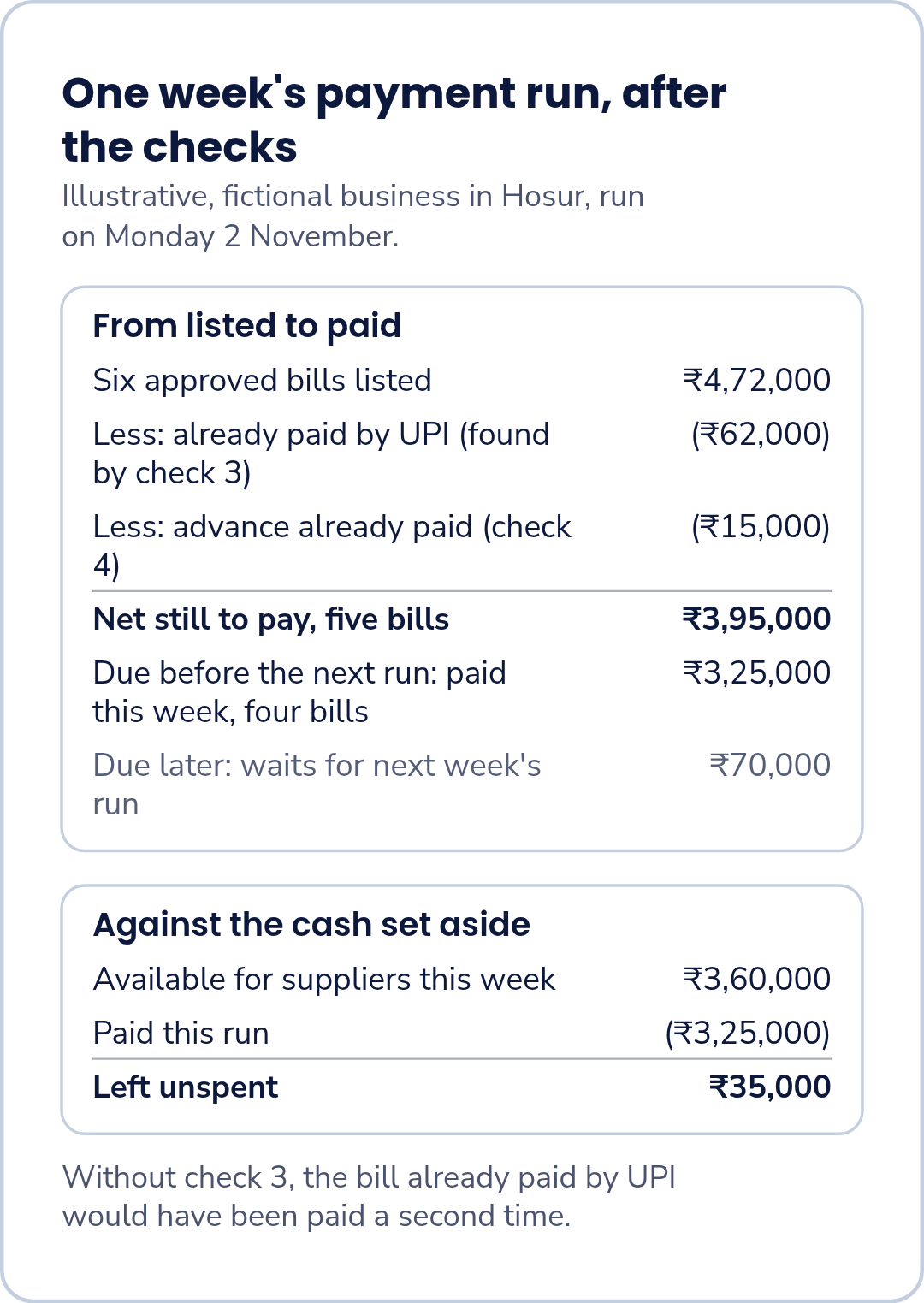
Check 3 finds that Supplier C's bill was paid by UPI on Wednesday 28 October, from a reminder on the owner's phone. The row is marked paid with that UPI reference and taken out of this run. Without the check, ₹62,000 would have gone out a second time.
Check 4 finds a ₹15,000 advance paid to Supplier F when the order was placed. The net to pay is ₹40,000 − ₹15,000 = ₹25,000.
After the checks, five bills with a net ₹3,95,000 are still to be paid (₹4,72,000 listed, less ₹62,000 already paid and the ₹15,000 advance). Four of them, ₹3,25,000 in total (₹1,20,000 + ₹85,000 + ₹95,000 + ₹25,000), fall due before next Monday's run, so they are paid this week. The ₹70,000 bill due on Thursday 12 November waits for next week's run. The owner has set ₹3,60,000 as the amount available for suppliers this week, so the ₹3,25,000 due is covered and ₹35,000 of that amount is left unspent. Had the cash been short, the owner would have chosen which bills wait and called those suppliers before their due dates.
The owner approves the list, including the note that Supplier E is due next week, and the four payments are made the same day.
After you pay
Write the payment reference against each bill in the schedule and in the purchase register, and mark it paid. The next run's check 3 then finds it straight away, and so does whoever reconciles the bank account.
Ask your accountant
Ask your accountant whether any legal payment timelines, or any deductions from the payment, apply to particular suppliers, and add what they tell you to the schedule as a note.
Discuss your payment run in a demo
If you would like to talk through how you plan and check supplier payments each week, and ask whether FastComply Books currently supports that routine for your business, request a demo and choose "Book a demo" on the form. FastComply Books is in an invitation pilot in India, so the demo is where we confirm what is available for your business.