Keep one list of every payment your business makes once a year: internet, software subscriptions, the domain and website, insurance, maintenance contracts (AMCs) and any licence fees. For each row, record when it renews, what you paid last time, how it renews and who decides. Pick a month before each renewal to look at it, and write your decision on the row: keep, change or stop. Then total the list by month, so you can see in advance which months carry the larger payments.
Renewal tools and vendor reminders already exist. This is the version you build and keep yourself, in a spreadsheet, with the decision written down and the totals ready to use in your cash planning.
Why vendor reminders aren't enough
Reminders go to whoever signed up, which may be a personal email address or someone who has since left. They can arrive close to the date the money is due, and they come one at a time, so you never see the year as a whole. A list the business owns shows every renewal, its cost and who is responsible, whoever is in the office.
Make one list of every yearly payment
One row per yearly payment:
- item and vendor
- what it covers
- renewal date
- amount last paid
- how it renews: automatically or only when you pay
- who decides whether to renew
- where the papers or login details are kept: the location only, never the password
- notice and price-revision terms (copied as written, not interpreted)
- where the agreement is kept
- notes
Copy the agreement's own words for notice and price revision; if you are unsure what a clause means, ask a lawyer. This list does not interpret it.
When something new starts, add its row that day. When something ends, leave the row on the list and mark it "stopped", so nobody wonders later whether it was missed.
Ask your accountant or the issuing office which licences and registrations apply to you and how early to renew them.
Choose a review month for each
For each row, pick a month before the renewal date to look at it. How far ahead is your choice. Give yourself enough time to compare alternatives or stop an automatic renewal if you decide to. Some businesses look at all upcoming renewals in one sitting each month; others review each item on its own.
Keep, change or stop: decide on the row
In the review month, the person who decides looks at the row and writes one of three decisions, with the date:
- Keep: renew as it is.
- Change: a different plan, vendor or price.
- Stop: end it. For anything that renews automatically, check the vendor's own terms for how to stop it before the renewal date.
A decision written on the row is easy to check later; a decision made in someone's head is not.
Turn the list into a 12-month calendar of cash out
Total the renewals by the month they fall due. Twelve monthly totals tell you which months carry the larger payments. Put each month's renewal total into the regular-payments line of your cash forecast. The amounts are what you paid last time; next year's price may be different.
Worked example: a coworking space's year
Illustrative example: a fictional coworking-space operator in Chandigarh; amounts as last paid, before tax. The business and figures are invented.
| Month | Item | Amount last paid |
|---|---|---|
| November | Leased-line internet | ₹1,44,000 |
| November | Domain and website | ₹6,500 |
| February | Lift AMC | ₹96,000 |
| April | Building insurance | ₹42,000 |
| June | Generator AMC | ₹18,000 |
| August | Two software subscriptions, ₹18,000 each | ₹36,000 |
| Year | ₹3,42,500 |
November carries ₹1,44,000 + ₹6,500 = ₹1,50,500. The year's total is ₹1,44,000 + ₹6,500 + ₹96,000 + ₹42,000 + ₹18,000 + ₹36,000 = ₹3,42,500.
The owner chose July as the review month for the two August subscriptions. In the July review, one of them has not been used since the business changed its booking system, so the owner writes "stop" on that row with the date and checks the vendor's terms for stopping the automatic renewal. The August outflow becomes ₹36,000 − ₹18,000 = ₹18,000, and the year's renewals, if nothing else changes, come to ₹3,42,500 − ₹18,000 = ₹3,24,500.
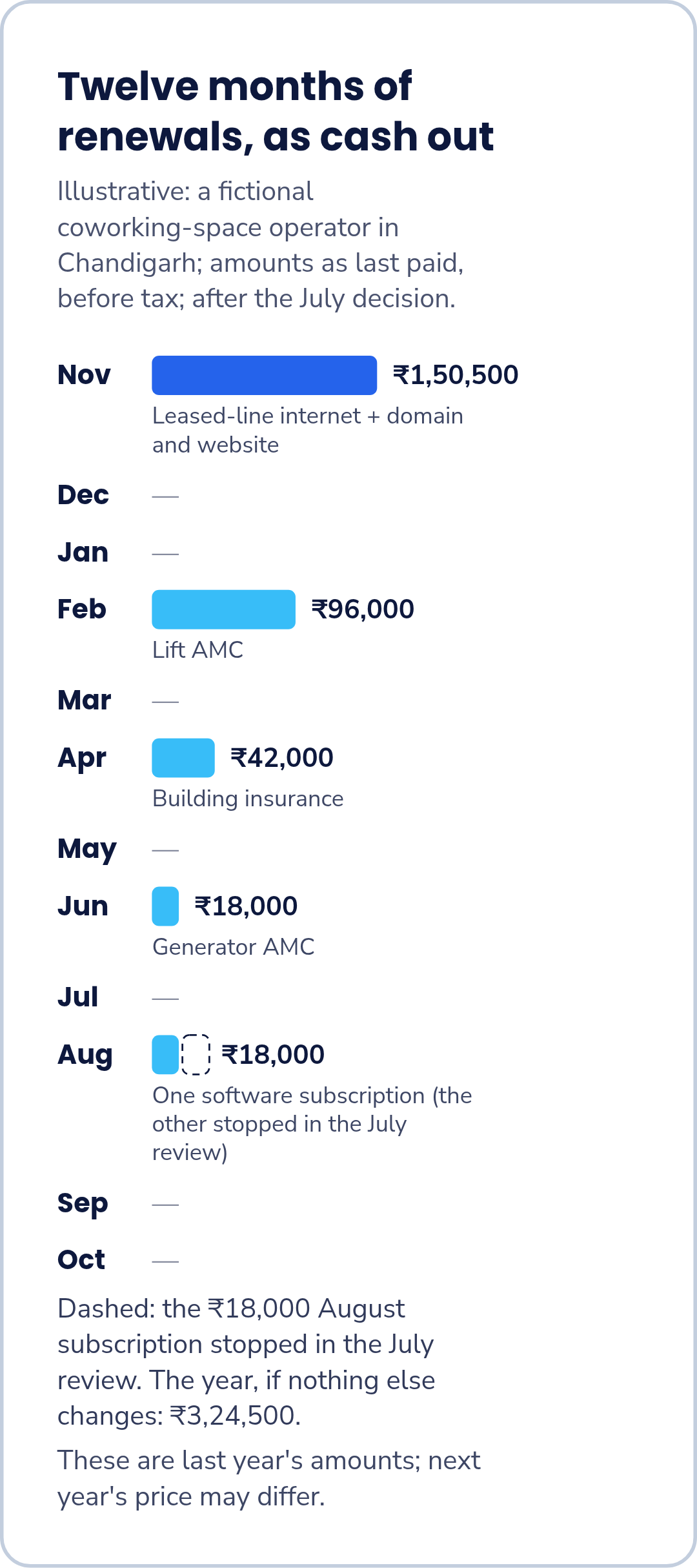
The 12-month strip after the July decision:
| Nov | Dec | Jan | Feb | Mar | Apr | May | Jun | Jul | Aug | Sep | Oct |
|---|---|---|---|---|---|---|---|---|---|---|---|
| ₹1,50,500 | — | — | ₹96,000 | — | ₹42,000 | — | ₹18,000 | — | ₹18,000 | — | — |
The twelve months add up to ₹1,50,500 + ₹96,000 + ₹42,000 + ₹18,000 + ₹18,000 = ₹3,24,500, and November stands out as the heaviest month.
Renewals list template
Core columns, the ones you look at in each review month:
| Item and vendor | Renewal date | Amount last paid | How it renews | Who decides | Review month | Decision and date |
|---|---|---|---|---|---|---|
Keep these for each row too, as extra columns or on a second sheet listed by item:
- What it covers
- Where papers or login details are kept
- Notice and price-revision terms (copied as written, not interpreted)
- Where the agreement is kept
- Notes
12-month cash-out strip
| Nov | Dec | Jan | Feb | Mar | Apr | May | Jun | Jul | Aug | Sep | Oct |
|---|---|---|---|---|---|---|---|---|---|---|---|
The renewals list is also worth including in any handover when the person who looks after it changes.
Planning the year's payments ahead?
If you would like to hear about FastComply Books for your business, you can request early access. FastComply Books is in an invitation pilot in India and public sign-up is not open yet.