Once a month, put your courier or aggregator bill next to your own list of what you dispatched, and match the two line by line using the AWB or tracking number. For every line, ask four questions. Did we ship it? Was it charged once? Is the weight plausible? Is the COD or return fee right? Anything that fails goes on a short dispute log with your evidence, and stays open until the credit actually appears on a later bill or wallet statement.
This is a routine for a small seller shipping through one courier or aggregator. It needs no software and no recalculating from the rate card: just your dispatch list, a photo habit at packing, and a log.
Why courier bills go unchecked
A month's courier bill can run to hundreds of small lines, and if you pay from a wallet, the money may be deducted before anyone looks. But a duplicate charge, a parcel that was never yours or a return fee on a delivered order can repeat every month if nobody checks. Checking the whole bill in one sitting, against a list you already keep, makes it a single monthly task.
Keep your own dispatch list
Your order or billing app, or a sheet, probably holds most of this already. For every parcel, record:
- order number
- AWB or tracking number
- dispatch date
- packed weight and box size
- payment mode: prepaid or COD
- status: delivered, returned, in transit
This list is what you check the bill against. Without it, the bill is the only record of what was shipped.
A photo at packing
Before handing a parcel over, take a photo of the sealed parcel on the scale with the label visible. This is general practice that helps when you raise a dispute: it shows the weight and the box at the time of dispatch. Keep the photos in a folder by date, or named with the AWB.
Four questions on the month's bill
Match each bill line to the dispatch list by AWB, then ask:
- Did we ship it? An AWB on the bill that is not on your dispatch list.
- Was it charged once? The same AWB charged twice.
- Is the weight plausible? A billed weight or slab higher than the packed weight and box size you recorded. How box size counts towards the billed weight is set by your courier's own terms and rate card; check those rather than working it out yourself.
- Is the COD or return fee right? A COD fee on a prepaid order, or a return fee on an order your list shows as delivered.
Lines that pass all four need nothing more. Lines that fail any one go on the dispute log.
Raise disputes in batches
Collect the month's failures and raise them together, each with its evidence: the dispatch list entry, the packing photo and the bill line. Check your courier's own terms for how disputes are raised and by when; if their deadline would pass before your monthly check, check the bill more often.
If you pay the courier by invoice rather than from a wallet, check whether your agreement with them lets you hold back the disputed amount while it is looked into; if it does, pay the rest on the normal terms.
Close a dispute only when the credit arrives
A dispute the courier has accepted is not the same as money back. Keep each dispute open on the log until the credit appears on a later bill or wallet statement, and note where you saw it. Anything not credited stays open and is raised again.
Ask your accountant how freight charges, refunds and any tax on them are recorded.
Worked example: a homeware seller's month
Illustrative example: a fictional online seller of bamboo and cane homeware in Shillong; one month's bill, amounts before tax. The business and figures are invented.
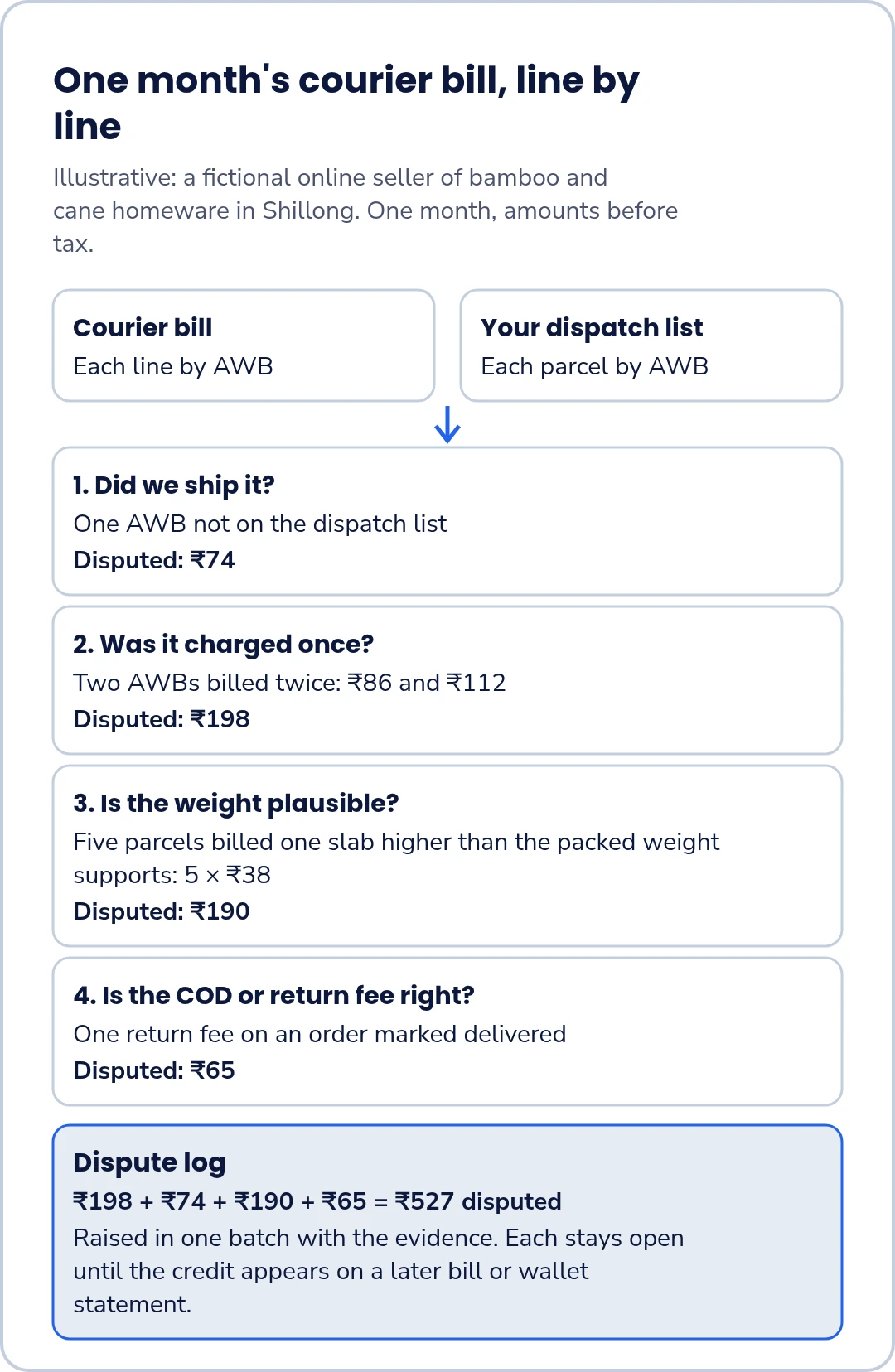
The seller ships through one aggregator and checks the month's bill against its dispatch list. Four kinds of problem turn up:
| Question | What was found | Amount disputed |
|---|---|---|
| Was it charged once? | Two AWBs billed twice: ₹86 and ₹112 | ₹198 |
| Did we ship it? | One AWB not on the dispatch list | ₹74 |
| Is the weight plausible? | Five parcels billed one slab higher than the packed weight supports; ₹38 each (the extra charge for one slab higher; fictional) | ₹190 |
| Is the COD or return fee right? | One return fee on an order marked delivered | ₹65 |
| Total disputed | ₹527 |
The duplicates come to ₹86 + ₹112 = ₹198. The five weight disputes come to 5 × ₹38 = ₹190. In total, ₹198 + ₹74 + ₹190 + ₹65 = ₹527 is disputed.
The seller raises all of these in one batch, attaching the packing photos for the five weight disputes and the dispatch list entries for the rest. Each goes on the dispute log as open. When next month's bill arrives, the seller logs each credit that appears, with the date and where it was seen; anything not credited stays open.
Templates
Dispatch list
| Order no. | AWB | Dispatch date | Packed weight | Box size | Prepaid / COD | Status |
|---|---|---|---|---|---|---|
Check sheet for the month's bill
| AWB | On our list? | Charged once? | Weight plausible? | COD / return fee right? | Dispute? |
|---|---|---|---|---|---|
Dispute log
| AWB | Issue | Amount | Raised on | Status | Credit seen on (bill / wallet statement, date) |
|---|---|---|---|---|---|
File the month's courier bill with your other purchase bills, and if the aggregator sends a statement of account, check its balance the same way you would any supplier's statement. For goods bills, the same kind of check is matching the order, the delivery and the bill.
Talk through your books in a demo
If you would like to talk through how your business keeps its books, request a demo and choose "Book a demo" on the form. FastComply Books is in an invitation pilot in India, so the demo is where we confirm what is available for your business.