
Give every business vehicle a name, and write that name on every bill for it when the bill is filed: fuel slips, card and UPI lines, FASTag statement lines, service and repair bills. Once a month, gather those into one row per vehicle with the km run, each type of cost, the total, fuel ÷ km and total ÷ km. Compare each vehicle only with its own earlier months. When a row moves, check the slips first, then ask the driver what changed.
Why one "vehicle expenses" total hides the problem
Fuel is paid in cash, by card and by UPI; tolls come on a FASTag statement; repairs are paid at different garages. In the books, all of it lands in one "vehicle expenses" total. That total can tell you the month was higher. It cannot tell you which vehicle, or why, and by the time anyone asks, the slips are hard to find.
How vehicle costs are treated in your accounts is your accountant's call. This log is a working record alongside the books, built from the same bills.
Setting up the log
- Vehicle list: the name used in the business (for example Pickup A, Pickup B, Truck C), the registration number, who usually drives it, and where its papers are kept.
- Every vehicle bill gets the vehicle's name when it is filed: fuel slip, card or UPI line, FASTag statement line, service or repair bill.
- Monthly row per vehicle: odometer at start and end, km run, fuel, tolls, servicing, repairs, tyres, other, total, fuel ÷ km and total ÷ km (your own figures, compared only with the same vehicle's earlier months; fuel ÷ km is the steadier one to watch, because a single repair moves the total).
Getting the odometer readings. Note the odometer on the first and last day of the month, or ask each driver to write it on a card kept in the vehicle. km run = end reading − start reading.
Gathering the bills. A natural point to fill in the month's rows is once you have the month's card statement, UPI history and FASTag statement, alongside the cash fuel slips and the garage bills. Put each bill under the vehicle named on it. A bill with no vehicle name goes on a short list to ask about, not into whichever row seems likely.
Compare each vehicle with its own months
Look at each vehicle against its own last three months, not against other vehicles or published mileage figures. A truck carrying cement and a pickup doing local drops do different work and will always look different.
Fuel ÷ km is the steadier figure to watch from month to month. Total ÷ km jumps in a month with a repair or new tyres, and that may be entirely expected.
When a row moves: slips first, then the driver
When a vehicle's fuel ÷ km moves away from its own recent months, check the slips before anything else:
- a slip filed under the wrong vehicle;
- a slip entered twice;
- a bill that belongs to another month.
A slip under the wrong vehicle moves two rows at once: one vehicle looks higher and another looks lower than it really is. So when one vehicle's figure rises, look also at any vehicle whose figure has dropped.
If the slips are right, ask the driver what changed: a different route, heavier loads, more waiting in traffic, a breakdown. A change in the work is a reason, not a fault. Ask to understand, not to accuse.
Worked example: a building-materials dealer in Ranchi
Illustrative example: a fictional building-materials dealer in Ranchi with two pickups and one small truck; October, amounts as on the bills. The business has 14 staff and sells cement, steel bars and tiles. All details are invented.
October, as first entered:
| Vehicle | km run | Fuel (₹) | Tolls (₹) | Servicing (₹) | Repairs (₹) | Total (₹) |
|---|---|---|---|---|---|---|
| Pickup A | 2,400 | 21,600 | 1,200 | 22,800 | ||
| Pickup B | 2,300 | 23,400 | 1,100 | 6,800 (clutch) | 31,300 | |
| Truck C | 1,800 | 30,600 | 2,400 | 4,500 | 37,500 | |
| All three | 91,600 |
Pickup A: ₹21,600 + ₹1,200 = ₹22,800. Pickup B: ₹23,400 + ₹1,100 + ₹6,800 = ₹31,300. Truck C: ₹30,600 + ₹2,400 + ₹4,500 = ₹37,500. All three: ₹22,800 + ₹31,300 + ₹37,500 = ₹91,600.
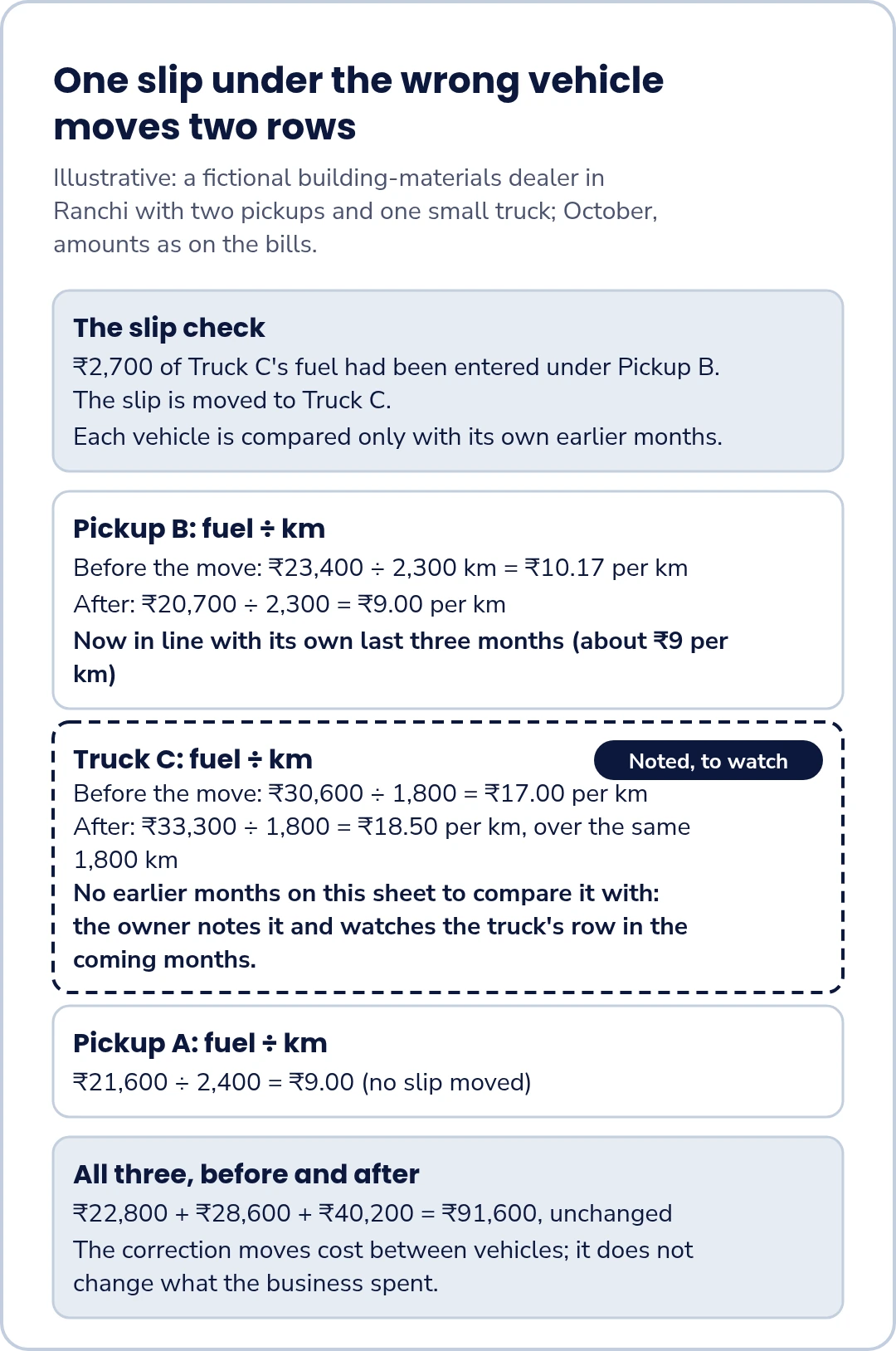
Pickup B's total is up because of the clutch repair, which is expected. Its fuel ÷ km is what the owner looks at: ₹23,400 ÷ 2,300 km = ₹10.17 per km, against about ₹9 per km in Pickup B's own last three months.
The owner checks the slips. ₹2,700 of Truck C's fuel had been entered under Pickup B. The slip is moved to Truck C:
| Vehicle | Fuel (₹) | Total (₹) | Fuel ÷ km (₹) |
|---|---|---|---|
| Pickup A | 21,600 | 22,800 | 9.00 |
| Pickup B | 20,700 | 28,600 | 9.00 |
| Truck C | 33,300 | 40,200 | 18.50 |
| All three | 91,600 |
Pickup B fuel: ₹23,400 − ₹2,700 = ₹20,700; ₹20,700 ÷ 2,300 = ₹9.00 per km. Pickup B total: ₹20,700 + ₹1,100 + ₹6,800 = ₹28,600.
Truck C fuel: ₹30,600 + ₹2,700 = ₹33,300; ₹33,300 ÷ 1,800 = ₹18.50 per km, over the same 1,800 km (₹17.00 before the move: ₹30,600 ÷ 1,800). Truck C total: ₹33,300 + ₹2,400 + ₹4,500 = ₹40,200.
Pickup A fuel ÷ km: ₹21,600 ÷ 2,400 = ₹9.00.
All three: ₹22,800 + ₹28,600 + ₹40,200 = ₹91,600, unchanged. The correction moves cost between vehicles; it does not change what the business spent.
Pickup B's fuel ÷ km is now in line with its own last three months. Truck C's figure has risen from ₹17.00 to ₹18.50 per km, and this sheet has no earlier months for Truck C to compare it with, so the owner notes it and watches the truck's row in the coming months.
Templates
Vehicle list:
| Vehicle name | Registration no. | Usually driven by | Papers kept at |
|---|---|---|---|
Monthly sheet (one row per vehicle):
Month: ______
| Vehicle | km run | Fuel (₹) | Total (₹) | Fuel ÷ km | Total ÷ km |
|---|---|---|---|---|---|
For each row, also note the odometer start and end, tolls, servicing, repairs, tyres, other costs and any notes, as extra columns or on a second sheet. Total = fuel + tolls + servicing + repairs + tyres + other.
Keeping a cost record for each vehicle?
If you would like to hear about FastComply Books for your business, you can request early access. FastComply Books is in an invitation pilot in India and public sign-up is not open yet.