A 13-week cash forecast is one table: a row for each of the next 13 weeks, showing the money you expect in, the money going out, and the balance at the end of each week. Build it from four things you already have: a reconciled bank balance, your list of what customers owe, your list of bills to pay, and your regular commitments. Count only receipts that are confirmed, keep hoped-for receipts in a separate list, and compare each week's closing balance with a minimum you choose. When a week falls below that line, you can see it weeks ahead and act.
Why 13 weeks, and why weekly
A quarter, week by week, is long enough to see a problem in time to act and short enough that the figures are still reasonable estimates. Weekly rows matter because a monthly total hides when payments bunch together: salaries, rent and a large supplier payment in the same week can leave that week short even when the month as a whole looks fine.
The forecast will not be exactly right, and it does not need to be. Its job is to show a short week early enough to do something about it.
Build it from four lists
- Opening balance. Start from a bank balance you have reconciled, so the first week begins from a figure you trust.
- What customers owe. Take your receivables list. For each invoice, put the expected receipt in the week you realistically expect it, based on how that customer actually pays, not only on the terms printed on the invoice.
- What you owe. Take your schedule of supplier bills and put each payment in the week you plan to pay it.
- Regular commitments. Salaries, rent, loan EMIs, subscriptions and anything else that goes out on a known cycle.
Add one more line: tax and statutory payments, with amounts and dates as listed by your accountant. Ask your accountant for this list rather than working out dates or amounts yourself.
Confirmed and expected receipts
Split money coming in two ways:
- Confirmed: the customer has committed to a date in writing, or pays on a known, regular cycle.
- Expected: you think it will arrive, but nothing confirms it yet.
Calculate the closing balance from confirmed receipts only. Keep expected receipts in their own list. That way a payment that slips does not quietly turn a short week into a comfortable one on paper. When an expected receipt is confirmed, move it into the forecast.
Set your minimum line
Choose the lowest closing balance you are comfortable with in any week. There is no right figure; it depends on your business and how much buffer you want. The forecast's question each week is simple: does any week close below the line?
Worked example: a commercial-cleaning company in Visakhapatnam
Illustrative example: a fictional commercial-cleaning company in Visakhapatnam. All figures are invented.
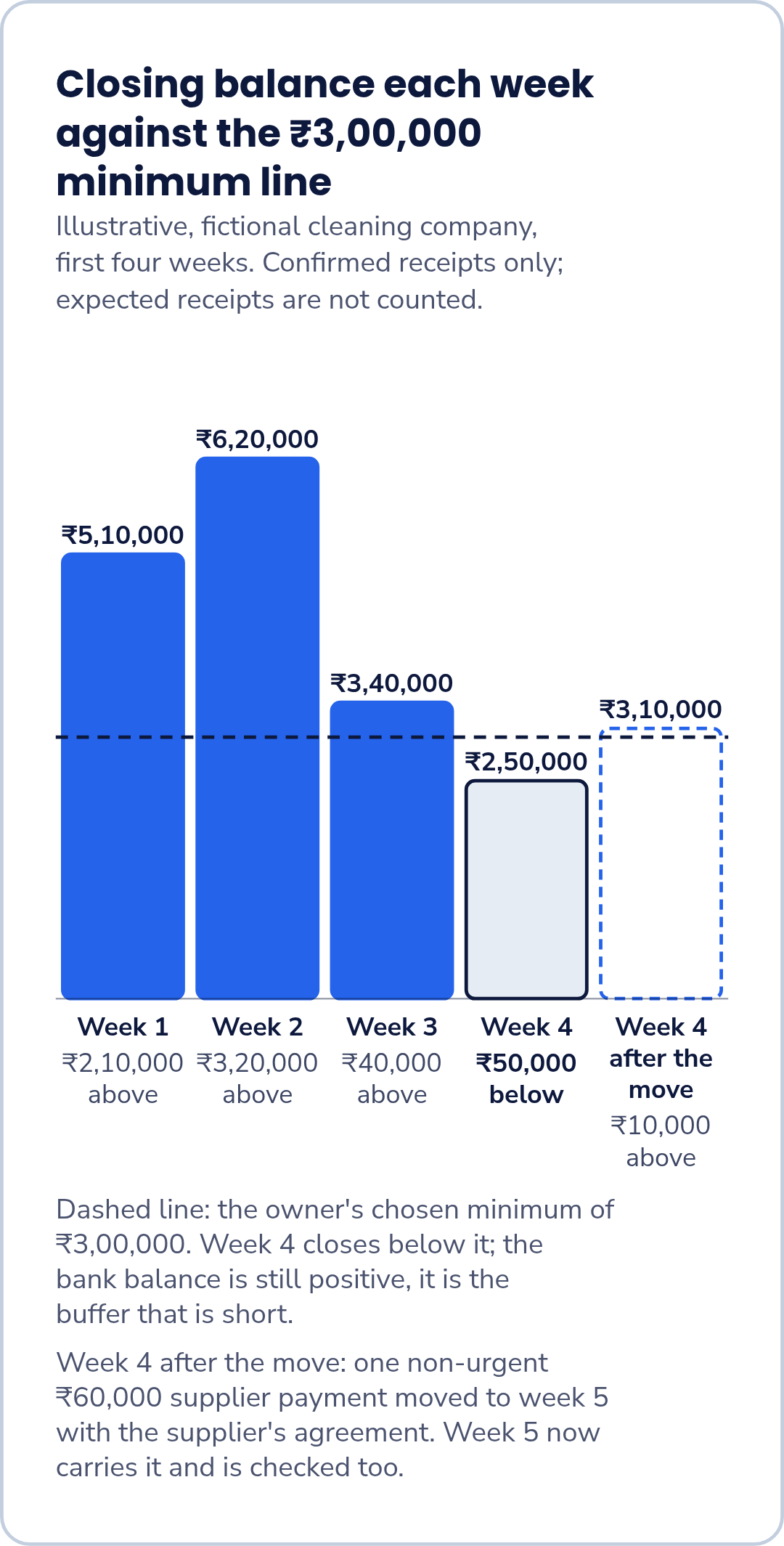
The owner sets a minimum line of ₹3,00,000. The first four weeks, using confirmed receipts only:
| Week | Opening | Confirmed in | Out | Closing | Gap to ₹3,00,000 line |
|---|---|---|---|---|---|
| 1 | ₹6,00,000 | ₹1,50,000 | ₹2,40,000 | ₹5,10,000 | ₹2,10,000 above |
| 2 | ₹5,10,000 | ₹2,20,000 | ₹1,10,000 | ₹6,20,000 | ₹3,20,000 above |
| 3 | ₹6,20,000 | ₹60,000 | ₹3,40,000 | ₹3,40,000 | ₹40,000 above |
| 4 | ₹3,40,000 | ₹40,000 | ₹1,30,000 | ₹2,50,000 | ₹50,000 below |
Weeks 5 to 13 continue the same way.
Week 3 is heavy: rent of ₹90,000, a supplier payment run of ₹1,70,000 and ₹80,000 of tax and statutory payments as listed by the accountant, ₹3,40,000 in all. The company stays above the line that week, but week 4 opens lower and closes at ₹2,50,000, which is ₹50,000 below the minimum line. The bank balance is still positive; it is the owner's buffer that is short.
A customer has said informally that a ₹1,25,000 payment should come in week 4. If it does, week 4 would close at ₹3,75,000 (before the supplier payment is moved). But nothing confirms it, so it stays on the expected list and is not counted.
The owner acts in week 1, three weeks ahead:
- asks the customer for a firm date for the ₹1,25,000; and
- after agreeing it with the supplier, moves one non-urgent ₹60,000 supplier payment from week 4 to week 5.
Salaries and the tax and statutory payments listed by the accountant stay where they are.
With that payment moved, week 4 looks like this:
| Week | Opening | Confirmed in | Out | Closing | Gap to ₹3,00,000 line |
|---|---|---|---|---|---|
| 4 (after the move) | ₹3,40,000 | ₹40,000 | ₹70,000 | ₹3,10,000 | ₹10,000 above |
Week 4 is back above the line even without the expected receipt. Week 5 now carries the extra ₹60,000, so the owner checks week 5 against the line too.
The blank template
Copy these into any spreadsheet and fill them from your own lists. Out is the total of your payment lines for the week: suppliers, salaries, rent, loan EMIs, tax and statutory payments (amounts and dates as listed by your accountant) and other payments. In a spreadsheet you can keep each of those as its own column or row and add them up.
Weekly forecast (confirmed receipts only)
| Week | Opening | Confirmed in | Out | Closing | Gap to line |
|---|---|---|---|---|---|
| 1 | |||||
| 2 | |||||
| 3 | |||||
| 4 | |||||
| 5 | |||||
| 6 | |||||
| 7 | |||||
| 8 | |||||
| 9 | |||||
| 10 | |||||
| 11 | |||||
| 12 | |||||
| 13 |
- Closing = opening + confirmed in − out.
- Each week's opening is the previous week's closing.
- Gap to line = closing − your minimum line. A negative gap is a short week.
Expected receipts (not counted above)
| Customer | Amount | Week you expect it | What would confirm it |
|---|---|---|---|
To see what a week would look like if the expected receipts arrive, add every expected receipt due up to and including that week to that week's closing balance.
The weekly update
Once a week, on the same day:
- For the week just finished, record what actually happened: real receipts, real payments and the real bank balance. The next week opens from that real balance, not the forecast one.
- Note the biggest difference between forecast and actual, and why it happened.
- Move any receipts that slipped into the week you now expect them, and move any expected receipts that have been confirmed into the forecast.
- Drop the finished week and add a new week at the end, so the forecast always looks 13 weeks ahead.
What the forecast is not
It is not a budget, which plans income and costs month by month. It is not a measure of profit either: a month can be profitable while cash is short, and the other way round. The forecast only answers one question: will there be enough money in the bank each week?
Discuss your cash planning in a demo
If you would like to talk through how you plan cash week by week, and ask whether FastComply Books currently supports that routine for your business, request a demo and choose "Book a demo" on the form. FastComply Books is in an invitation pilot in India, so the demo is where we confirm what is available for your business.