
To see client-wise profitability without time-tracking software, work out a contribution for each client over a quarter: the fees you billed them, minus costs you can trace to their work (freelancers, printing, travel for their jobs), minus the team's hours on their work multiplied by one internal hourly cost that you set yourself. Compare clients on that figure and on contribution as a percentage of fees. The result is an estimate, not your profit, but it can be enough to show which clients carry the business and which ones cost more in team time than their fees cover. The same method works project by project if that is how you bill.
Why overall profit hides client differences
Your profit and loss statement shows the whole business. If the total looks fine, it can hide one client whose fee covers the freelancers on their work but not the hours your own team puts in. Team salaries appear as one line, so nothing in the P&L tells you which client those hours went to. Looking client by client brings that time back into view.
The contribution formula
For each client, over the same period:
Contribution = Fees
             − Traceable job costs
             − (Team hours on the client × internal hourly cost)

Contribution % = Contribution ÷ Fees × 100
- Fees: what you billed the client in the period, excluding GST.
- Traceable job costs: money spent only because of that client's work, such as freelancers, printing, or travel for their jobs.
- Team hours: your own team's hours on that client. If you do not track time, ask each person for a rough estimate of their weekly hours per client and multiply up. Say plainly that these are estimates.
Rent, software used across the business, admin staff and other overheads are not spread across clients. Spreading them needs choices about how to divide them, and those choices can change the answer without telling you anything new about the client. Leaving them out keeps the comparison simple, but it means contribution is not the same as profit. Overheads still have to be paid out of the total contribution.
Choosing an internal hourly cost
Use one figure for everyone, and treat it as your own planning estimate. One simple way is to divide the team's monthly salary cost by the team's working hours in a month. In the fictional example below, the owner divided a monthly team salary cost of ₹2,00,000 by about 250 working hours a month: ₹2,00,000 ÷ 250 = ₹800 an hour. That figure is invented for the example; what matters is your own salary cost and your own team's hours.
Whatever you arrive at is a management estimate, not an accounting or costing-standard figure, and not a benchmark for what an hour should cost. Your accountant can help you refine it. Whatever figure you choose, use the same one for every client and every quarter, so the comparison stays fair.
Hours your team spends on work for no particular client, such as internal admin or pitching, do not appear in any client's figure. That is another reason the total contribution is not your profit.
Worked example: a video-production agency's quarter
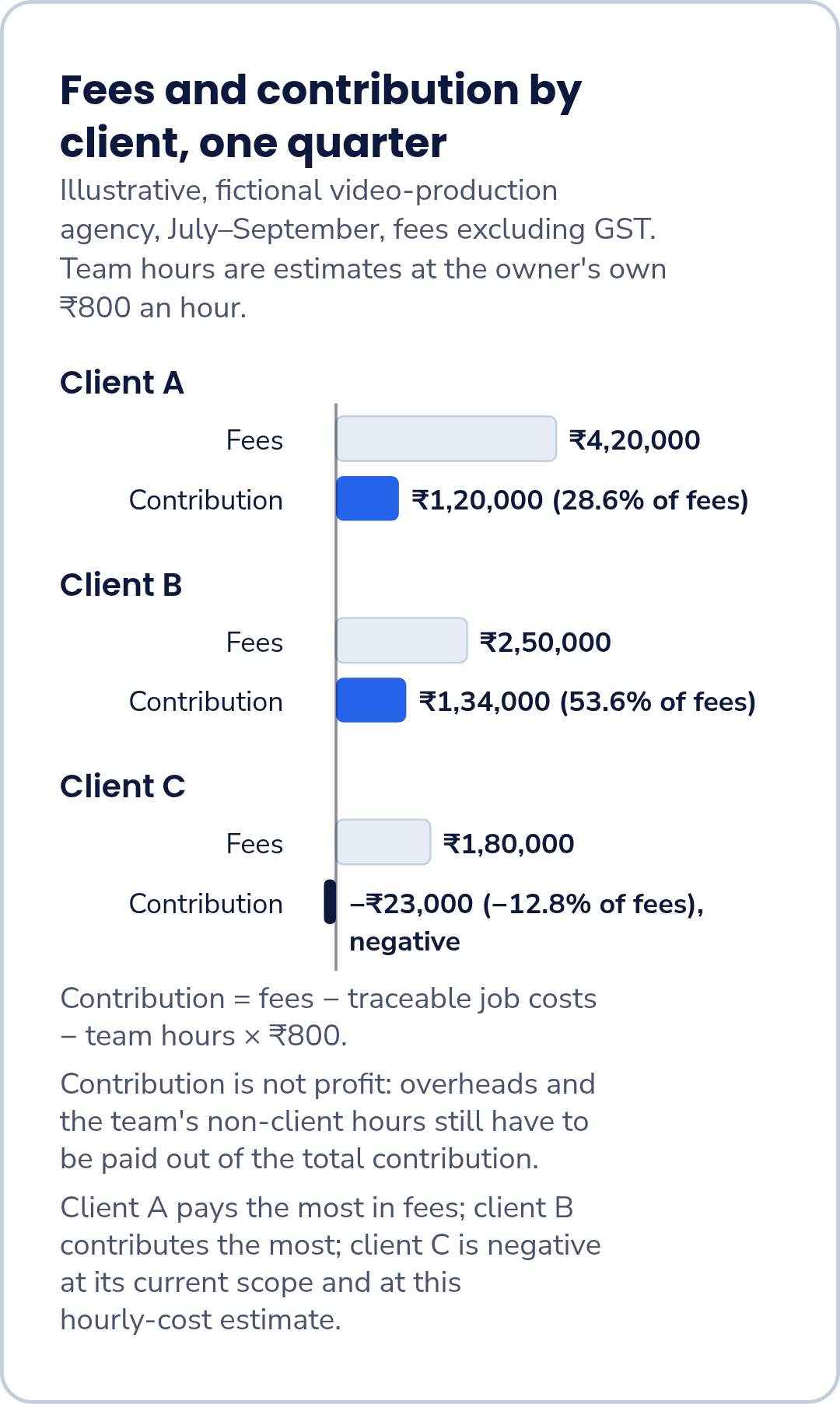
Illustrative example: a fictional Hyderabad video-production agency, July–September, fees excluding GST. All figures are invented. ₹800 per hour is the owner's own estimate (₹2,00,000 ÷ 250 hours a month), not a typical rate, and team hours are estimated from weekly hours per client.
| Client | Fees | Traceable costs | Team hours × ₹800 | Contribution | % of fees |
|---|---|---|---|---|---|
| A | ₹4,20,000 | ₹60,000 | 300 h = ₹2,40,000 | ₹1,20,000 | 28.6% |
| B | ₹2,50,000 | ₹20,000 | 120 h = ₹96,000 | ₹1,34,000 | 53.6% |
| C | ₹1,80,000 | ₹35,000 | 210 h = ₹1,68,000 | −₹23,000 | −12.8% |
| Total | ₹8,50,000 | ₹1,15,000 | 630 h = ₹5,04,000 | ₹2,31,000 | 27.2% |
Each row: fees minus traceable costs minus team cost. For client A, ₹4,20,000 − ₹60,000 − ₹2,40,000 = ₹1,20,000, which is 28.6% of fees. For client B, ₹2,50,000 − ₹20,000 − ₹96,000 = ₹1,34,000, or 53.6%. For client C, ₹1,80,000 − ₹35,000 − ₹1,68,000 = −₹23,000, or −12.8%. In total, ₹8,50,000 − ₹1,15,000 − ₹5,04,000 = ₹2,31,000, which is 27.2% of fees. The agency's overheads for the quarter still have to come out of that ₹2,31,000.
The team cost the agency ₹6,00,000 for the quarter (₹2,00,000 × 3) for about 750 hours (250 × 3). The 630 client hours account for ₹5,04,000 of it. The other 120 hours, about ₹96,000, went on admin, pitching and other non-client work, and also have to come out of the ₹2,31,000.
What the owner sees:
- Client A pays the most in fees but is not the strongest contributor. It takes 300 of the 630 client hours.
- Client B contributes the most, ₹1,34,000, from less than two-thirds of A's fees and far fewer hours.
- Client C has a negative contribution at its current scope and at the owner's hourly-cost estimate. Its 210 hours cost more than its fee covers after job costs.
What to do with the result
A negative or low contribution is the start of a conversation, not a decision. For client C, the owner's options include:
- Review the scope. Compare the work actually being done with what was agreed. Extra rounds of revisions or work that has crept in are worth raising with the client.
- Revise the fee at renewal, using the hours as the basis for the conversation.
- Change how the work is delivered, for example with fewer review rounds or a clearer brief at the start.
- Keep the arrangement as it is, knowing what it costs, if there are reasons that matter to you, such as a new relationship you expect to grow.
Check the estimate before acting on it. Ask the team whether the hours estimate for C looks right, and whether the quarter was typical for that client.
Slow payment is a different question. A client who pays late affects your cash, not their contribution; deal with that separately.
Quarterly client review
One row per client, kept from quarter to quarter:
| Client | Fees | Contribution | % of fees | Team hours | Hours vs last quarter | One decision |
|---|---|---|---|---|---|---|
Over several quarters, the "Hours vs last quarter" column shows whether a client's work is growing while the fee stays the same.
Limits of this method
- It is an estimate, not your accounts. The hours are estimates and the hourly cost is your own planning figure.
- Overheads are not spread, so contribution is not profit.
- One quarter can be unusual. A project starting or ending can move a client's figure a long way.
- Use it for your own decisions. Ask your accountant before relying on it for a pricing dispute or anything formal.
Discuss your client reporting in a demo
If you would like to talk through how you look at profit by client or project, and ask whether FastComply Books currently supports that routine for your business, request a demo and choose "Book a demo" on the form. FastComply Books is in an invitation pilot in India, so the demo is where we confirm what is available for your business.