When your accountant sends the profit and loss statement, ask five questions in this order before you look at net profit: is everything in, did income move and why, did the margin after direct costs hold, what was one-off, and does the profit match the cash you see? None of them needs accounting knowledge. Each one either confirms the report or gives you a specific question to send back.
What a P&L shows, and what it does not
A profit and loss statement covers a period, such as a month. It lists the income the business earned in that period, takes away what it cost to earn it, and shows what is left. It does not show how much cash you have, what customers still owe you or what you owe suppliers. That is why a month can show a profit while the bank balance falls, and why question 5 is on the list.
Plain words
- Income: what the business earned from its work in the period.
- Direct costs: costs that rise and fall with the work done, such as freelancers or tools bought for a project.
- Gross profit: income minus direct costs.
- Gross margin: gross profit as a percentage of income.
- Overheads: costs of running the business whatever the work, such as rent, salaries and software.
- Net profit: in a simple P&L like the example below, gross profit minus overheads. Your accountant's report may show more lines, such as interest or depreciation; ask what each one is.
- Percentage point: the gap between two percentages. A margin that goes from 65% to 60% has fallen by 5 percentage points.
The five questions
1. Is everything in? Look down the cost lines for the ones you expect every month: rent, salaries, software subscriptions, your accountant's fee, electricity and internet. If one is missing or looks very different from last month, ask why before reading anything else. A missing cost makes every figure below it look better than it is.
2. Did income move, and why? Compare income with last month. Write down the reason for any change you can explain: a new client, a client lost, a large invoice raised earlier or later than usual. Whatever you cannot explain becomes a question.
3. Did the margin after direct costs hold? Look at gross margin rather than gross profit. Gross profit can rise while the margin falls, which means each rupee of income is costing more to earn. There is no single "right" margin; compare with your own previous months.
4. What was one-off? Mark anything that will not recur: a repair, an annual fee, a one-time project. Note it beside the figure, so next month's comparison is fair.
5. Does the profit match the cash you see? If the P&L shows a profit but the bank balance has not grown in line with it, note what you know: customers who have not paid yet, suppliers you have not paid yet, money spent on things that are not in the P&L. Then ask your accountant to explain the difference rather than trying to work it out from the P&L alone.
Worked example: a digital agency in Kochi
Illustrative example: a fictional digital agency in Kochi. All figures are invented and exclude GST.
| Line | August | September |
|---|---|---|
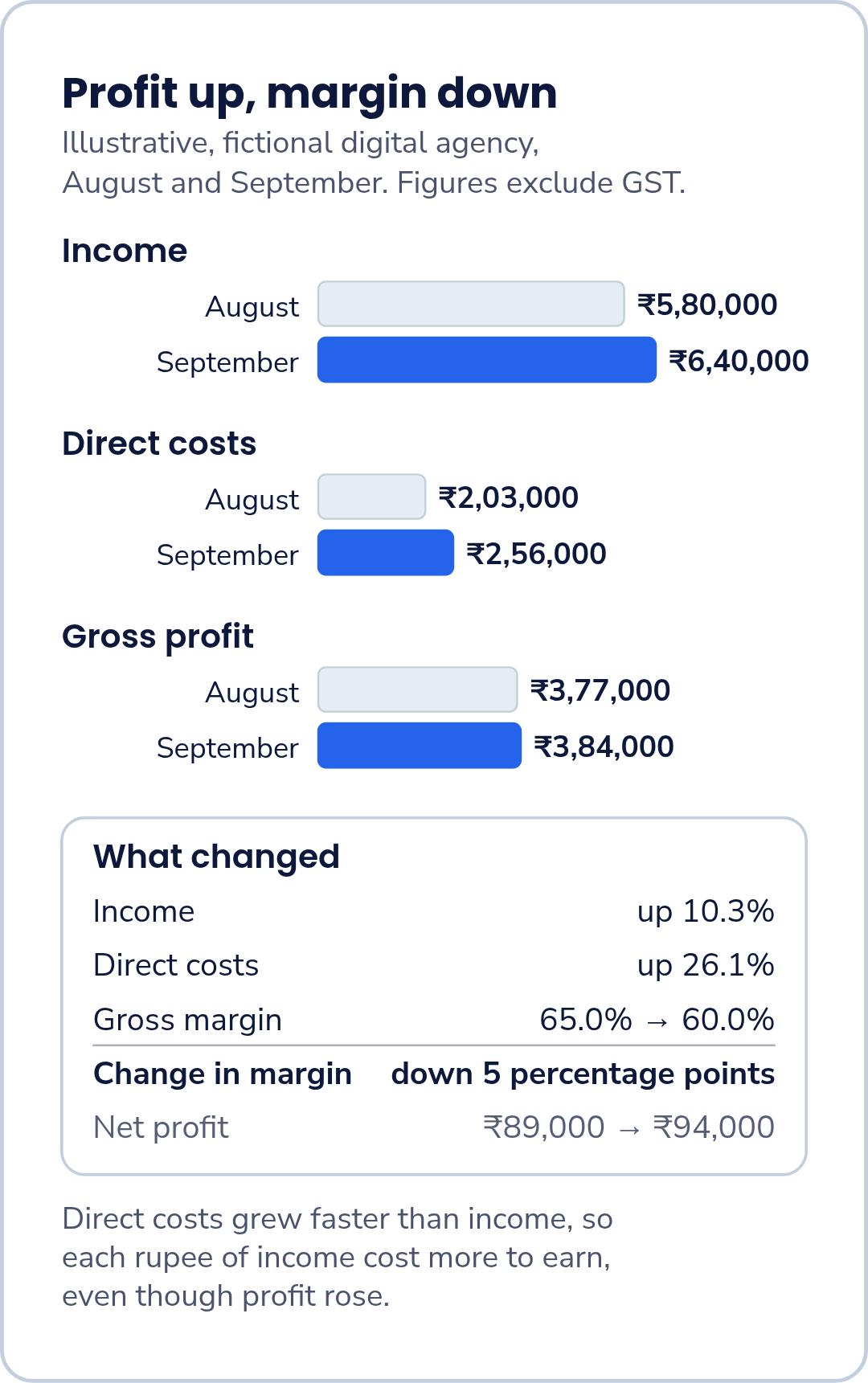
| Income | ₹5,80,000 | ₹6,40,000 |
| Direct costs (freelancers, project tools) | ₹2,03,000 | ₹2,56,000 |
| Gross profit | ₹3,77,000 | ₹3,84,000 |
| Gross margin | 65.0% | 60.0% |
| Overheads | ₹2,88,000 | ₹2,90,000 |
| Net profit | ₹89,000 | ₹94,000 |
Read only the bottom line and September looks better than August: net profit is up ₹5,000. The five questions tell a fuller story.
- Everything in? The owner checks the overheads against August's list. Rent, salaries and software are all there; overheads rose by only ₹2,000 (₹2,88,000 to ₹2,90,000).
- Income: up ₹60,000 (₹5,80,000 to ₹6,40,000), or 10.3%. The owner knows why: a new client's first project started in September.
- Margin: gross margin fell from 65.0% to 60.0%, down 5 percentage points, even though gross profit rose ₹7,000. Direct costs rose ₹53,000 (₹2,03,000 to ₹2,56,000), or 26.1%, much faster than income. The new project used more freelancers than the agency's usual work.
- One-off: the owner marks part of the freelancer cost as set-up work for the new client, which may not recur. Whether it does is something to watch in October.
- Cash: the bank balance has not risen by anything like ₹94,000. The new client has not yet paid its first invoice, so the owner asks the accountant to confirm what customers owe at the end of September.
The useful finding is not the higher profit. It is that the new project earns less per rupee of income than the rest of the work, and the owner now has a specific question to put to the accountant and to the project.
Questions to send your accountant
Write down whatever the five questions raised, and send it back with the report. A template:
P&L questions: [Business name], [Month]

1. Missing or unusual costs:
2. Income changes I can't explain:
3. Margin: what drove the change from [ ]% to [ ]%?
4. Items I have marked as one-off (please confirm):
5. Profit vs cash: what explains the difference this month?
6. Anything else:
If you and your accountant keep a shared log of open questions, add these to it so they are answered rather than forgotten. If you receive the P&L quarterly rather than monthly, the same questions work for any period, and you can ask your accountant whether a monthly copy is possible.
Review your numbers with your accountant
These five questions work with any report. If you would like to talk through how you review your P&L each month, and ask whether FastComply Books currently supports that routine for your business, request a demo and choose "Book a demo" on the form. FastComply Books is in an invitation pilot in India, so the demo is where we confirm what is available for your business.