Four duties touch every payment: creating it, approving it, paying it and checking it afterwards. In a small office they can all end up with one person, such as whoever keeps the accounts. You do not need a large team to change that. Give at least two of the four duties to different people, write down who does what in a one-page duty map, and where you cannot split a duty, add a simple check by someone else. Splitting duties does not make mistakes impossible. It makes mistakes, and misuse, easier to spot.
The four duties
| Duty | What it covers |
|---|---|
| Create | Entering bills, adding new suppliers, entering or changing bank details, preparing a payment |
| Approve | Deciding what gets paid, and when |
| Pay | Releasing the payment: the bank login, the UPI app, the cheque book |
| Check | Reconciling the bank account and reviewing what was paid afterwards |
When one person does all four, nobody else is placed to notice a wrong supplier, a duplicated bill or a changed account number until much later, if at all. Separating even one duty from the rest helps. A practical first split is between the person who prepares payments and the person who releases them.
Maker-checker for a small office
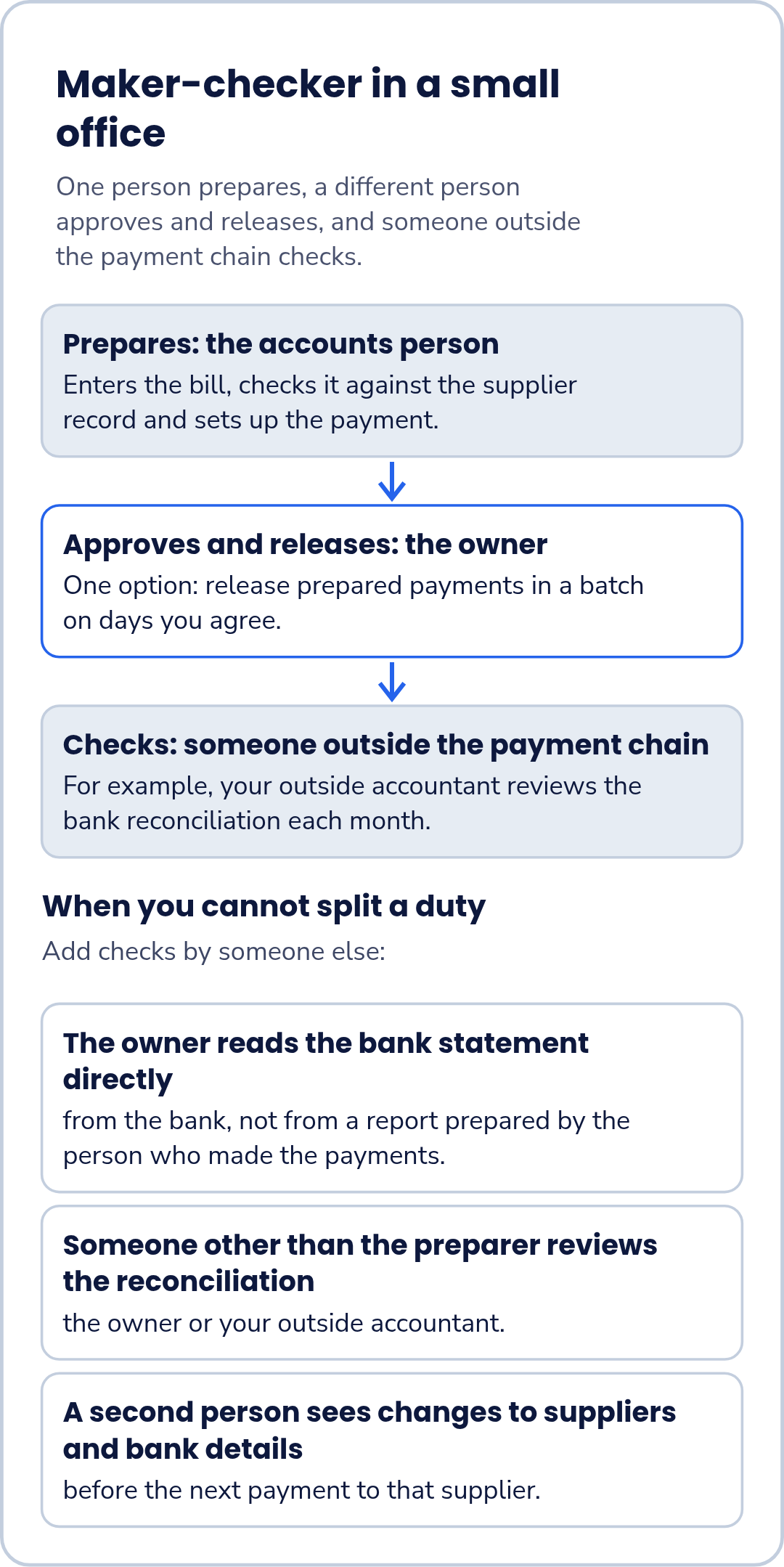
"Maker-checker" means one person prepares a transaction (the maker) and a different person approves or releases it (the checker). In a small office it can look like this:
- The accounts person prepares. They enter the bill, check it against the supplier record and set up the payment.
- The owner approves and releases. Where your bank offers separate roles for preparing and authorising a payment, you can use them. Ask your bank what is available on your account.
- Someone outside the payment chain checks. For example, your outside accountant reviews the bank reconciliation each month, as a working arrangement you agree with them.
If the owner wants payments below a certain amount to go through without them, the owner sets that amount.
Worried this will slow payments down? One option is for the owner to release prepared payments in a batch on days you agree, so nothing waits long and the owner is not interrupted for each one.
The duty map
Write down who does each duty for each kind of work. A blank map:
| Work | Creates | Approves | Pays / releases | Checks |
|---|---|---|---|---|
| Supplier bills | ||||
| New suppliers | ||||
| Bank-detail changes | ||||
| Payments | ||||
| Petty cash | ||||
| Bank reconciliation |
Two things to look for once it is filled in: any row where one name appears in every column, and any row with no one in the Checks column.
For bank-detail changes, confirm every change with the supplier on a number already on your records before it is entered.
For petty cash, keep the person who holds the cash different from the person who approves top-ups and checks the count.
When you cannot split a duty
Sometimes one person has to do most of the work. Then add checks by someone else:
- The owner reads the bank statement directly, from the bank, not from a report prepared by the person who made the payments. Look down the payee names and amounts and ask about anything you do not recognise.
- Someone other than the preparer reviews the reconciliation. That can be the owner or your outside accountant.
- Changes to suppliers and bank details are seen by a second person before the next payment to that supplier.
How often you do these is for you to choose. Do them on a regular cycle you and your accountant agree, rather than only when something looks wrong.
Worked example: a six-person office in Mysuru
Illustrative example: a fictional six-person office in Mysuru. All details are invented.
The office has six people: the owner, an accounts assistant, an office manager and three other staff (1 + 1 + 1 + 3 = 6). An outside CA, not counted in the six, works with them on the books and reviews the bank reconciliation each month.
Before. In October the office made 46 payments. The accounts assistant prepared, paid and reconciled all 46. Create, pay and check sat with one person.
After. The owner and the assistant fill in the duty map together and agree a change:
| Work | Creates | Approves | Pays / releases | Checks |
|---|---|---|---|---|
| Supplier bills | Accounts assistant | Owner | Owner | Outside CA (through the reconciliation) |
| New suppliers | Accounts assistant | Owner | — | Owner |
| Bank-detail changes | Accounts assistant, after confirming with the supplier on a number already on record | Owner | — | Owner |
| Payments | Accounts assistant | Owner | Owner | Outside CA (through the reconciliation) |
| Petty cash | Office manager (holds the cash, writes vouchers) | Owner (approves top-ups) | Office manager (pays out from the box) | Owner, at the weekly count with the office manager |
| Bank reconciliation | Accounts assistant | — | — | Outside CA |
The owner now approves and releases payments. That works here because someone else prepares each payment and someone else again checks the reconciliation. From November, every payment passes through at least two people. Petty cash follows the same idea: the office manager holds and pays out the cash, and the owner approves top-ups and counts the box with them each week. The three other staff have no payment duties.
The first statement read. The owner reads the bank statement directly and finds one payee name they do not recognise. The assistant explains: a regular supplier had started trading under a new name. The assistant updates the supplier record with the new trade name, and the owner checks the change.
Nothing was wrong. But the owner now knows the name, and the supplier record matches the bank statement.
A checklist for your regular review
Go through this at an interval you agree with your accountant:
- The duty map is up to date: names, new staff, people who have left.
- No row has one name in every column.
- Every row has someone in the Checks column.
- The owner has read the bank statements directly since the last review.
- Someone other than the preparer has reviewed each reconciliation.
- Every bank-detail change since the last review was confirmed and seen by a second person.
- Bank logins and payment apps are held only by the people the map says release payments.
- The petty cash holder and the top-up approver are still different people.
Discuss your controls in a demo
These controls work with any software and any bank. If you're evaluating FastComply Books, ask in a demo whether user roles and approvals are available for your business and how they would fit the way your team splits work. Request a demo and choose "Book a demo" on the form. FastComply Books is in an invitation pilot in India, so the demo is where we confirm what is available for your business.