When your accountant or accounts assistant is leaving and your outside CA is staying, three things carry the handover. First, the CA stays and acts as the check: they confirm the balances at the cut-off, so the new person starts from figures someone outside the day-to-day work has agreed. Second, no password changes hands: you, the owner, remove the old person's access and give the new person their own. Third, an open-items list with amounts records everything that is not finished. Around those, set a cut-off date, ask for a short "how we do things" sheet, and walk through the open items together in the last week.
The same steps apply whether the books are kept in software, in a spreadsheet or on paper.
When your accountant or accounts assistant is leaving
The accounting software holds what has been entered. It does not hold:
- bills that arrived but were not entered yet
- why a balance looks odd, and what was agreed about it
- which supplier payment is on hold, and why
- who has access to net banking, the bills inbox and the shared drive
- the monthly routine: what gets done on which day, and what goes to the CA
Those things live in one person's head, laptop and phone. They are what a handover has to capture.
Pick a cut-off date
Choose a date up to which the person leaving finishes everything: entries made, bank accounts reconciled, bills filed. The new person starts from the day after. One practical choice is the last day of a month, because the cut-off then lines up with a full month's statements and your CA's monthly work; any date you agree on works. If the last working day is not the cut-off, write down which period each person is responsible for.
The access list
List every system the accounts person uses:
- the accounting software
- net banking, and any role they have in approving payments
- email inboxes where bills and statements arrive
- shared drives or folders
- any portals the accounts person used for the business
- payment apps on an office phone
For each one, record who has access now, the date the access changes, and who has it afterwards.
- You control access. The owner holds the main access to each system and decides who else gets it.
- Give the new person their own access. Where a system allows more than one user, add the new person under their own login. Where it allows only one login, keep that login under your own control: set a new password yourself, don't pass it on, and ask the provider whether a separate login can be added for the new person.
- Remove the old person's access on their last day.
- Never hand over or share passwords, and do not write any password into the handover documents.
Ask your accountant which filings and portal accesses apply to your business.
Where things are
Write down where each kind of record lives: purchase bills, sales invoices, bank statements, the monthly pack for the CA, and any loose papers. If the folders already follow a fixed layout, one line saying so is enough.
The open-items list
This list holds most of what would otherwise be lost. List everything that is not finished, with an amount where there is one:
- bank lines at the cut-off that have not been matched to an entry
- bills received but not yet entered
- supplier bills on hold, and why
- customer amounts that are disputed
- questions still open with the CA
- anything half done
For each item: what it is, the amount, why it is open, who owns it after the handover, and by when.
The "how we do things" sheet
One or two pages, in the leaving person's words:
- the monthly routine: what is done each week and each month, and what goes to the CA and when
- entries that repeat every month, such as rent or a subscription
- regular suppliers and customers, and anything unusual about how they bill or pay
- any odd balances and the explanation for each
- anything agreed with the CA that is not written down elsewhere
Balances at the cut-off, checked by your CA
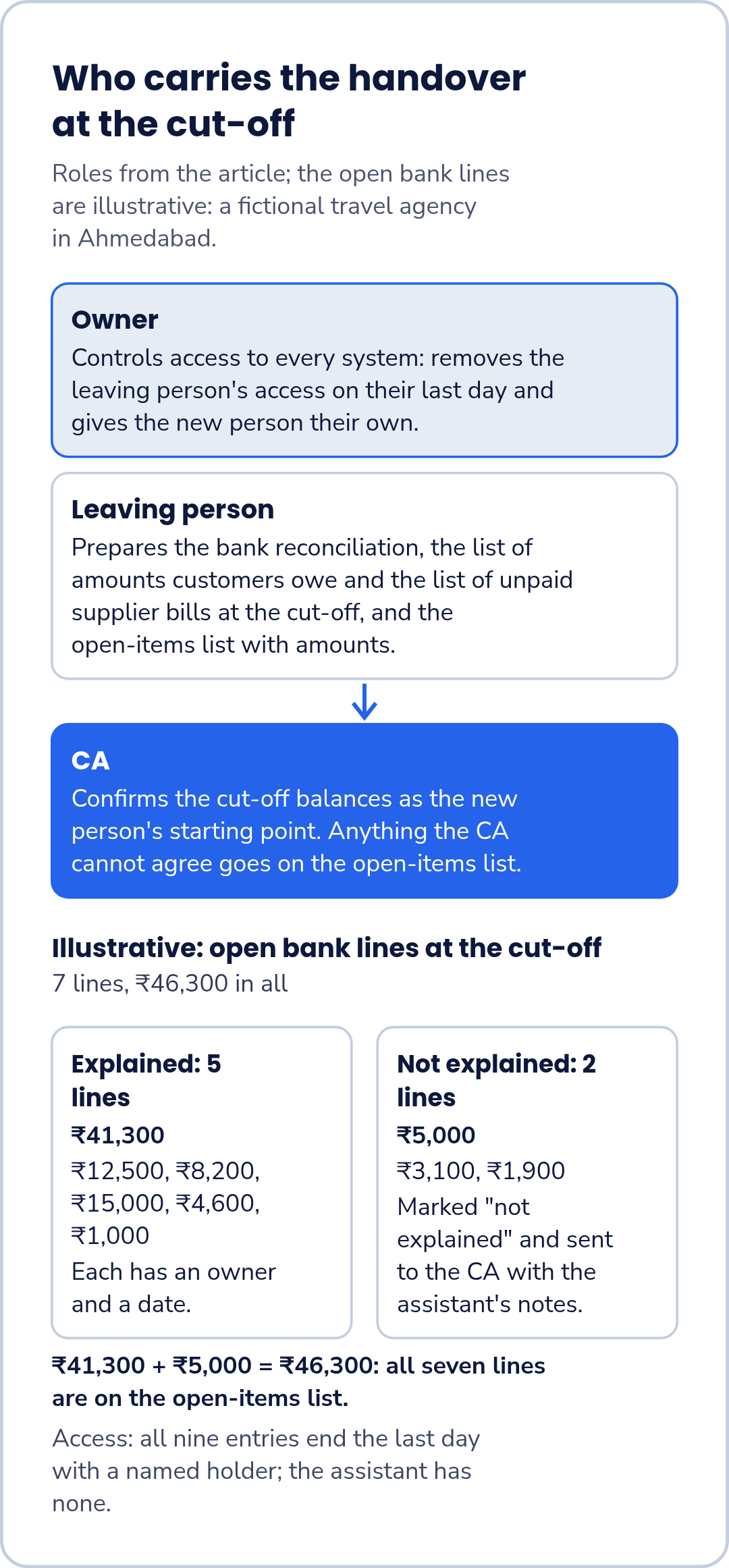
At the cut-off, the leaving person prepares the bank reconciliation, the list of amounts customers owe and the list of unpaid supplier bills. Send these to your CA and ask them to confirm they are the starting point for the new person. Anything the CA cannot agree goes on the open-items list.
The last-week walk-through
In the last week, the leaving person and the new person (or the owner, if nobody has joined yet) sit together and go through the open-items list line by line. Each item gets an owner and a date. Both sign the list. Questions are much easier to answer while the person who knows is still there.
Worked example: a travel agency's handover
Illustrative example: a fictional travel agency in Ahmedabad. The business, people and figures are invented.
The agency has 12 staff. Its accounts assistant of four years is leaving, with two weeks' notice. The outside CA is staying. The owner sets the cut-off as the last day of the month, which falls inside the notice period.
Open bank lines at the cut-off. Seven bank lines are not yet matched:
| Bank line | Status |
|---|---|
| ₹12,500 | Explained on the list |
| ₹8,200 | Explained on the list |
| ₹15,000 | Explained on the list |
| ₹4,600 | Explained on the list |
| ₹3,100 | Not explained |
| ₹1,900 | Not explained |
| ₹1,000 | Explained on the list |
| Total | ₹46,300 |
₹12,500 + ₹8,200 + ₹15,000 + ₹4,600 + ₹3,100 + ₹1,900 + ₹1,000 = ₹46,300.
Five lines, totalling ₹41,300 (₹12,500 + ₹8,200 + ₹15,000 + ₹4,600 + ₹1,000), are explained on the open-items list, each with an owner and a date. The other two, ₹3,100 and ₹1,900, totalling ₹5,000, are not explained. They go on the open-items list marked "not explained", and to the CA with the leaving assistant's notes on what she remembers about them. ₹41,300 + ₹5,000 = ₹46,300, so all seven lines are on the list.
Access. The access list has nine entries. Six are changed on the last day: the assistant's access is removed, and the new person gets their own. The other three, a shared drive and two supplier portals, had been set up under the assistant's own account, so the owner first asks each provider to move it to the owner's account and then gives the new person their own access. By the end of the last day, every one of the nine has a named holder, and the assistant has none.
Templates
Handover checklist
Handover: [Business name]
Leaving: [name]       Joining / taking over: [name]       Cut-off date: [ ]

[ ] Cut-off date agreed; periods each person finishes written down
[ ] Access list complete; old access removed and new access given on [date]
[ ] Where things are: written down
[ ] Open-items list with amounts, owners and dates
[ ] "How we do things" sheet
[ ] Bank reconciliation, customer list and supplier list at the cut-off sent to the CA
[ ] CA has confirmed the cut-off balances (or listed what is open)
[ ] Last-week walk-through done; open-items list signed by both
Access list
| System | Who has access now | Change on | Who has it after |
|---|---|---|---|
Open-items list
| Item | Amount | Why open | Owner after | By when |
|---|---|---|---|---|
Setting up the books for what comes next?
If you would like to hear about FastComply Books for your business, you can request early access. FastComply Books is in an invitation pilot in India and public sign-up is not open yet.