Once a month, list every debit on the business bank statement that isn't a payment to a supplier, staff or the owner, and isn't a customer refund: bank charges, rentals, standing instructions, mandates and codes you don't recognise. Compare each with a standing list of the debits you expect. Anything new, different or unknown is marked "ask", with who to ask written beside it.
"They're small amounts. The bank knows what it's doing." Some of them aren't the bank's at all: a standing instruction for a service you stopped, a rental for a machine you returned, a subscription taken twice. Each is small, and each can repeat every month until someone asks.
Why small debits go unasked
The statement carries small debits with short codes: rentals, SMS charges, transfer charges, mandates for things that may have ended. The bank reconciliation matches them to the books; it doesn't ask whether each one should be there at all. An amount that small may not stop the month's work, so it can be matched, recorded and left without a question.
Reviewing every debit each month, checking auto-debits and standing instructions, and looking for duplicates and increases are already published (jaysudha, bizle), as are a list of active mandates and standing instructions with a "where to check" view for each kind of debit (terra-insight's page on unrecognised debits), and a register of recurring charges with who set each up and a decision (quickwell, costloop). This page's own part is narrow: a standing expected-debits list carried from month to month, covering bank charges, equipment rentals and mandates together, with a "who to ask" column and two checks against your own registers.
The monthly list
Once the month's statement is in, before or alongside the reconciliation, the accounts person lists every debit that isn't a supplier, staff, owner or customer payment. For each one, write the description as it appears on the statement, the date, the amount, what it is (if known), whether it is expected (yes, or ask), who to ask, the date you asked, the answer, and whether it is closed.
The matching itself stays in the bank reconciliation workflow.
The expected-debits list, kept from month to month
Keep a second, standing list of every debit you expect to see: the description pattern on the statement, what it is, who set it up and when, the usual amount, its frequency, and when it ends, if you know. Each month, anything on the statement that isn't on this list, or is different in amount or count, is marked "ask".
When an answer comes back, the item moves onto the expected list, or is marked "stopped". Anything still unanswered carries forward to next month's list.
Who to ask: the bank, the supplier or service, or yourselves
Not every debit is the bank's: some debits that look like bank charges belong to a supplier, a service or the business itself. So the "who to ask" column has three answers:
- the bank, for its own charges and for codes you can't place;
- the supplier or service, for standing instructions and mandates they collect; ending a mandate is between you, them and your bank;
- yourselves first, for anything someone in the business may have set up.
Which charges apply to your account is set by your bank's own schedule and your agreements with it; how they are recorded is for your accountant.
Two checks against your own registers
A mandate or standing instruction for a service contract: look it up in the annual renewals list. Has the contract ended or been cancelled?
A rental for a card terminal, soundbox or other equipment: look it up in the deposits register. Has the equipment been returned?
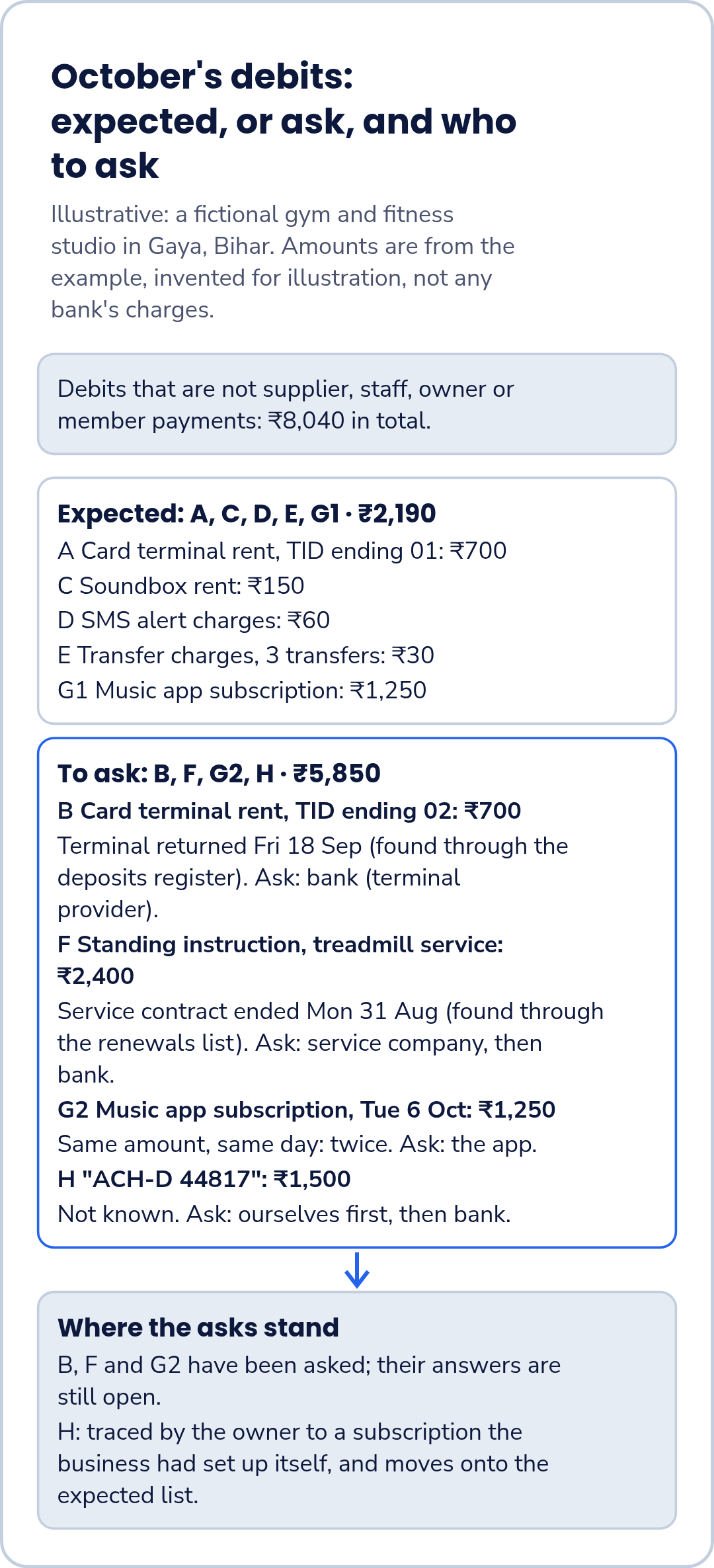
Worked example: a Gaya gym's October statement
Illustrative example: a fictional gym and fitness studio in Gaya, Bihar, with the owner and 5 staff (3 trainers, 1 front desk, 1 cleaner) on one floor of weights and cardio machines. Members pay monthly by UPI or card. The studio has one current account, one card terminal (a second was returned in September), a UPI soundbox and a few standing instructions. Amounts invented for illustration, not any bank's charges; verify independently.
October 2026's debits that are not supplier, staff, owner or member payments:
| Ref | As on the statement | Amount (₹) | What it is | Expected? | Who to ask |
|---|---|---|---|---|---|
| A | Card terminal rent, TID ending 01 | 700 | Rent for the terminal in use | Yes | – |
| B | Card terminal rent, TID ending 02 | 700 | Terminal returned Fri 18 Sep | Ask | Bank (terminal provider) |
| C | Soundbox rent | 150 | UPI soundbox at the desk | Yes | – |
| D | SMS alert charges | 60 | Alerts on the account | Yes | – |
| E | Transfer charges, 3 transfers | 30 | Three outgoing transfers | Yes | – |
| F | Standing instruction, treadmill service | 2,400 | Service contract ended Mon 31 Aug | Ask | Service company, then bank |
| G1 | Music app subscription, Tue 6 Oct | 1,250 | Music licence for the floor | Yes | – |
| G2 | Music app subscription, Tue 6 Oct | 1,250 | Same amount, same day: twice | Ask | The app |
| H | "ACH-D 44817" | 1,500 | Not known | Ask | Ourselves first, then bank |
| Expected: A, C, D, E, G1 | 2,190 | ||||
| To ask: B, F, G2, H | 5,850 | ||||
| Total | 8,040 |
B was found through the deposits register: the terminal went back on Fri 18 Sep, and its return receipt is filed. F was found through the renewals list: the treadmill service contract ended on Mon 31 Aug and was not renewed. B, F and G2 have been asked; their answers are still open. H was traced by the owner to a subscription the business had set up itself, and moves onto the expected list.
Where this sits next to the reconciliation and card statements
The bank reconciliation asks whether the books match the bank; this check asks whether each debit should exist at all. Card fees and card statement lines stay in checking a business credit card statement line by line. The same "is this expected?" question for electricity and other utility bills is in the guide to unusual utility bills. A wider look at every cost line is in the line-by-line cost review.
Template
Monthly list: the debit
| Description as on the statement | Date | Amount (₹) | What it is | Expected? (yes / ask) |
|---|---|---|---|---|
Monthly list: the follow-up
| Description as on the statement | Who to ask | Asked on | Answer | Closed? |
|---|---|---|---|---|
Expected-debits list
| Description pattern | What it is | Set up by, when | Usual amount (₹) | Frequency | Ends on |
|---|---|---|---|---|---|
Going through your bank statement each month?
If you would like to hear about FastComply Books for your business, you can request early access. FastComply Books is in an invitation pilot in India and public sign-up is not open yet.