Sit down once with the last 12 months of bank statements and card statements, and list every cost the business pays again and again: one row per vendor and purpose, with the 12-month total. For each row, write the answers to two questions: "Who uses this now?" and "What happens if we stop it?" Then decide: keep, change, stop or ask. Read the terms before stopping anything, note who acts and by when, and check that the next bills show the change.
Why costs creep
Most regular costs started for a good reason: a phone connection for a new hire, a software tool for a project, extra space for a busy season. The reason ends; the payment does not. Each one is small, so none stands out, and the P&L shows only that a heading such as "rent" or "software" has grown, not which payment within it is no longer needed.
Pull 12 months of payments, not memory
Work from what actually left the business: the bank statements, the business card statements and the petty cash book for the last 12 months. Memory misses the small automatic payments, and P&L headings group them together. If you pay staff back for expenses, go through the staff expense claims for the same months too.
One row per recurring cost
Group the payments so each recurring cost is one row: the vendor, what it is for, how often it is paid (monthly, quarterly, yearly) and the total paid in the 12 months. A cost paid monthly and a cost paid yearly sit side by side as 12-month totals.
Two questions for every line
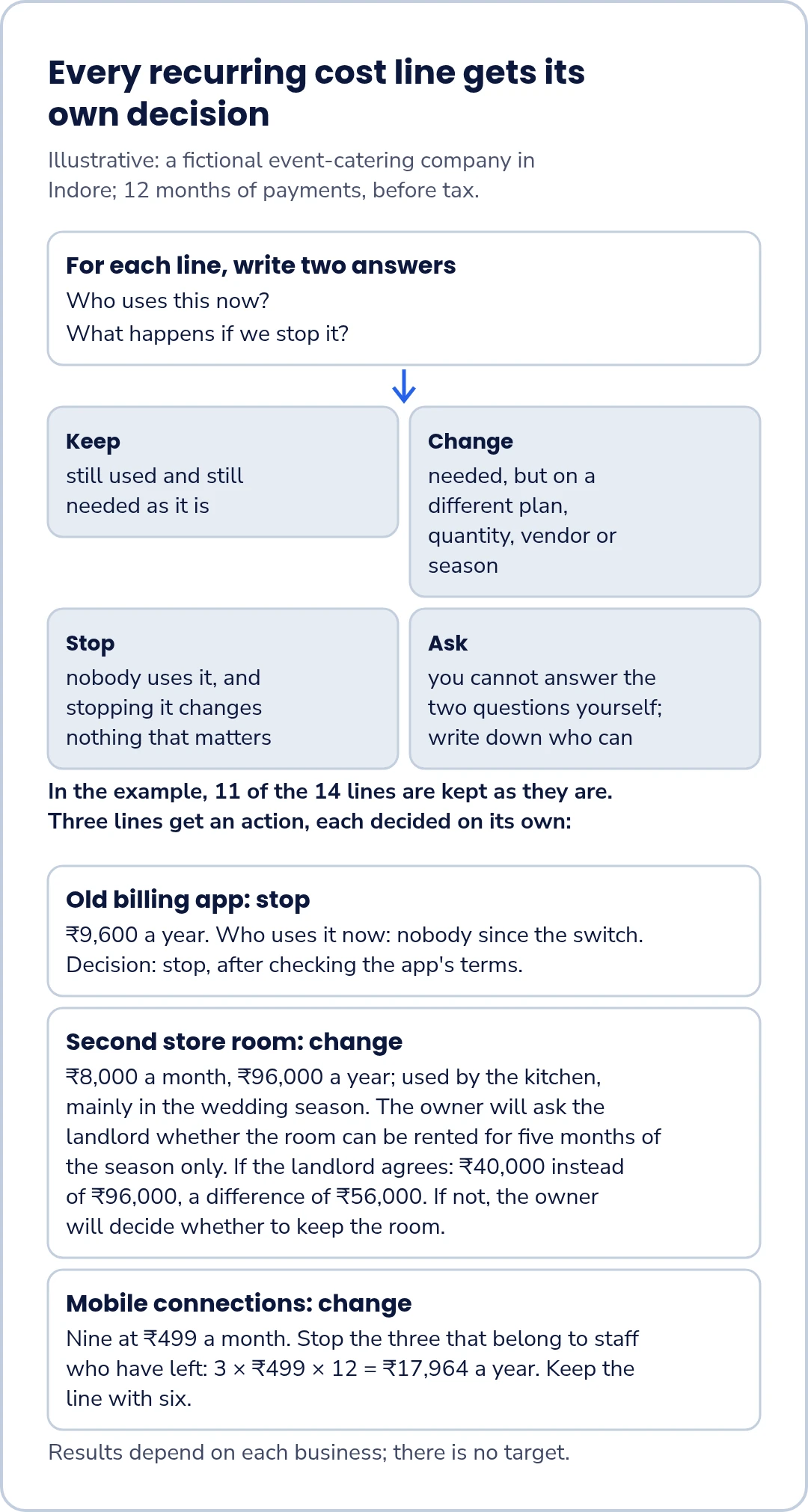
For each row, write the answers:
- Who uses this now? A name or a team, not "everyone".
- What happens if we stop it? What would actually change, and for whom.
Start with the rows where nobody can name a current user, but answer the second question before deciding anything: some costs, such as insurance or the business's domain name, have no day-to-day user and are still needed. Do not skip the other rows either: a row with a clear user can still be on the wrong plan or quantity.
Keep, change, stop or ask
Every row gets one decision:
- Keep: still used and still needed as it is.
- Change: needed, but on a different plan, quantity, vendor or season.
- Stop: nobody uses it, and stopping it changes nothing that matters.
- Ask: you cannot answer the two questions yourself; write down who can.
For every change, stop or ask, note who will act and by when.
Check the terms before you stop anything
Check each contract's own terms before you stop it, and ask your accountant if a cost has tax or accounting effects. Some agreements need notice or run to a fixed end date; the agreement itself tells you.
When the action is done, look at the next bill or statement for that cost. If the change does not show, follow it up. Decide, too, who can sign up for new subscriptions.
You can repeat the review each year, alongside your list of yearly renewals.
Worked example: an event caterer in Indore
Illustrative example: a fictional event-catering company in Indore; 12-month totals, before tax. The business has about 22 staff, a kitchen, a store room and two delivery vehicles. All details are invented.
The owner and the office manager list 14 recurring cost lines from the year's bank and card statements. Eleven lines are kept as they are. Three lines get an action (11 + 3 = 14):
Two billing apps. The business switched billing apps during the year and is still paying for the old one, ₹9,600 a year. Who uses it now: nobody since the switch. Decision: stop, after checking the app's terms.
Second store room. Rent is ₹8,000 a month, ₹8,000 × 12 = ₹96,000 a year. Who uses it now: the kitchen, mainly in the wedding season. Decision: change. The owner will ask the landlord whether the room can be rented for five months of the season only. If the landlord agrees, the rent for the year would be ₹8,000 × 5 = ₹40,000 instead of ₹96,000, a difference of ₹96,000 − ₹40,000 = ₹56,000. If the landlord does not agree, the owner will decide whether to keep the room.
Mobile connections. Nine connections at ₹499 a month each. Three belong to staff who have left. Decision: change: stop those three connections and keep the line with six. The three stopped connections come to 3 × ₹499 × 12 = ₹17,964 a year.
Each line is decided on its own. Results depend on each business; there is no target.
Review sheet (template)
| Line | Vendor and what for | 12-month total (₹) | Who uses it now | If we stop it | Decision (keep / change / stop / ask) |
|---|---|---|---|---|---|
For each row, also note how often it is paid, who acts, by when, and the date it was done, as extra columns or on a second sheet.
Reviewing your regular costs once a year?
If you would like to hear about FastComply Books for your business, you can request early access. FastComply Books is in an invitation pilot in India and public sign-up is not open yet.