
Keep one register of every deposit your business has paid: rent security deposits, electricity and water connection deposits, deposits on rented equipment. One row per deposit, with the amount, the date, the proof, where the agreement is filed, the return conditions copied as written, and the status. Check the register's total of deposits still held against the deposits figure in your books, and explain any difference. When you leave premises or close a connection, work through an exit checklist so the deposit is claimed back and the row is closed.
Why deposits get forgotten
A deposit is paid once, often years ago, and then nothing happens. The rent agreement is filed, the person who signed it moves on, and the receipt for an electricity connection may be older than anyone in the office. When the business moves out, nobody is sure what was paid or what the agreement said, and the "deposits" figure in the books is a number nobody can explain.
Make a deposits register
One row per deposit:
- paid to;
- for what (rent, electricity connection, water connection, equipment);
- premises, or the connection or account number;
- amount paid and date paid;
- proof (receipt or bank reference);
- where the agreement or receipt is filed;
- return conditions, copied word for word from the agreement;
- status: held, part returned, returned, or adjusted against rent;
- date closed.
Copy the return conditions exactly as the agreement states them. Do not summarise or interpret them on the register.
If the deposit is under a rent agreement, put the agreement's renewal date on your list of renewals.
Find the deposits you have forgotten
Go through:
- rent agreements, current and old;
- electricity and water bills, which show the connection or account numbers;
- any equipment rental papers;
- the list behind the "deposits" balance, which your accountant can give you.
Each deposit you find becomes a row, with whatever proof exists.
Check the register against your books
Add up the deposits the register shows as still held, and compare that total with the deposits figure in your books. A natural point to do this is once a year, before your accountant closes the year; you can do it more often if you wish.
If the two figures differ, list the difference and find its cause, deposit by deposit. The difference can go either way: a deposit returned or adjusted that the books still show, or a deposit in the register that the books do not show. Give the list to your accountant.
When you leave premises or close a connection
- Find the row in the register.
- Collect the final meter readings and the final bill.
- Give notice as the agreement says.
- Record on the row what is returned, and anything deducted, with the landlord's or supplier's written reason.
- Close the row with the date.
How a deduction is recorded is your accountant's decision.
If rent is adjusted against the deposit: if the last months' rent is set off against the deposit, write the set-off on the row the same day and tell your accountant. This page does not cover whether a set-off changes anything for tax or how it is recorded.
Ask your accountant how deposits are shown in your accounts, and a lawyer if a landlord refuses to return one.
Worked example: a coaching institute in Patna
Illustrative example: a fictional coaching institute in Patna with three rented centres. The institute has about 15 staff. All details are invented.
The owner builds the register from the rent agreements, the electricity bills and the water-cooler rental papers.
| Deposits still held | Amount (₹) |
|---|---|
| Rent deposit, Centre A | 1,50,000 |
| Rent deposit, Centre B | 1,20,000 |
| Rent deposit, Centre C | 90,000 |
| Rent deposits | 3,60,000 |
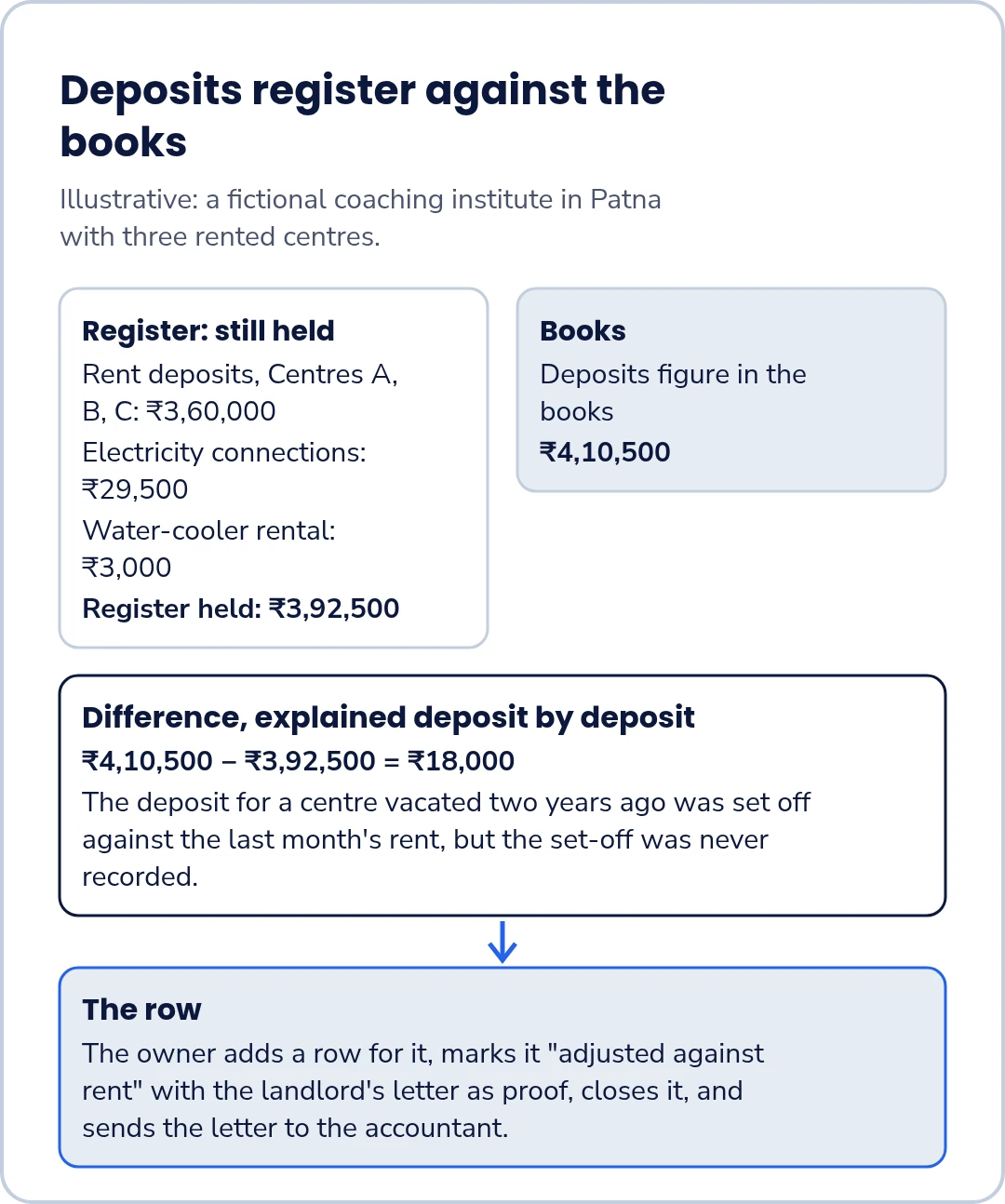
| Electricity connection deposits (₹12,000 + ₹9,500 + ₹8,000) | 29,500 |
| Water-cooler rental deposit | 3,000 |
| Register total held | 3,92,500 |
₹1,50,000 + ₹1,20,000 + ₹90,000 = ₹3,60,000; ₹12,000 + ₹9,500 + ₹8,000 = ₹29,500; ₹3,60,000 + ₹29,500 + ₹3,000 = ₹3,92,500.
Books show deposits of ₹4,10,500; the register shows ₹3,92,500 still held. The ₹18,000 difference is the deposit for a centre vacated two years ago: it was set off against the last month's rent, but the set-off was never recorded. The owner adds a row for it, marks it "adjusted against rent" with the landlord's letter as proof, closes it, and sends the letter to the accountant.
(₹4,10,500 − ₹3,92,500 = ₹18,000.)
Templates
Deposits register:
| Paid to | For what | Amount paid (₹) | Date paid | Status | Date closed |
|---|---|---|---|---|---|
Keep these details for each row as well, in more columns or on a separate sheet:
- premises, or connection or account no.
- proof (receipt or bank reference)
- where filed
- return conditions (copied as written)
Exit checklist:
| Step | Done | Date | Notes |
|---|---|---|---|
| Row found in the register | |||
| Final meter readings and final bill collected | |||
| Notice given as the agreement says | |||
| Amount returned recorded on the row | |||
| Any deduction recorded, with the written reason | |||
| Row closed |
Deposits listed and matched to your books?
If you would like to hear about FastComply Books for your business, you can request early access. FastComply Books is in an invitation pilot in India and public sign-up is not open yet.