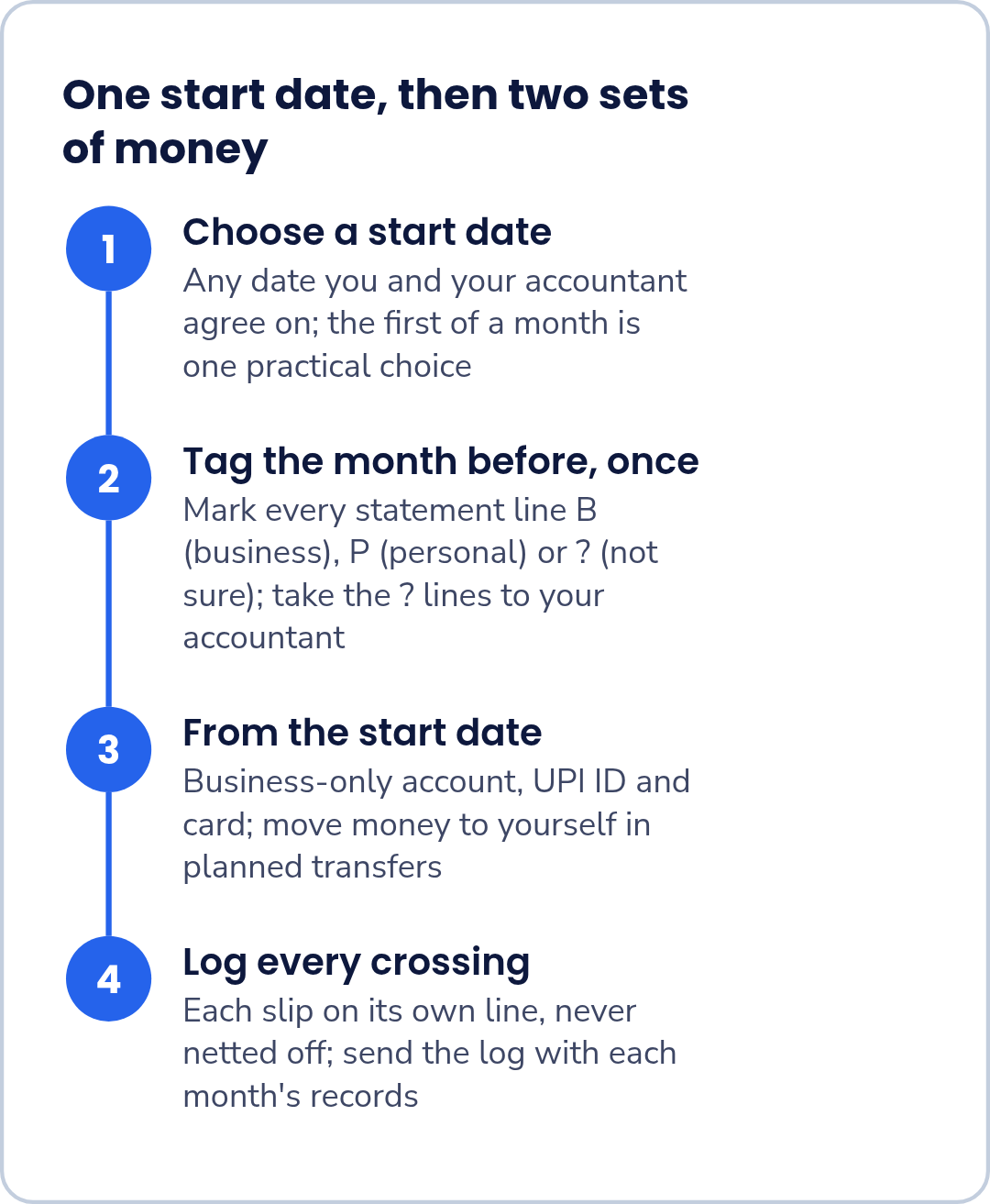
If one account and one UPI ID carry both your business and your household, you do not need to untangle the past to fix it. Choose a start date. From that date, run business money through business-only accounts and move money to yourself in one regular, planned transfer. Tag the last month before the start date once, line by line, and after that keep a short log of every payment that crosses the line by mistake.
This guide is about keeping the records apart. What the separation means for tax or legal purposes is for your CA to explain. The practical problem is simple: when business and personal payments share an account, every line has to be explained before anyone can say what the business earned or spent, and only you can give those explanations.
Choose a clean start date
Pick a date from which the new setup applies. The first day of a month is one practical choice, because the change then lines up with a full monthly statement, but any date you and your accountant agree on works. Tell your accountant the date. Everything before it is handled once, by the tagging pass below. Everything after it follows the new setup, with the crossing log catching anything that slips through.
You do not need to redo earlier months. Which earlier periods, if any, need more attention is for your accountant to say.
The setup
| Money | Business | Personal |
|---|---|---|
| Bank account | One account used only for the business | Your own account |
| UPI ID or QR code | Linked to the business account; given to customers and suppliers | Linked to your personal account; used for household payments |
| Card, if the business has one | Used only for business purchases | Used for everything else |
| Moving money to yourself | Planned transfers from business to personal, rather than paying household costs directly | Receives those transfers |
Ask your bank which account type and documents apply to you. Once the business UPI ID is set up, update it everywhere customers see it: invoices, the shop counter, your website or messages.
Planned transfers. Rather than paying household costs straight from the business account, move money to your personal account and pay household costs from there. One option is a single transfer on the same date each month, so it shows up as one recognisable line instead of dozens of small ones. The amount, how often you move it and how it is recorded are for you and your accountant to decide.
The one-off tagging pass
Take the full statement for the month before your start date, or whatever period your accountant asks for. Go down it line by line and mark each one:
- B: business
- P: personal
- ?: you are not sure
| Date | Narration | Amount (₹) | Tag | Note |
|---|---|---|---|---|
| B / P / ? |
Do not guess on the "?" lines. Write down anything you remember about them and go through that list with your accountant. When every line has a B or a P, send the tagged statement with your usual records.
The crossing log
After the start date, a business bill will sometimes get paid from the personal card, or a household payment will go out from the business UPI. What matters is that it is written down when it happens, rather than discovered later.
| Date | Amount (₹) | Direction | What it was for | Evidence attached | Accountant's note |
|---|---|---|---|---|---|
| Business paid personal / Personal paid business | Yes / No |
Log each crossing as its own line, even if two of them seem to cancel each other out, and send the log to your accountant with each month's records.
Worked example: a printing shop in Madurai
Illustrative example: a fictional printing shop in Madurai, run by a proprietor on one savings account. All details and figures are invented.
The owner picks 1 October as the start date. Customer payments, paper and ink suppliers, school fees and groceries had all been running through one savings account and one UPI ID.
The tagging pass. The September statement has 86 lines. The owner tags them:
| Tag | Lines |
|---|---|
| B (business) | 51 |
| P (personal) | 23 |
| ? (ask) | 12 |
| Total | 86 |
The 12 "?" lines go to the accountant with the owner's notes beside each one.
The new setup. From 1 October, the shop has a business-only account, with a new UPI QR code at the counter and on its invoices. The owner chooses to move money to the personal account in one transfer on the same date each month.
The crossings. Two slips happen in October, and both go into the log:
| Date | Amount (₹) | Direction | What it was for | Evidence attached | Accountant's note |
|---|---|---|---|---|---|
| 9 Oct | 6,200 | Personal paid business | Printing paper, paid on the personal card | Yes, supplier bill | |
| 21 Oct | 1,850 | Business paid personal | Household purchase, paid from the business UPI | Yes, UPI receipt |
The two lines stay separate: the owner does not net them off or decide how either is recorded. The accountant sees exactly what crossed, in which direction and why.
What to agree with your accountant
Tell your accountant; don't decide alone
How the regular transfer, any crossings and any money you put into the business are recorded is your accountant's decision. Bring them the start date, the tagged statement, the "?" list and the crossing log, and ask how they would like each one handled.
Also agree:
- which period the tagging pass should cover;
- how they want the crossing log sent, and whether they want extra columns in it;
- what to do with old payment details, such as a personal UPI ID that customers still use.
Starting fresh with a business-only account?
If you would like to hear about FastComply Books for your business, you can request early access. FastComply Books is in an invitation pilot in India and public sign-up is not open yet.