Before you change a reorder level, write down why the item ran out. If the order was placed late, the level was fine: fix the order habit. If the supplier took longer than you had noted, re-time the level using the supplier's actual delivery days. If the item sold faster than usual, raise the level using the new daily sales. Keep a ran-out list at the counter through the month, and at the review make one decision per item, recorded with the new level and the date.
Three reasons, three fixes
An item that ran out does not always need a higher level. The reason decides the fix:
| Why it ran out | How you can tell | What to change |
|---|---|---|
| Order placed late | Stock fell to the level, but the order went in days later. | Fix the habit. The level stays; fix the order day, or who checks the shelf. |
| Supplier slower than noted | The order went in on time, but delivery took longer than the days you had noted. | Re-time the level. Recalculate it with the supplier's actual delivery days from the last few deliveries, not the promised days. |
| Sold faster than usual | The order and the delivery were on time, but the stock went faster than the level assumed. | Raise the level. Recalculate it with the new daily sales. |
Raising every level that ran out changes the wrong thing when the order was simply late, and can leave more stock on the shelf than the item needs.
Write down one decision per item, with the new level and the date, so next month's review can see what was changed and why.
The ran-out list
Keep a sheet at the counter for the whole month. Each time a reviewed item runs out, whoever notices writes:
- the item;
- the date it ran out;
- how many days it was empty (filled in when the stock arrives);
- why: order placed late, supplier slower than noted, or sold faster than usual.
The review itself can be once a month, from this sheet. A busy shop may prefer to look at the sheet more often.
Which items to review. Start with the items that sell most, around 25 for a small shop, chosen from your bills or from memory. Also include any slower item your customers expect to find every time, even if it sells only a few a month: running out of it matters as much as running out of a best-seller. Items outside the list are not checked by this review, so add an item to the list when it runs out or starts piling up.
Worked example: a utensils shop in Amritsar
Illustrative example: a fictional steel utensils and kitchenware shop in Amritsar; October review; verify independently. All details are invented.
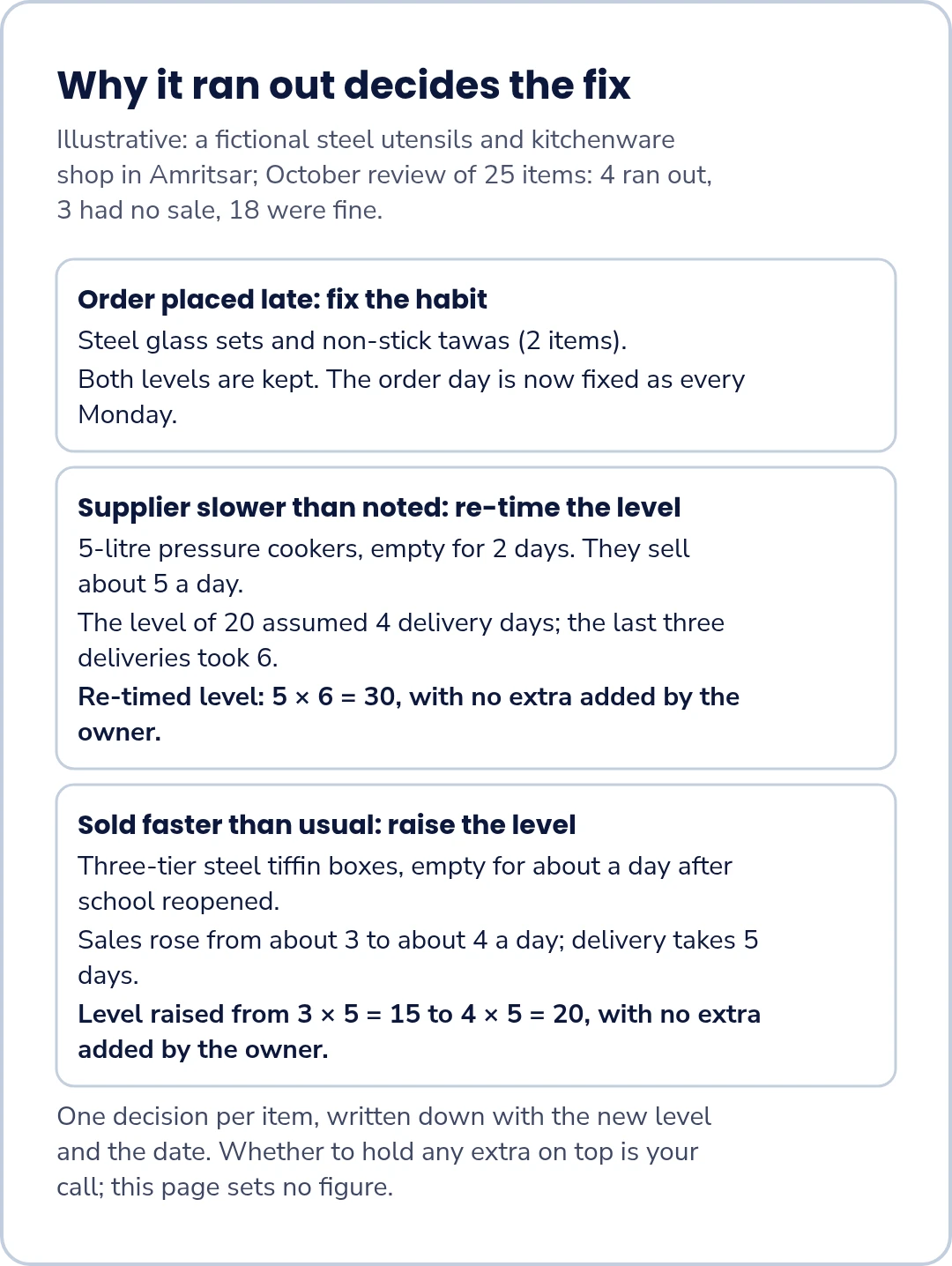
The owner reviews 25 items: 4 ran out, 3 had no sale all month, and 18 were fine.
4 + 3 + 18 = 25.
The 4 that ran out:
Order placed late (2 items): steel glass sets and non-stick tawas. Both levels are kept. The order day is now fixed as every Monday.
Supplier slower than noted (1 item): 5-litre pressure cookers, empty for 2 days. They sell about 5 a day. The level of 20 assumed 4 delivery days, but the last three deliveries took 6 days. Re-timed level: 5 × 6 = 30, with no extra added by the owner.
5 × 4 = 20; 20 ÷ 5 = 4 days of stock; 6 − 4 = 2 days empty.
Sold faster than usual (1 item): three-tier steel tiffin boxes, empty for about a day after school reopened. Sales rose from about 3 to about 4 a day, and delivery takes 5 days. Level raised from 3 × 5 = 15 to 4 × 5 = 20, with no extra added by the owner.
15 ÷ 4 = 3.75 days of stock; 5 − 3.75 = 1.25 days, about a day empty.
2 + 1 + 1 = 4.
Both new levels only just cover the delivery days at the current daily sales. If sales rise again or a delivery runs late, the item will run out again, and the ran-out list will show why. Whether to hold any extra on top is your call; this page sets no figure. The tiffin boxes sold faster because school reopened, so the owner also notes when to look at that level again once the rush passes.
Setting a first level, if there is none
What the item sells in a normal day × the supplier's actual delivery days, plus any extra you choose to hold; any extra is your call.
Items that didn't sell
Many shop guides suggest also listing the reviewed items with no sale all month, and stopping reorders of those until they sell. In the example, three items had no sale in October: copper bottle sets (₹18,400 at cost), gift hampers (₹9,600) and large cooking vessels (₹6,000), ₹34,000 at cost on the shelf. The owner stops reordering all three until they sell.
₹18,400 + ₹9,600 + ₹6,000 = ₹34,000.
How unsold stock is valued in your accounts is your accountant's call.
Before a busy season
Before a busy season you know is coming, you can set levels from the same months last year, and bring them back down afterwards. When the larger order arrives, check the delivery and the bill against the order.
Template: the ran-out list
| Item | Date ran out | Days empty | Why (late order / slower supplier / faster sales) | Fix | New level |
|---|---|---|---|---|---|
Also record on each row: the old level and the date you decided.
Talk through your books in a demo
If you would like to talk through how your business keeps its books, request a demo and choose "Book a demo" on the form. FastComply Books is in an invitation pilot in India, so the demo is where we confirm what is available for your business.