When a physical stock count and your stock report disagree, fix the record that caused the difference, not the stock figure: the purchase bill, the sale, the delivery or the damage note. Adjust the stock figure only for what is still unexplained after that. And never net differences: list each one on its own line, even when two of them seem to cancel out. Counting one group of stock each month, and writing the quantities down before you look at the stock report, keeps the paper trail fresh enough to do this.
Why a yearly count does not tell you why
A once-a-year count shows how far the stock report has drifted from the shelf. It rarely shows why. By then the bill that was entered against the wrong item, or the delivery that came short, is months old, and the easiest thing is to adjust the figure and move on. The same mistakes then repeat the next year.
Counting a smaller slice each month keeps the paper trail fresh. When a difference appears, the bill, the delivery note and the person who made the sale are all still to hand, and the cause can be fixed at its source.
Fix the source record, not the stock figure — and never net
Once the steps below have found the cause of a difference, correct the record that caused it:
- A sale billed under the wrong item is fixed by correcting the sale entry. The stock figure then comes right on its own; no stock adjustment is needed.
- A short delivery is raised with the supplier, with the delivery note.
- A bill not entered is entered.
- Damaged stock is listed for your accountant.
Only what is still unexplained after this goes on the difference log as an unexplained difference. Ask your accountant how damaged stock and count differences are recorded and valued.
Never net differences. A shortage on one item and an excess on another are two separate problems, even if they add up to zero. Each gets its own line, its own cause and its own fix. The worked example below shows why.
Choose this month's group
Split your stock into groups by shelf, rack or category, for example four to six groups. Count one or two groups each month so that, over a cycle, every group gets counted. Keep shop floor and godown on separate lines, even for the same item.
How long the cycle is, and when you also do a full count, is for you and your accountant to agree.
Before you count
- Enter everything pending for that group: purchase bills, sales, returns and transfers between shop and godown.
- Set a cut-off time. Anything sold or received after it is left out of this count and entered afterwards.
- Move damaged or expired items of that group to one marked spot, and count them separately.
Count first, then compare
As general practice, the person counting writes down what they find before seeing the stock report, so the report does not influence the count. Count in the unit you sell in: pieces, lengths or boxes, as on your bills. Where you can, have the count done or checked by someone other than the person who keeps the stock record.
Only then put the counted figures next to the stock report and mark each item that differs. Recount every item that differs before you look for a cause; a miscount is the simplest explanation.
Trace each difference to its cause
For each difference that survives a recount, work down this list:
| Possible cause | Where to look |
|---|---|
| Purchase bill not entered, or entered wrong | Bills received for that item since the last count |
| Sale billed under the wrong item | Sales of similar items, sizes or variants |
| Goods given out without a bill, such as on an informal credit slip | Slips, notes or messages at the counter |
| Delivery short or excess, but the bill entered in full | Delivery notes against the bill |
| Damage or expiry not recorded | The marked spot for damaged stock |
| Transfer between shop and godown not entered | Transfer notes, both locations' counts |
Worked example: a hardware shop in Guwahati
Illustrative example: a fictional hardware and sanitaryware shop in Guwahati, with an owner, five staff, one shop floor and one small godown. All details and quantities are invented.
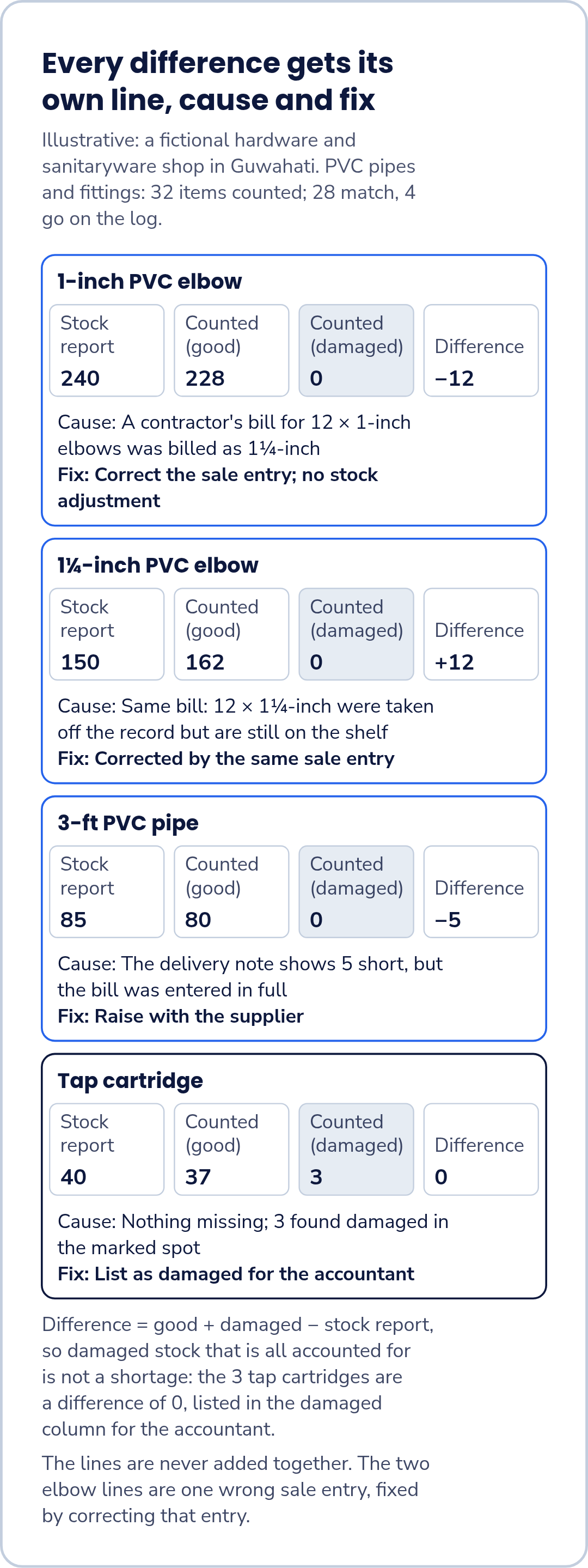
This month's group is PVC pipes and fittings: 32 items. The count shows 28 match the stock report with nothing damaged, and 4 need a line on the log (28 + 4 = 32): three with a difference and one with damaged stock.
| Item | Stock report | Counted (good) | Counted (damaged) | Difference | Cause | Fix |
|---|---|---|---|---|---|---|
| 1-inch PVC elbow | 240 | 228 | 0 | −12 | A contractor's bill for 12 × 1-inch elbows was billed as 1¼-inch | Correct the sale entry; no stock adjustment |
| 1¼-inch PVC elbow | 150 | 162 | 0 | +12 | Same bill: 12 × 1¼-inch were taken off the record but are still on the shelf | Corrected by the same sale entry |
| 3-ft PVC pipe | 85 | 80 | 0 | −5 | The delivery note shows 5 short, but the bill was entered in full | Raise with the supplier |
| Tap cartridge | 40 | 37 | 3 | 0 | Nothing missing; 3 found damaged in the marked spot | List as damaged for the accountant |
The elbows. The two lines look like they cancel out, but they are two errors from one wrong sale entry. Correcting the bill from 1¼-inch to 1-inch fixes both. No stock adjustment is made.
The pipe. The books show 5 more pipes than were ever received. The owner raises it with the supplier, attaching the delivery note.
Difference = good + damaged − stock report, so damaged stock that is all accounted for does not show as a shortage.
The tap cartridges. 37 good on the shelf, 3 damaged in the marked spot: 37 + 3 = 40, which matches the stock report, so the difference is 0. Nothing is missing, but 3 can't be sold. They still go on the log, in the damaged column, for the accountant.
Why each line stays separate. Added together, the differences come to −12 + 12 − 5 + 0 = −5. That total is not a result and is not stock lost: it hides the fact that three items were wrong for two different reasons, and that 3 cartridges can't be sold. None of that is solved by changing a total.
Count sheet and difference log
Count sheet, filled in by the counter before seeing the stock report:
| Item | Unit | Location (shop / godown / damaged spot) | Counted | Counted by | Time |
|---|---|---|---|---|---|
Difference log, kept for your accountant:
| Item | Stock report | Counted (good) | Counted (damaged) | Difference | Cause | Fix | Who decided |
|---|---|---|---|---|---|---|---|
Send the difference log to your accountant with your usual records.
Talk through your books in a demo
If you would like to talk through how your business keeps its books, request a demo and choose "Book a demo" on the form. FastComply Books is in an invitation pilot in India, so the demo is where we confirm what is available for your business.