Once a month, account for every container you own:
Owned = godown + vehicles + with customers (per register) + broken set aside
Count what is in the godown and on the vehicles, take what your register says is with customers, count any broken ones set aside, and compare the total with the number you own. If there is a difference, write it down and look for the cause, starting in your own godown and yard, before you change anything or blame a customer. The figure for what is with customers comes from a simple register for each customer, filled from the delivery slip, and confirming balances with your largest customers helps you find the differences while both sides still remember.
This works on paper or in a spreadsheet, with no app, whether your containers are 20-litre jars, crates, drums, cans or cylinders.
How containers go missing
A driver writes jars out and empties back on the delivery slip, but the delivery slip reaches the office a day late, or not at all. A customer keeps a few extra jars through a busy week. Broken ones are stacked behind the godown and nobody writes them up. Each driver knows their own route this week, but nobody knows the total until a customer stops ordering and their containers do not come back.
The customer register
One row per customer per container type, per month:
- opening balance (what the customer held at the start of the month)
- sent full
- empties back
- closing balance: opening + sent full − empties back
- the delivery slip numbers the figures came from
Note any deposit on the customer's row. If you take deposits on containers, ask your accountant how they are recorded.
The delivery slip
The delivery slip is where every figure in the register comes from. At each stop, the driver writes how many went out full and how many empties came back, and the customer signs or initials it. The office enters the slips the same day if it can. A delivery slip that has not reached the office is chased the next morning, because a missing delivery slip shows up later as containers nobody can find.
The month-end owned count
On the last working day of the month, or whichever day suits your delivery cycle:
- Count the containers in the godown.
- Count the containers on the vehicles.
- Take the total of customers' closing balances from the register.
- Count the broken containers set aside.
Then compare:
Owned = godown + vehicles + with customers (per register) + broken set aside
If the two sides do not agree, write the difference on the count sheet. Do not change the register to make it agree. Find the cause first: delivery slips not yet entered, a customer's balance that is wrong, or containers sitting somewhere nobody counted.
Confirming balances with customers
Each month, confirm balances with your largest customers: send each one their closing balance as a message, or ask them to sign a delivery slip showing it. Where a customer's count differs from yours, follow it up within the week, while the deliveries are still fresh in everyone's memory. You can confirm a customer's container balance at the same time as their payment balance.
If a supplier's statement also shows the containers you hold of theirs, check that count against your own register in the same way.
Customers who stop ordering
When a customer stops ordering, put their closing balance on a "to collect" list the same week, with the customer's name, the number of containers and who will collect them. Remove a row from the list only when the containers are back in the godown.
Worked example: a water-jar distributor's October
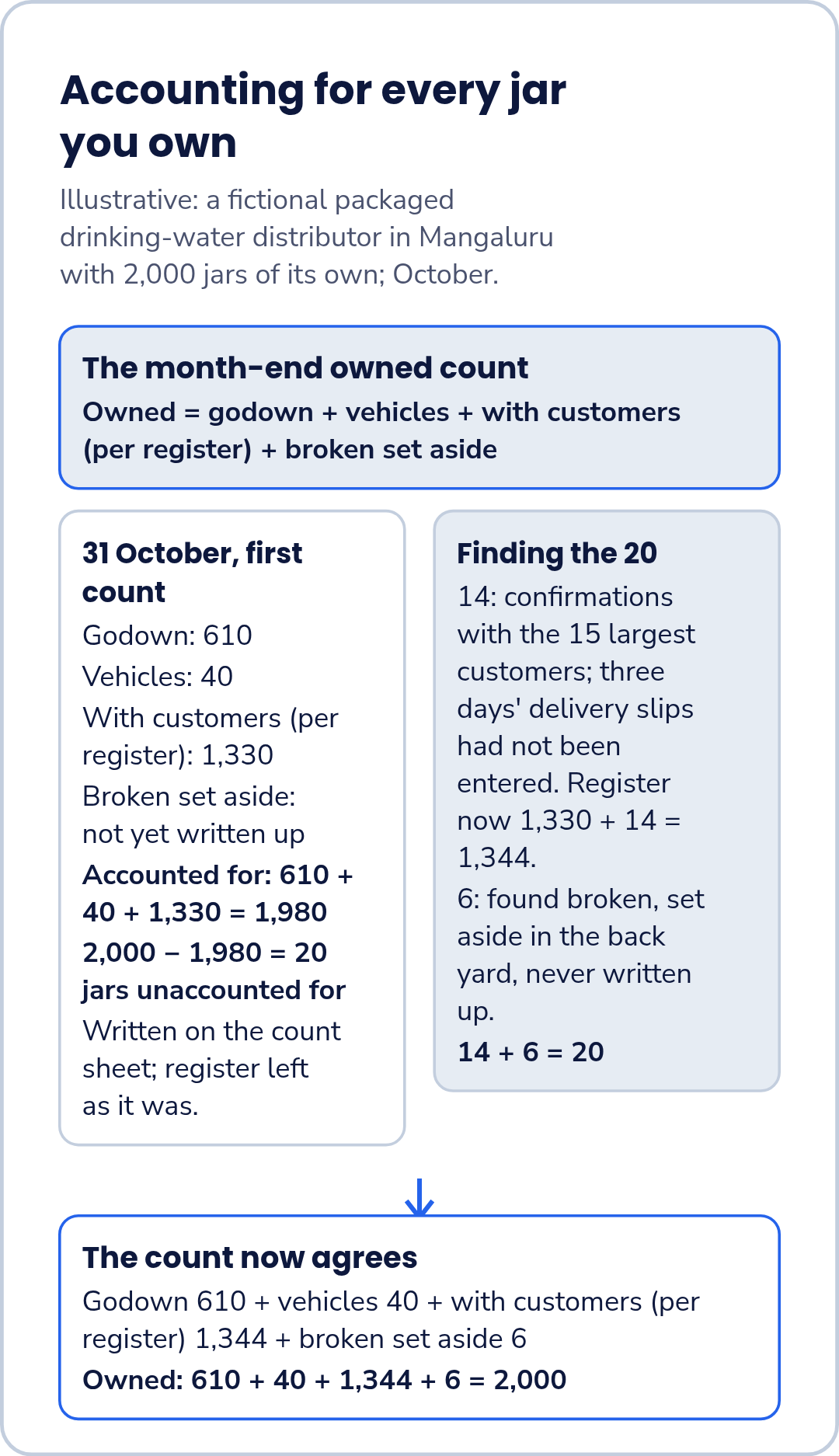
Illustrative example: a fictional packaged drinking-water distributor in Mangaluru with 2,000 jars of its own; October.
The distributor delivers 20-litre jars to about 140 offices and shops. October's register, as entered by the office, showed:
| Register line | Jars |
|---|---|
| Opening with customers | 1,260 |
| Sent full | 3,480 |
| Empties back | 3,410 |
| Closing with customers | 1,330 |
1,260 + 3,480 − 3,410 = 1,330.
On 31 October the owner counted:
| Where | Jars |
|---|---|
| Godown | 610 |
| Vehicles | 40 |
| With customers (per register) | 1,330 |
| Total accounted for | 1,980 |
| Owned | 2,000 |
| Difference | 20 |
610 + 40 + 1,330 = 1,980, and 2,000 − 1,980 = 20 jars unaccounted for. The owner wrote the 20 on the count sheet and left the register as it was.
Confirmations with the 15 largest customers showed 14 more jars with three customers than the register said: three days' delivery slips had not been entered. Once those slips were entered, the register showed 1,344 with customers.
1,330 + 14 = 1,344. Because those delivery slips were missing, October's sent-full and empties-back figures above were also incomplete until those slips were entered.
The remaining 6 jars were found broken, set aside in the back yard and never written up. They are now written up on the count sheet. 14 + 6 = 20, and the count now agrees:
| Where | Jars |
|---|---|
| Godown | 610 |
| Vehicles | 40 |
| With customers (per register) | 1,344 |
| Broken set aside | 6 |
| Owned | 2,000 |
610 + 40 + 1,344 + 6 = 2,000. Who signs off the broken pile each month is worth deciding as part of your simple controls.
Register and owned-count sheet
Customer register (one row per customer per container type, per month)
| Customer | Container type | Opening balance | Sent full | Empties back | Closing balance | Delivery slip numbers | Deposit noted (if any) |
|---|---|---|---|---|---|---|---|
Month-end owned count
Date: [ ]          Container type: [ ]          Counted by: [ ]

Godown                          [ ]
Vehicles                        [ ]
With customers (per register)   [ ]
Broken set aside                [ ]
Total accounted for             [ ]
Owned                           [ ]
Difference                      [ ]   Cause found: [ ]
To collect
| Customer | Container type | Number | Collect by | Collected on |
|---|---|---|---|---|
Keeping count of what comes back?
If you would like to hear about FastComply Books for your business, you can request early access. FastComply Books is in an invitation pilot in India and public sign-up is not open yet.