A month-end close should leave you able to say three things: the month's activity is recorded, every bank balance and customer balance can be explained, and the open questions have owners. In a service business, the awkward items are often work finished but not billed, supplier bills that arrive late, and customer payments not yet matched to invoices.
This checklist covers the work an owner or bookkeeper can do in-house. It does not decide accounting treatment. Where a decision is needed, such as which month some income or cost belongs to, the checklist tells you what facts to collect and leaves the decision to your accountant. The examples are fictional, and this is not a tax or filing calendar.
1. Set the timetable and the roles
Fix the period end and an internal target for finishing. For example, a business might aim to close April by the fifth working day of May. That is a management target, not a legal deadline. Name who collects documents, who prepares the entries and who reviews the exceptions. In a small business, two of these roles may fall to the same person, but the reviewer should not be checking only their own work.
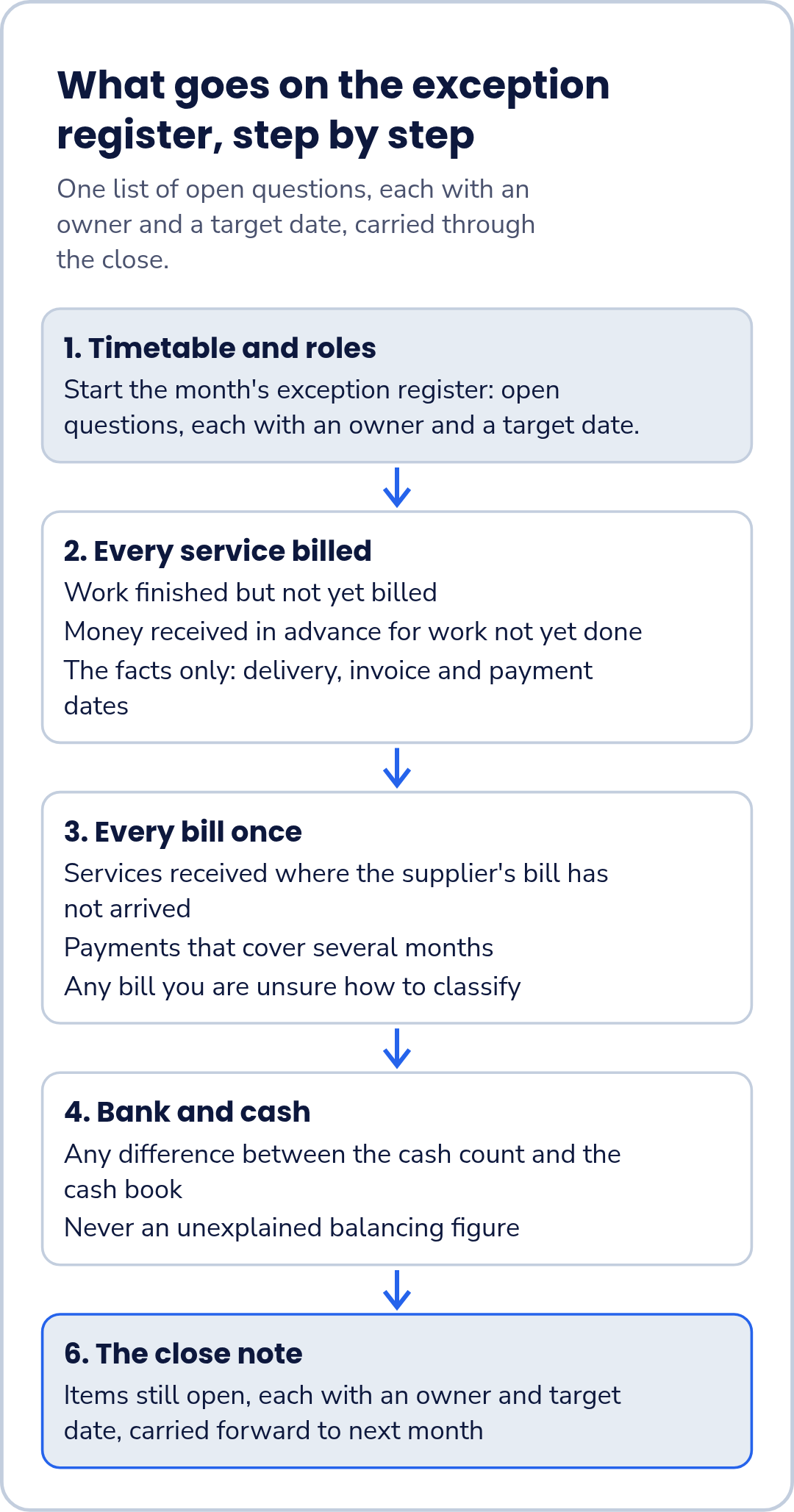
Keep one folder per month for sales invoices, bills and receipts, bank statements, and an exception register: a simple list of open questions, each with an owner and a target date.
Fictional example. A five-person consultancy keeps its exception register as a shared sheet. Midway through the April close it has three lines:
- Office rent of ₹45,000 paid on 5 April; the landlord's bill has not arrived. Owner: Kavya (bookkeeper). Target: 6 May.
- ₹1,25,000 received on 28 April with no invoice reference in the bank narration. Owner: Arjun (partner). Target: 7 May.
- No internet bill for April; the last one received was for March. Owner: Kavya. Target: 6 May.
Each line says what is missing, who will chase it and by when, so the close does not stall on one person's memory.
2. Check that every service delivered has been billed
Compare the invoice register with what was actually delivered: completed jobs, approved timesheets or agreed milestones. Then check:
- invoice numbers run in sequence, with any gaps or cancellations explained
- customer names, dates and amounts match the engagement
- each credit note or cancellation has a documented approval
- disputed invoices stay on the list until the dispute is settled
Make a list of work finished but not yet billed, and a separate list of money received in advance for work not yet done. Do not change invoice or receipt dates to make the month look different.
Fictional example. An IT support firm finishes an engagement on 29 April and invoices it on 3 May. Another customer pays on 25 April for work to be done in May. Record both sets of facts (delivery date, invoice date, payment date and what the payment was for) on the exception register. Which month the income belongs to is a question for your accountant, under the accounting policy your business follows.
3. Collect every bill once
Gather bills from email, shared folders, paper copies received by courier and staff expense claims. Compare recurring costs against last month: rent, software subscriptions, professional fees, utilities and phone bills. A missing recurring cost often means a missing bill.
Two checks prevent double counting:
- the same bill has not been entered once from the email copy and again from the bank payment
- every payment record carries the supplier's bill reference
A bank debit records that money left the account, but not what the payment was for or which month the cost belongs to. Put these items on the exception register for your accountant:
- services received this month where the supplier's bill has not arrived
- payments that cover several months, such as an annual subscription or insurance
- any bill you are unsure how to classify
4. Reconcile every bank account and cash
For each business bank account, compare the complete statement with the bank ledger for the same period, starting from last month's reconciled balance. Match receipts, payments, charges and transfers, then explain every remaining difference. Never add an unexplained balancing figure to make the two agree.
Transfers between your own accounts should appear in both ledgers as transfers, not as income in one and an expense in the other. If the business keeps cash, count it, compare the count with the cash book and record any difference on the exception register.
5. Review what customers owe and what you owe
Allocate this month's receipts and credit notes to invoices before you review overdue balances, so nobody is chased for an invoice already paid. For each overdue invoice, record the remaining balance, the due date, the reason it is unpaid and the next action.
For suppliers, compare your balances with their statements where you have them, and separate disputed bills from bills simply awaiting approval for payment.
6. Review the reports, then write a close note
Compare the month's profit and loss with the previous month and with what you expected. Look for missing recurring costs, unusual margins and accounts with a balance on the wrong side (for example, cash in hand below zero, or a customer who appears to have paid more than was billed with no advance to explain it). Then look at the balance sheet: a sensible profit figure does not prove that bank, customer or advance balances are right.
Finish with a one-page close note:
- main changes from last month and their reasons
- items still open, each with an owner and target date
- questions sent to the accountant, and their answers once received
- who prepared the close, who reviewed it and the date
After the close, agree with your accountant how any change to a closed month will be approved and recorded, and keep the evidence for each later change.
Questions to take to your accountant each month
- Which month does income belong to for work finished but not yet billed, and for advances received?
- How should services received without a bill, and payments covering several months, be recorded?
- How should credit notes, disputed invoices and long-overdue balances be handled?
- Are any corrections needed from the bank and cash reconciliations?
Reusable checklist
- Fix the period end, the internal target and who does what.
- Check invoices against work delivered; list unbilled work and advances.
- Collect every bill once; list late bills and multi-month payments.
- Reconcile every bank account and count cash; explain every difference.
- Allocate receipts, then review overdue customer and supplier balances.
- Review profit and loss and the balance sheet for anything unexpected.
- Send the open questions to your accountant and record their answers.
- Write the close note and carry unresolved items forward with owners.
If you would like to see how FastComply Books could support a monthly close shared with your accountant, request a demonstration, choose 'Book a demo' on the form and ask which workflows are currently available for your business.