When you find a mistake in an entry that has already been posted, do not open it and change it, and do not delete it. Leave the original in place and record a correction that refers to it, with a short note saying what was wrong, what was done, who did it and who checked it. If the month is already closed, a report or return was prepared from it, tax figures are affected, or you are not sure it is a mistake at all, ask your accountant before you change anything.
Why editing or deleting causes trouble later
Changing the original entry can leave the final balance looking right. What it loses is the history. Last month's report was sent with the old figure. The bank reconciliation was done against it. Your accountant may already have worked from it. When the original silently changes, nobody can see why the figures they were given no longer match the books, and the next person to look has to work it out from scratch.
A visible correction answers that question in advance: here is the original, here is what was wrong, here is the fix, and here is who agreed it.
Four common mistakes
| Mistake | Example |
|---|---|
| Wrong ledger | A rent bill posted to repairs |
| Wrong amount | ₹18,500 keyed as ₹15,800 |
| Wrong date or period | A bill dated in one month entered in the next |
| Posted twice | A supplier bill keyed in from the invoice, then entered again from its payment |
A tip for amount errors: two swapped digits in a whole-rupee amount always produce a difference divisible by 9. In the example above the difference is ₹2,700 (₹18,500 − ₹15,800), which is 9 × ₹300. A difference divisible by 9 does not prove a swap; it only tells you where to look first.
Correct, don't erase
The rule is the same for all four: keep the posted entry and record a correction that refers to it. There are two common ways to do that:
- reverse and re-enter: cancel the original with an equal and opposite entry, then enter it again correctly; or
- a correcting entry: one entry that adjusts the original to what it should have been.
Which method is used is your accountant's choice. Either way, the original stays visible and the correction points back to it.
Reversing a duplicate is a correction too. The duplicate stays in the books with its reversal beside it, so anyone can see it was entered twice and put right.
Your accountant can tell you whether any record-keeping rules apply to your business.
The correction note
Write a note for every correction, and keep it with the correction itself or in your corrections list:
Correction note

What was wrong:
Original entry (reference, date, amount):
What was done:
Date of correction:
Done by:
Checked by:
Evidence attached:
"Checked by" should be someone other than the person who made the correction, where you can.
When to stop and ask your accountant first
Do not make the correction yourself if any of these apply:
- the month is already closed, or reports for it have been sent;
- a return or other report was prepared from the figures;
- the correction would change tax figures;
- it is a judgement rather than a clear error, such as which ledger an unusual item belongs in.
In these cases, write the correction note up to "What was wrong" and send it to your accountant. They decide how the correction is made and on what date.
If none of these apply (the month is still open and the error is clear, such as an obvious duplicate), correct it in the way you have agreed with your accountant for open months, and still write the note.
Worked example: a furniture maker in Ludhiana
Illustrative example: a fictional furniture maker in Ludhiana. All details and amounts are invented.
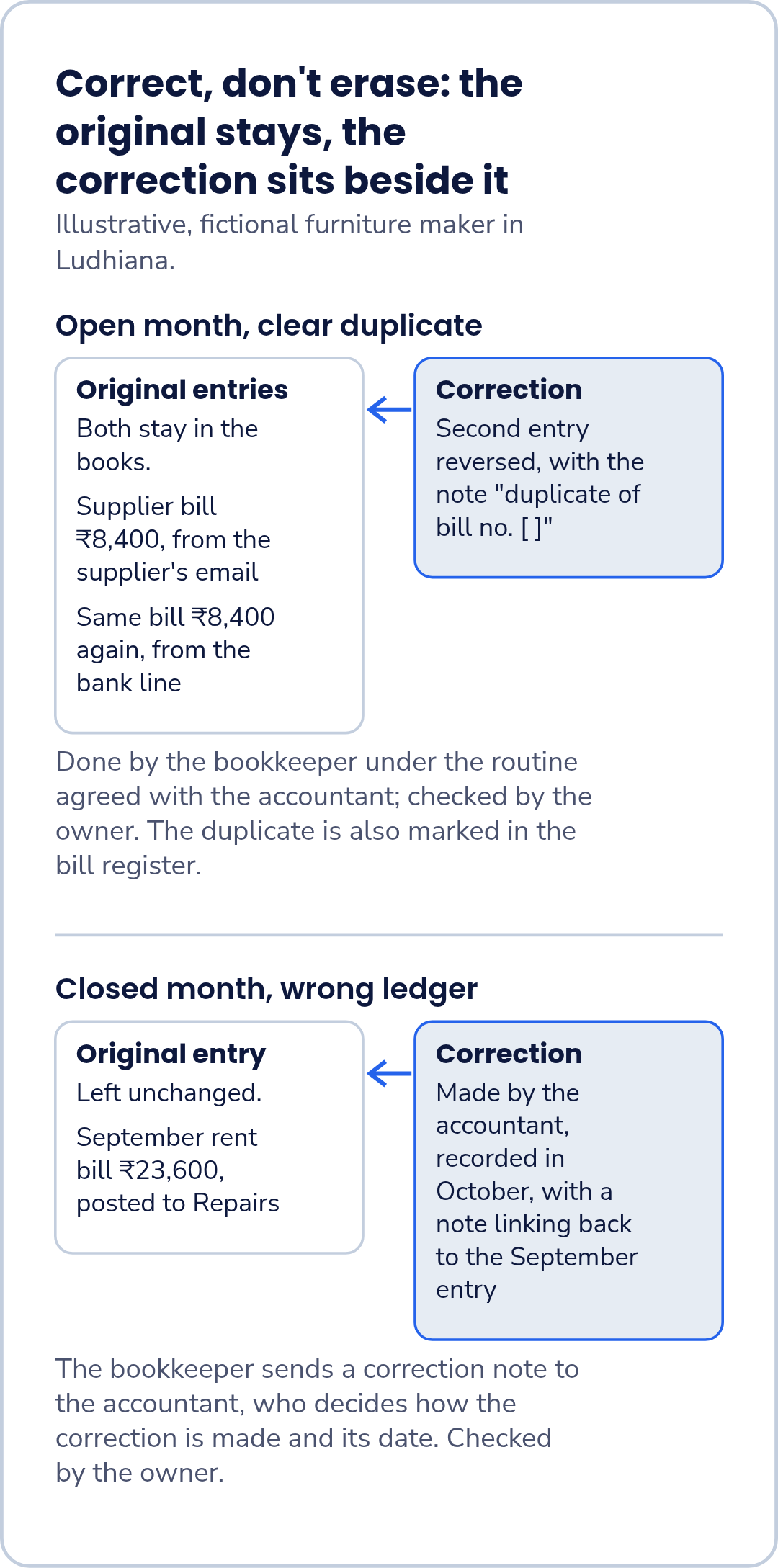
A rent bill in the wrong ledger, in a closed month. In October the bookkeeper notices that a ₹23,600 rent bill for September was posted to "Repairs". September has been closed and its P&L has already gone to the owner. The bookkeeper does not open the September entry. They fill in the correction note with what was wrong and the original reference, and send it to the accountant.
The accountant decides how the correction is made and its date. In this example, the correction is recorded in October, so October's report shows the change, and the note links back to the original September entry. The owner can see why the repairs and rent figures they were sent for September differ from what the books now show.
A bill entered twice, in an open month. A ₹8,400 supplier bill was entered twice in October, once from the supplier's email and once from the bank line. October is still open and the bookkeeper is sure it is a duplicate. Following the routine already agreed with the accountant for clear duplicates in an open month, they reverse the second entry with the note "duplicate of bill no. [ ]", and the owner checks it. The bookkeeper also marks the duplicate in the bill register.
| Original | Problem | What was done | Decided by | Checked by |
|---|---|---|---|---|
| September rent bill, ₹23,600 | Posted to Repairs; month closed | Sent to the accountant, who made the correction | Accountant | Owner |
| October supplier bill, ₹8,400 | Entered twice; month open | Second entry reversed with a note | Bookkeeper, under the agreed routine | Owner |
Keep a corrections list
Collect every correction note in one list and go through it with your accountant when you next review the books together, for example at each month-end. The list shows what was fixed and why. If the same kind of mistake keeps appearing, such as a supplier often posted to the wrong ledger or bills often entered twice, fix the cause rather than correcting it again each time.
Discuss your correction routine in a demo
This habit works in any accounting software or on paper. If you're evaluating FastComply Books, ask in a demo how corrections would be recorded for your business and what is currently available. Request a demo and choose "Book a demo" on the form. FastComply Books is in an invitation pilot in India, so the demo is where we confirm what is available for your business.