Agree four things with your accountant and write them on one page: who prepares, checks and approves each part of the monthly work, and who only needs to be told; which decisions stay with you as the owner; one place where every question is logged until it is answered; and the dates you are both working to. Once it is agreed, both sides have the same answer to "who is doing this?"
Why "the accountant handles it" is not enough
An external accountant can record and check your books and advise you on them. What they cannot do is know things only you know, or make decisions that are yours to make: whether to pay a supplier this week, whether a customer's dispute is settled, what an unexplained receipt was for. When nobody has written down where those decisions sit, questions wait in chat threads, the accountant waits for answers, and you wait for numbers.
Writing it down is not about managing your accountant. It is about making the hand-offs between you visible.
The who-does-what table
For each kind of work, put a name in four columns:
- Prepares: does the work.
- Checks: looks over it before it is relied on.
- Approves: says yes, it can go ahead or be treated as final.
- Is told: needs to know, but does nothing.
Here is one possible arrangement for a business with an in-house clerk and an external accountant. Yours will differ; fill it in together.
| Work | Prepares | Checks | Approves | Is told |
|---|---|---|---|---|
| Sales invoices | Clerk | Owner | Owner | Accountant |
| Purchase bills | Clerk | Accountant | Owner | |
| Bank and cash lines | Accountant | Clerk | Accountant | Owner |
| Payments to suppliers | Clerk | Owner | Owner | Accountant |
| Unusual items | Owner explains | Accountant | Accountant advises, owner decides | Clerk |
| Monthly reports | Accountant | Owner | Owner | Clerk |
| Corrections to a month already closed | Accountant | Owner | Owner, on the accountant's advice | Clerk |
If a row has the same name in Prepares and Checks, ask whether someone else could check it. If a row has no name at all, that is the gap to fill first.
Decisions that stay with the owner
Some decisions are about the business, not about the books. In the arrangement suggested here, the owner keeps these:
- releasing payments to suppliers and staff;
- agreeing how a customer or supplier dispute is settled;
- deciding whether to stop pursuing an amount a customer owes;
- approving a correction to a month that has already been closed;
- explaining unusual receipts and payments.
The accountant advises on how each of these is recorded. In this arrangement, how an item is treated in the accounts is their call. Write down which is which, so neither of you waits for the other to decide.
The shared query log
Every question between you and your accountant goes into one log, whichever way it was first asked. Keep it as a shared sheet, or as a table one person updates and circulates; any tool works.
| # | Raised on | Raised by | Question | Who answers | Answered on | Days open |
|---|---|---|---|---|---|---|
"Days open" is the number of calendar days from Raised on to Answered on, or to today's date if it is still open.
Our own rule of thumb, not a standard: anything open more than two weeks goes on the agenda the next time you and your accountant review the books together. Pick a different trigger if it suits you better, but pick one.
The one-page "how we work" note
Put the agreement on a single page that you and your accountant both keep. A template:
How we work: [Business name] and [Accountant / firm]
Agreed on: [date]          Next review: [date]

1. People
   Owner: [name, phone, email]
   In-house: [name, role, phone, email]
   Accountant: [name, firm, phone, email]

2. Who does what
   [the four-column table]

3. Decisions that stay with the owner
   [the list]

4. Records each month
   Sent by: [date you agree]   Sent to: [email / shared folder]
   (What goes in the monthly pack is a separate checklist.)

5. Questions
   All questions go into the query log at [location].
   Reviewed together: [when]. Items open more than [two weeks] are discussed first.

6. What we never send
   Passwords, OTPs, PINs or full card numbers, by any channel.
The dates in it are internal targets you agree with your accountant, not legal deadlines.
Worked example: a trading business in Tiruppur
Illustrative example: a fictional light-trading business in Tiruppur with one accounts clerk and an external accountant. All details and figures are invented.
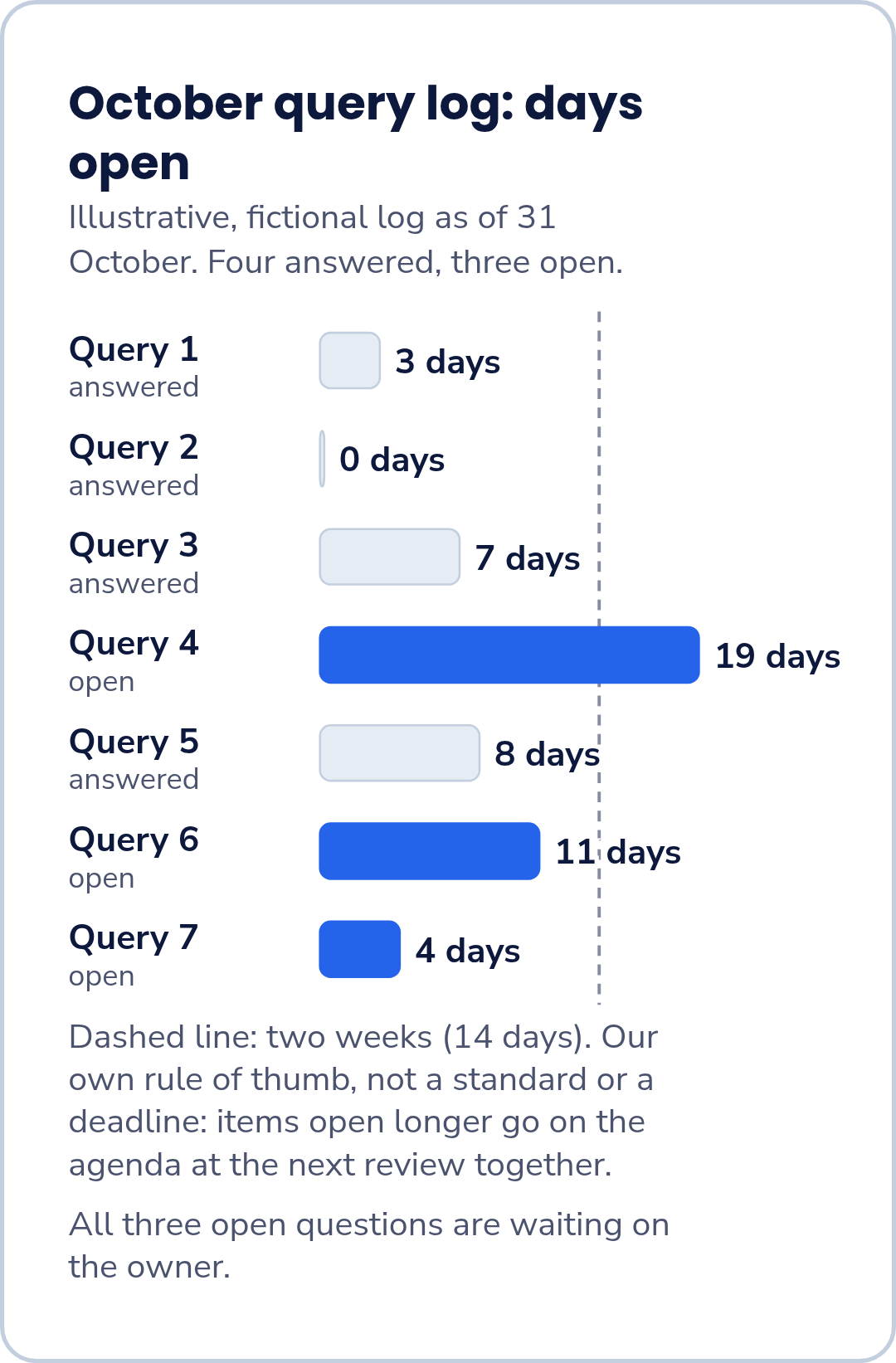
The owner, the clerk and the accountant fill in the who-does-what table much as shown above. The query log for October, as of 31 October:
| # | Raised on | Raised by | Question | Who answers | Answered on | Days open |
|---|---|---|---|---|---|---|
| 1 | 3 Oct | Accountant | Bill missing for a transport payment | Clerk | 6 Oct | 3 |
| 2 | 5 Oct | Clerk | New supplier added this month: how do you want it set up in the books? | Accountant | 5 Oct | 0 |
| 3 | 8 Oct | Accountant | A customer credit note: is it approved? | Owner | 15 Oct | 7 |
| 4 | 12 Oct | Accountant | A ₹48,000 receipt with no customer name: who paid it, and for what? | Owner | Open | 19 |
| 5 | 14 Oct | Accountant | Supplier statement shows a bill not in our records | Clerk | 22 Oct | 8 |
| 6 | 20 Oct | Clerk | A supplier bill was paid twice: should we ask the supplier for a refund, or agree that they deduct it from the next bill? | Owner | Open | 11 |
| 7 | 27 Oct | Accountant | Staff advance: has it been repaid? | Owner | Open | 4 |
Seven queries in the month: four answered, three open. Query 4 has been open 19 calendar days (12 October to 31 October), so under the two-week rule of thumb it goes first on the agenda. Queries 6 and 7, at 11 and 4 days, wait for the normal review. Query 6 is a business decision for the owner; once it is made, how it is recorded is the accountant's call.
What the log shows is a pattern, not a problem with any one person: all three open questions are waiting on the owner. So the useful next step is for the owner to set aside time to answer them, starting with who sent the ₹48,000.
Review the arrangement
The table and the note are a starting point. Look at them together with your accountant at an interval you agree, and again whenever something changes: a new clerk, a new accountant, a new bank account, a new line of business. If the query log keeps showing the same kind of question, change the table or the note so the answer is settled once.
Discuss working with your accountant in a demo
If you would like to talk through how you and your accountant divide the monthly work, and ask whether FastComply Books currently supports that routine for your business, request a demo and choose "Book a demo" on the form. FastComply Books is in an invitation pilot in India, so the demo is where we confirm what is available for your business.