Give every tool, phone and laptop you hand out a number. Keep one kit list per person, signed by them and by a supervisor, and a board list for shared tools showing who has each one now. Write down every move and every repair. Every few months, check where each item is and mark it seen, at repair, with someone else, or missing. A few days before someone's last day, go through their kit list with them, while anything not found can still be looked for.
Why tools go missing without anyone taking them
In a workshop, tools move all day. A mechanic borrows a socket set from the next bay and drops it in his own box. A scanner goes out for repair and nobody notes when. A spare phone sits in a drawer after an adviser leaves. Nothing is taken; it simply stops being clear who has what. By the time someone needs the item, nobody remembers where it went.
Signing tools out and back in, signed lists per person, returning items before someone's last day, a regular check for anything missing and checking that a kit is complete against its list are all common practice. This page puts them into one routine for a small workshop without software: in the regular check, a personal kit counts as seen only when every tool on its list is there; shared tools sit on a board next to the personal kits; and the register records only where each item is, using four marks rather than condition grades.
Mark and number what you issue
Mark each item with paint or a tag, and give it an ID: for example K-01 for a personal toolkit, S-12 for a shared tool, P-03 for a phone. A personal toolkit is one item on the register; the tools inside it are on that person's kit list.
Items that are also assets in your books keep their asset-register reference next to the ID.
One kit list per person, signed
One page per person, with:
- item ID;
- description;
- date issued;
- condition when issued;
- the person's signature, and the supervisor's.
Shared special tools that do not belong to one person go on their own board or shelf list, with a "who has it now" column that is updated each time a tool is taken or put back.
Write down every move and repair
When an item goes to another person or out for repair, write one line on both lists: from, to and the date. File the repair slip against the item's ID. The lists then show where each item is without anyone having to remember.
It helps if the person who checks the kits is not the person who holds the store key.
The "show your kit" check
Every few months, for example once a quarter, ask everyone to show their kit, and check the shared-tool board. Give every item on the register one mark:
| Mark | What you record |
|---|---|
| seen | Nothing more. A personal kit counts as seen only when every tool on its kit list is there; a tool that isn't goes on the kit list with its own mark. |
| at repair | The repair slip is on file |
| with someone else | Move it to that person's list, or for a shared tool update "who has it now" on the board, with the date |
| missing | The date noticed, the last known holder, and the cost in your records |
"Missing" is a record, not a finding against anyone. If something isn't returned, talk to your accountant or labour adviser before deciding anything about pay.
If an item was stolen or damaged and you have insurance, it may also belong in a claim file.
Before someone's last day
A few days before a person leaves, go through their kit list with them, item by item. Anything not in their box can still be looked for while they are there. When every item is accounted for, both of you sign the completed list, and it goes into the handover file.
Worked example: a two-wheeler service garage in Puducherry
Illustrative example: a fictional two-wheeler service garage in Puducherry; October check; verify independently. The garage has 9 mechanics and 2 service advisers, all working in-house. All details are invented.
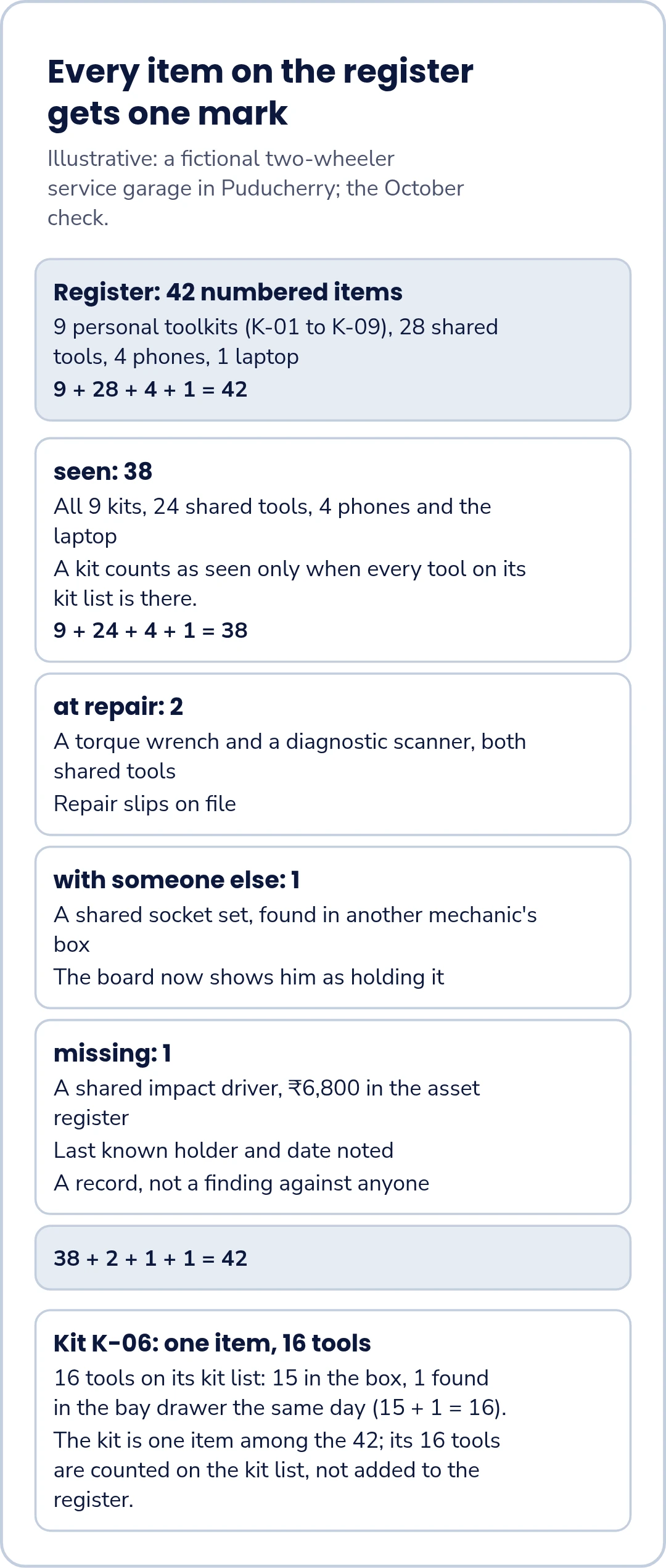
Register: 42 numbered items: 9 personal toolkits (K-01 to K-09, each one item, with its contents on the person's kit list), 28 shared tools, 4 phones and 1 laptop.
9 + 28 + 4 + 1 = 42.
The October check:
| Mark | Items |
|---|---|
| seen | 38 |
| at repair | 2: a torque wrench and a diagnostic scanner, both shared tools, slips on file |
| with someone else | 1: a shared socket set, found in another mechanic's box; the board now shows him as holding it |
| missing | 1: a shared impact driver, ₹6,800 in the asset register; last known holder and date noted |
| Total | 42 |
Seen: all 9 kits, 24 shared tools, 4 phones and the laptop (9 + 24 + 4 + 1 = 38).
Shared tools seen: 28 − 4 = 24. All items: 38 + 2 + 1 + 1 = 42.
A mechanic leaving on 31 October. The check of his kit (K-06; 16 tools on his kit list) was done with him on 28 October. Fifteen tools were in his box; the sixteenth, a spark-plug socket, was found in the bay drawer the same day.
15 + 1 = 16.
His kit is one item among the 42; the 16 tools are the contents listed on his kit list, so they are counted on that list, not added to the register total. Once all 16 are back, both sign the completed list for the handover file, and K-06 goes to the store; the register shows it there until the next person signs for it.
Templates
Kit list (one per person):
Name: ______ Kit ID: ______
| Item ID | Description | Date issued | Condition | Person's signature | Supervisor's signature |
|---|---|---|---|---|---|
Shared-tool board:
| Item ID | Description | Who has it now | Taken on | Put back on |
|---|---|---|---|---|
Check sheet:
Date of check: ______
| Item ID | Holder on the list | Mark (seen / at repair / with someone else / missing) | Note |
|---|---|---|---|
Keeping your business records in order?
If you would like to hear about FastComply Books for your business, you can request early access. FastComply Books is in an invitation pilot in India and public sign-up is not open yet.