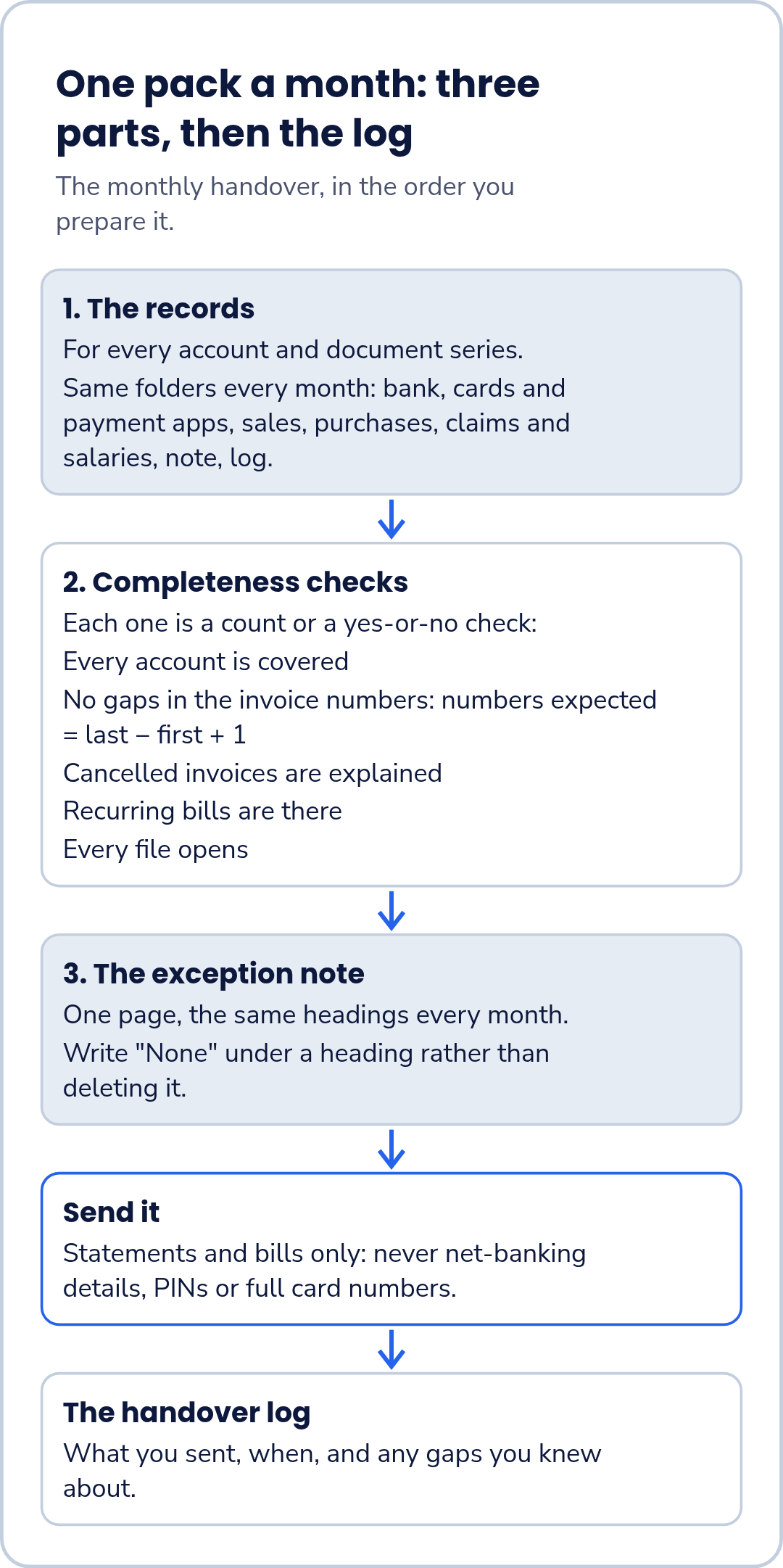
Send your accountant one pack each month with three parts: the records for every account and document series, a completeness check you have done yourself, and a one-page note of things only you know. Keep a short log of what you sent, when, and any gaps you knew about. When the pack is checked before it leaves you, your accountant starts from a more complete set of records, and fewer of the questions that come back are about missing files.
This is a manual routine that works with any accounting software, a spreadsheet or a shared folder. Use the list as a starting point and ask your accountant what to add or drop for your business.
The pack: what to include
| Record | Why your accountant needs it | Where it usually comes from |
|---|---|---|
| Statement for every business bank account | Receipts and payments in the books are checked against it | Net-banking download or the bank's emailed statement |
| Statement for each business credit card | Card spends may have no other record | Card portal or emailed statement |
| UPI or payment-app settlement reports, if customers pay you that way | Shows which customer payments make up each credit | Payment app or payment-gateway dashboard |
| Sales invoices for the month, including cancelled invoices and credit notes issued | Sales are recorded from these, and the number series is checked for gaps | Billing software, spreadsheet or invoice book |
| Purchase bills, expense receipts and any credit notes from suppliers | Support each expense and each supplier's balance | Email, supplier portals, paper bills |
| Staff expense claims with receipts | Explain reimbursements paid from the bank | Whoever approves claims |
| Salary or wages summary, if you pay staff | Explains salary payments leaving the bank | Whoever prepares the salary payments |
| Cash book or petty-cash sheet, if you handle cash | Cash does not appear on any bank statement | Whoever keeps the cash |
| Exception note (below) | Covers what the documents cannot explain | You |
If a row does not apply, say so in the exception note. "No cash transactions this month" is useful information; a missing file with no explanation becomes a query.
Completeness checks before you send
You do not need accounting knowledge for these. Each one is a count or a yes-or-no check.
- Every account is covered. List every bank account, card and payment app the business uses. Tick off one statement for each, covering the whole month.
- No gaps in the invoice numbers. For each invoice series, note the first and last number used this month. Numbers expected = last − first + 1. Count the invoices you have. If the counts differ, find which numbers are missing and why.
- Cancelled invoices are explained. If an invoice was cancelled, send a copy marked "cancelled" so the accountant can see why that number has no sale against it.
- Recurring bills are there. Put last month's pack beside this one and check that each regular supplier appears again: the landlord, the internet and phone providers, each software subscription and your accountant's own fee. If one is missing, find out whether it has arrived before you send the pack.
- Every file opens. Open each file once. A blank download or a statement that stops halfway is easier to fix now than after your accountant reports it.
The exception note
This is the part your accountant cannot get from anyone else. Keep it to one page and use the same headings every month:
Exception note: [Business name], [Month]

1. Unusual money in: advances from customers, refunds, money put in by the owner, anything you do not recognise
2. Personal spends paid from a business account or card
3. New loans or EMIs, assets bought or sold, new agreements (attach the document if you have it)
4. Disputes, cancelled invoices, invoices you expect to change, and work finished but not yet invoiced
5. New customers or suppliers, or changed details for existing ones
6. Missing records: what is missing, why, and when you expect it
7. Questions for you
Write "None" under a heading rather than deleting it, so your accountant knows you checked. Describe what happened; leave how it should be recorded to your accountant.
Sending it safely
Do not send net-banking passwords, OTPs, PINs or full card numbers to anyone, by email or chat. Your accountant needs statements and bills, not your login. The RBI has cautioned the public (press release, 13 September 2021) "not to share account login details, … card information, PIN, password, OTP, etc. with unidentified persons or agencies"; keeping login details to yourself is a sensible habit with people you know as well.
Some banks and card issuers send statements as password-protected PDFs. Agree with your accountant how to handle these. If you do share a file's password, send it separately from the file, for example by phone or message rather than in the same email.
Ask your accountant how they prefer to receive files, and how long you should keep each record.
The handover log
One table, kept with the monthly folders and reused every month:
| Month | Date sent | What was sent | Gaps noted when sent |
|---|---|---|---|
The log shows what went across and when, so nobody has to search old emails. After a few months it also shows which items are often late or missing; those are worth adding to your completeness checks.
Worked example: a design studio's October pack
Illustrative example: a fictional Chennai design studio. The business, people and numbers are invented.
The studio has three bank accounts, one business credit card and a single invoice series. Its office manager gathers the October pack and runs the checks:
| Check | Expected | Found | Result |
|---|---|---|---|
| Bank statements | 3 | 3 | Complete |
| Credit card statement | 1 | 0 | Card statement not downloaded |
| Invoice numbers DS-101 to DS-142 | 42 (142 − 101 + 1) | 41 | DS-119 missing |
| Purchase bills and receipts | Recurring bills, compared with September | 63 received | Recurring bills present |
The card statement had been emailed to the owner, not to the office. The office manager downloads it from the card portal and adds it.
DS-119. DS-118 and DS-120 are in the folder; DS-119 is not. The owner explains that DS-119 was raised for a client who then changed the scope of the work, and it was cancelled. The cancelled copy goes into the pack, so all 42 numbers are now accounted for: 41 invoices plus the cancelled DS-119.
Part of the October exception note:
- Unusual money in: an advance from a client for work starting in November.
- Personal spends: one personal purchase on the business card, marked on the statement.
- Cancelled invoices: DS-119, cancelled after a change of scope; copy attached.
- Missing records: none after the checks.
- Questions for you: none this month.
The log entry:
| Month | Date sent | What was sent | Gaps noted when sent |
|---|---|---|---|
| October | 4 November | 3 bank statements, 1 card statement, 41 invoices plus cancelled DS-119, 63 bills and receipts, exception note | None |
Both gaps were closed before the pack left the office, and the client advance is on the exception note, where only the owner could have put it.
Make it a routine
- One person owns it. Decide who prepares and sends the pack each month.
- A regular time. Prepare the pack at the same point each month, at a time that suits you and your accountant.
- The same folder layout every month. Use these folders: bank, cards and payment apps, sales, purchases, claims and salaries, note, log. Gaps are easier to spot when everything is always in the same place.
- Review the list together after two or three months. Use the log to agree what to add, drop or send differently.
An easier monthly handover for you both
Once your pack is routine, you may want to talk through how you and your accountant share and review records each month, and ask whether FastComply Books currently supports that routine for your business. FastComply Books is in an invitation pilot in India, so a demo is where we confirm what is available for your business. Request a demo and choose "Book a demo" on the form.