Give each outlet two lines, not one. First its own result: its sales, less the cost of goods it sold, less its own rent, staff and power. Then its result after shared costs: the costs paid once for all outlets, split on a basis you choose and write down. Then test the split: re-split the same month on two other bases and see whether the answer changes. If an outlet stays above zero on its own but falls below zero after shared costs, ask which shared costs would actually stop without it before you decide anything.
Why the shared costs decide the answer
Each outlet's sales are known, and its own rent and staff are easy to see. But some costs are paid once for all of them: a back office, an accounts person, a shared delivery rider, common advertising. How those are split can make an outlet look strong or weak, and often nobody has decided how to split them. A weak-looking outlet may simply be carrying a share nobody chose.
Splitting shared costs across a business's outlets, a branch-wise view, is common practice: read each outlet's own result before any shared cost, and write down the basis for each shared cost. What this page adds is a test of the split, and a question to ask before acting on it.
How outlets are shown in your accounts is your accountant's call. This sheet is a management view you build alongside your books. Running two separate businesses under one owner is a different question from running one business with several outlets, and this page does not cover it.
Each outlet's own result first
Own result = outlet sales − cost of goods sold at that outlet − the outlet's own costs
Own costs are the ones that belong to that outlet alone: its rent, its counter staff, its power bill. When you read the profit and loss statement, read this line first. It shows what each outlet earns before any split you choose.
List every shared cost and write down its basis
Make one row for each cost paid for all outlets:
- the cost;
- the monthly amount;
- the basis you chose to split it: equally, by each outlet's share of sales, or by a count the business already keeps, such as deliveries from the rider's log;
- why you chose that basis, in one line.
The basis is your choice; this page does not recommend one. Writing it down means anyone reading the sheet knows what the split rests on.
After shared costs = own result − the outlet's share of each shared cost
If you run a service business and want to see each client's own result instead, the client-wise view covers that.
Worked example: a phone-accessories retailer in Bhopal
Illustrative example: a fictional mobile-phone accessories retailer in Bhopal with three outlets; September figures; the bases are the owner's choices, not recommendations; verify independently. The business has 11 counter staff, one back office and one delivery rider shared by all three outlets. All details are invented.
Own result, September:
| Outlet | Sales | Cost of goods sold | Own costs (rent, staff, power) | Own result |
|---|---|---|---|---|
| A | ₹6,40,000 | ₹4,16,000 | ₹1,10,000 | ₹1,14,000 |
| B | ₹4,80,000 | ₹3,12,000 | ₹1,02,000 | ₹66,000 |
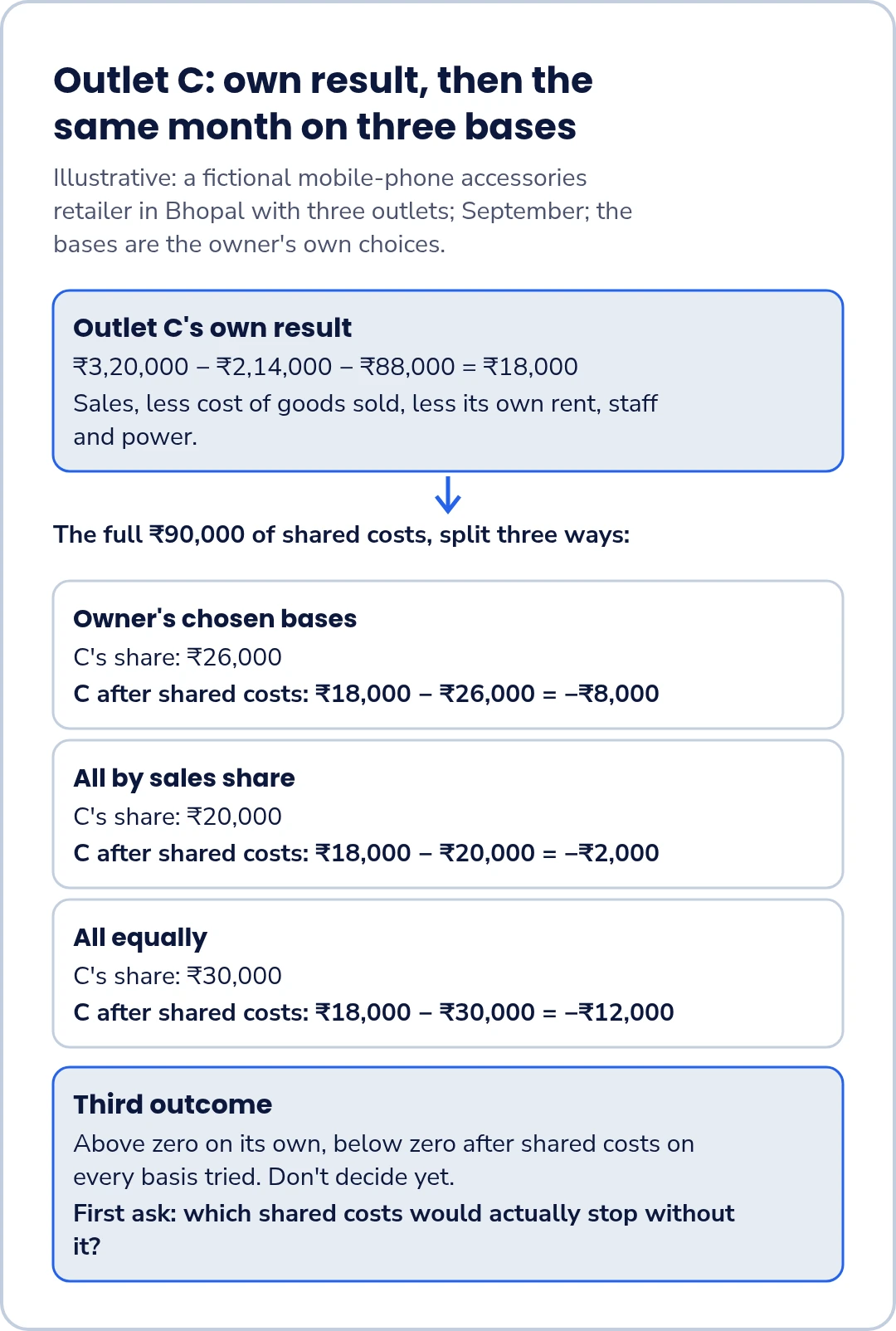
| C | ₹3,20,000 | ₹2,14,000 | ₹88,000 | ₹18,000 |
| Total | ₹14,40,000 | ₹9,42,000 | ₹3,00,000 | ₹1,98,000 |
A: ₹6,40,000 − ₹4,16,000 − ₹1,10,000 = ₹1,14,000. B: ₹4,80,000 − ₹3,12,000 − ₹1,02,000 = ₹66,000. C: ₹3,20,000 − ₹2,14,000 − ₹88,000 = ₹18,000. Total: ₹14,40,000 − ₹9,42,000 − ₹3,00,000 = ₹1,98,000.
Shared costs, ₹90,000, on the owner's chosen bases:
| Shared cost | Amount | Basis chosen | A | B | C |
|---|---|---|---|---|---|
| Back-office rent | ₹30,000 | Equal | ₹10,000 | ₹10,000 | ₹10,000 |
| Office and accounts staff | ₹45,000 | Sales share (6.4 : 4.8 : 3.2 lakh) | ₹20,000 | ₹15,000 | ₹10,000 |
| Delivery rider and fuel | ₹15,000 | Deliveries from the rider's log (120 : 60 : 120 of 300) | ₹6,000 | ₹3,000 | ₹6,000 |
| Shared per outlet | ₹90,000 | ₹36,000 | ₹28,000 | ₹26,000 |
Staff: ₹45,000 × 6.4 ÷ 14.4 = ₹20,000; × 4.8 ÷ 14.4 = ₹15,000; × 3.2 ÷ 14.4 = ₹10,000. Rider: ₹15,000 × 120 ÷ 300 = ₹6,000; × 60 ÷ 300 = ₹3,000; × 120 ÷ 300 = ₹6,000. A: ₹10,000 + ₹20,000 + ₹6,000 = ₹36,000. B: ₹10,000 + ₹15,000 + ₹3,000 = ₹28,000. C: ₹10,000 + ₹10,000 + ₹6,000 = ₹26,000.
After shared costs:
| Outlet | Own result | Shared costs | After shared costs |
|---|---|---|---|
| A | ₹1,14,000 | ₹36,000 | ₹78,000 |
| B | ₹66,000 | ₹28,000 | ₹38,000 |
| C | ₹18,000 | ₹26,000 | −₹8,000 |
| Total | ₹1,98,000 | ₹90,000 | ₹1,08,000 |
₹78,000 + ₹38,000 − ₹8,000 = ₹1,08,000 = ₹1,98,000 − ₹90,000.
On the owner's bases, Outlet C is below zero after shared costs, though its own result is ₹18,000.
The "does the answer change?" test
Re-split the same month's shared costs on two other bases, and look at each outlet's result after shared costs each time. There are three outcomes:
- The answer is the same every time, and it is not the third case below: the split is not what decides it, and you can act on the answer.
- The answer flips when the basis changes: do not act on it yet; look at the shared costs themselves, not at the split.
- The outlet is above zero on its own but below zero after shared costs on every basis you try: don't decide yet; first ask which shared costs would really go away without it.
In the example, the owner re-splits the full ₹90,000 two other ways:
| Basis | A | B | C | C after shared costs |
|---|---|---|---|---|
| Owner's chosen bases | ₹36,000 | ₹28,000 | ₹26,000 | −₹8,000 |
| All by sales share | ₹40,000 | ₹30,000 | ₹20,000 | −₹2,000 |
| All equally | ₹30,000 | ₹30,000 | ₹30,000 | −₹12,000 |
Sales share: ₹90,000 × 6.4 ÷ 14.4 = ₹40,000; × 4.8 ÷ 14.4 = ₹30,000; × 3.2 ÷ 14.4 = ₹20,000; C: ₹18,000 − ₹20,000 = −₹2,000 (A ₹74,000, B ₹36,000). Equally: ₹90,000 ÷ 3 = ₹30,000 each; C: ₹18,000 − ₹30,000 = −₹12,000 (A ₹84,000, B ₹36,000).
Outlet C is above zero on its own (₹18,000) and below zero after shared costs on all three bases. That is the third outcome.
Before closing an outlet: which costs would actually stop?
Before acting on the third outcome, list each shared cost and ask whether it would really go away without that outlet. Shared costs that would stay are carried by the other outlets.
In the example, if Outlet C closed and all ₹90,000 of shared costs stayed, Outlets A and B would carry them:
₹1,14,000 + ₹66,000 − ₹90,000 = ₹90,000 for the business, against ₹1,08,000 with C open.
The ₹18,000 gap is Outlet C's own result: C's sales, goods and own costs go, while the shared costs stay. So the figure to compare is the shared costs that would really stop: on these numbers alone, the business result without C is ₹90,000 plus whatever shared costs would stop.
So the owner's question is: which shared costs would actually stop?
Sheet template
Own result and after shared costs (one column per outlet):
| Line | Outlet A | Outlet B | Outlet C | Total |
|---|---|---|---|---|
| Sales | ||||
| Cost of goods sold | ||||
| Own costs | ||||
| Own result | ||||
| Shared costs (from the list below) | ||||
| After shared costs |
Own result = sales − cost of goods sold − own costs. After shared costs = own result − shared costs.
Shared-cost list:
| Shared cost | Monthly amount (₹) | Basis chosen, and why | A | B | C |
|---|---|---|---|---|---|
Test box:
| Basis | A after shared costs | B after shared costs | C after shared costs | Outcome (1, 2 or 3) |
|---|---|---|---|---|
| Your chosen bases | ||||
| Other basis 1: ______ | ||||
| Other basis 2: ______ |
An outlet-wise budget can use the same bases, so the monthly budget and this sheet split shared costs the same way.
Talk through your books in a demo
If you would like to talk through how your business keeps its books, request a demo and choose "Book a demo" on the form. FastComply Books is in an invitation pilot in India, so the demo is where we confirm what is available for your business.