
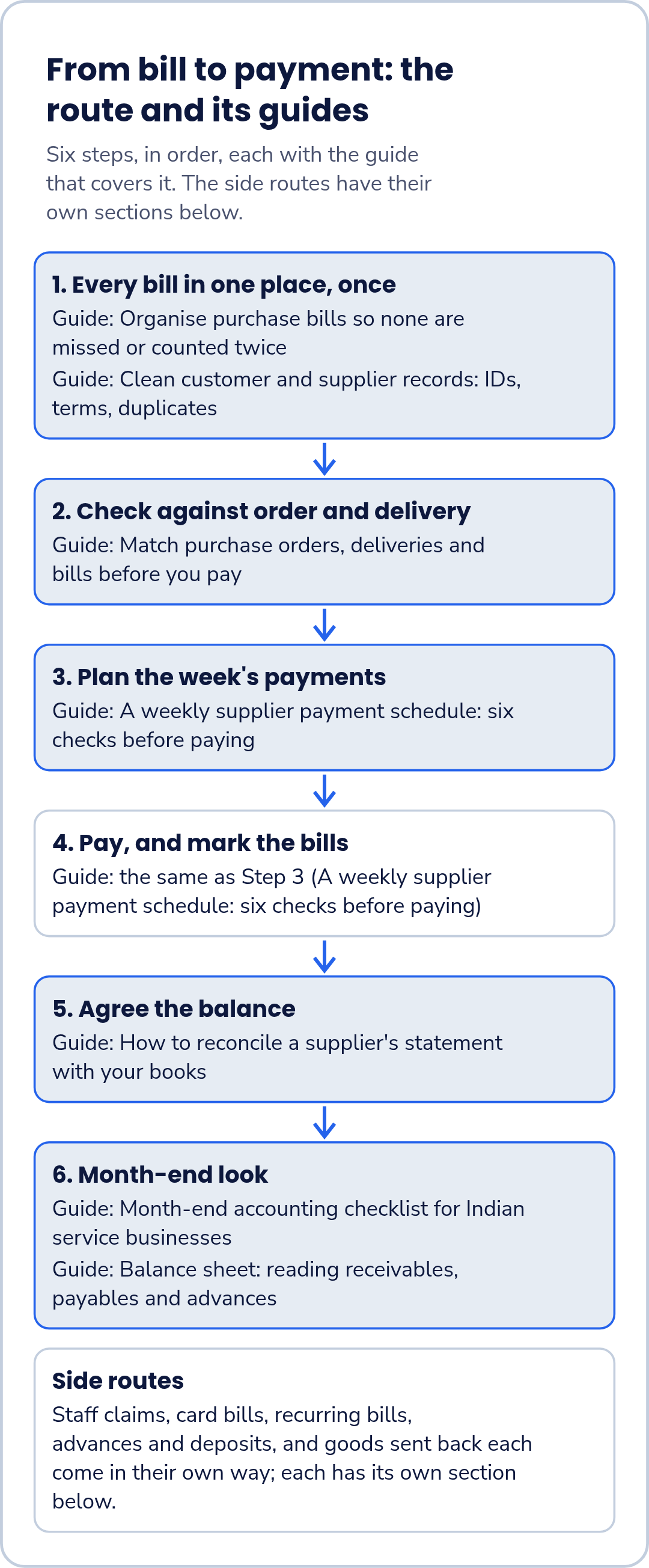
Accounts payable, or payables, is what you owe your suppliers, and the route from a supplier's bill to paying it has six steps: get every bill into one place, once; check it against what you ordered and what arrived; plan the week's payments; pay, and mark which bills each payment clears; agree the balance with your suppliers; and look at what you owe at month end. Some bills skip that route and need their own way in. Each section below summarises one step and links to the guide that covers it.
If you are a small business paying suppliers whenever they call, that is how bills can get paid twice, advances forgotten and an unchecked bill paid in full. The route below adds a short check to each bill and one sitting a week. You don't have to set it all up at once: start with Step 1, then add the next.
Each of these steps is common practice; this page puts them in one plain route for a business with no accounts team, with one fictional business followed throughout.
The route at a glance
| Step | What goes in | What comes out |
|---|---|---|
| 1. Every bill in one place, once | Bills by WhatsApp, email, courier and with the goods | One list of bills, each entered once |
| 2. Check against order and delivery | The bill, the order, the delivery note or challan | Bills cleared to pay, or held with a reason |
| 3. Plan the week's payments | Cleared bills and their due dates | This week's payment list |
| 4. Pay, and mark the bills | The payment list | Payments, each marked against the bills it clears |
| 5. Agree the balance | The supplier's statement and your books | The same balance on both sides, or a list of differences |
| 6. Month-end look | Everything you owe | A short list to act on before the month closes |
Side routes feed into this: staff claims, card bills, recurring bills, advances and deposits, and goods sent back.
The example used throughout. Illustrative example: a fictional supermarket in Sri Vijaya Puram (formerly Port Blair), Andaman and Nicobar Islands; October; verify independently. The supermarket has 16 staff and about 45 regular suppliers. Most stock is shipped from the mainland, so bills and goods often arrive on different days. All details are invented.
Step 1: Every bill in one place, once
Every bill, however it arrives, goes into one place and is entered once. The same bill can come twice, by WhatsApp and again in the courier packet, so check each new bill against what is already in.
Keep one record per supplier, too: one name, one set of payment terms and one set of bank details, so bills from the same supplier don't scatter across near-duplicate names. If a supplier's bank details change, check it with the supplier by phone before paying. Use a phone number already in your supplier record, not one given with the new details.
Who: whoever receives bills puts them in the one place; one person enters them.
In the example: 212 supplier bills arrived in October from about 45 suppliers. Three were second copies of bills already in, caught at entry, so 209 bills went in.
212 − 3 = 209.
The method is in how to organise purchase bills so none are missed or counted twice. Supplier records are covered in keeping clean customer and supplier records. If a bill-scanning or auto-entry tool suggests entries, a person still reviews them: see reviewing suggestions from bill-scanning and auto-entry tools.
Step 2: Check the bill against the order and the delivery
Before a bill is cleared to pay, check it against what was ordered and what was actually delivered: the order, and the delivery note or challan. A bill with a difference (short, damaged, or at a different rate from the order) is held, with the reason written down, until the supplier sends a corrected bill or a credit note.
The order is where the bill starts.
Who: whoever receives the goods confirms what arrived; the person entering bills does the check.
In the example: of the 209 bills, 186 matched the order and the goods received first time. Twenty-three had differences: 17 were short or damaged on arrival by ship, and 6 had a rate different from the order. The 23 were held until the supplier sent a corrected bill or a credit note.
186 + 23 = 209; 17 + 6 = 23.
The detail is in the guide to matching purchase orders, deliveries and bills before you pay.
Who says yes to a bill
In a small team, one option is that the owner approves bills for payment and someone else enters and checks them, so every bill passes two people before it is paid. If you work this way, decide in advance which bills the owner looks at one by one: all of them, or only those outside the usual suppliers; the rest still reach the owner on the weekly payment list in Step 3.
How to split these duties in a small team is covered in simple financial controls for a small team.
Step 3: Plan the week's payments
Once a week, list the bills cleared and approved for payment and due soon, and decide which go out in this week's payment run. Checking the list before anything is paid is where a bill already paid or a missing approval gets caught. If a supplier offers a discount for paying early, note the date on the weekly list. It also helps to list what you owe by how overdue it is, so the oldest bills are not the ones left out.
Some payments to suppliers carry legal timelines or tax steps, depending on who the supplier is and what you buy; ask your accountant which apply to your business.
Who: the person entering bills prepares the list; the owner approves it.
In the example: the supermarket runs its payments every Tuesday, and October had four payment runs.
The weekly list, the checks before paying and marking each payment against its bills are all in the guide to a weekly supplier payment schedule.
Step 4: Pay, and mark which bills each payment clears
Pay from the approved list, by UPI, NEFT or cheque, and mark each payment against the bill or bills it clears. A payment that is recorded but not marked against a bill leaves that bill looking unpaid, and it can be paid again. Send the supplier a note of which bills the payment covers, so their records and yours agree from the start.
Who: the owner or whoever releases payments; the person entering bills marks them.
In the example: the four weekly payment runs came to ₹9,60,000, ₹11,20,000, ₹8,70,000 and ₹8,90,000, ₹38,40,000 in all. Every payment was marked against the bills it cleared.
₹9,60,000 + ₹11,20,000 + ₹8,70,000 + ₹8,90,000 = ₹38,40,000. These payments cleared whichever bills were due, including some from earlier months.
The payment schedule guide linked in Step 3 covers this step too.
Step 5: Agree the balance with your suppliers
Ask your larger suppliers for their statement and compare the balance they show with what your books show. When the two differ, look for items that are on one side only: a bill they have raised that you haven't received, or a payment or credit note that only one side has entered. List each one until the difference is explained, then fix what is yours to fix.
Who: the person entering bills, with the owner seeing the result for the larger suppliers.
In the example: the largest supplier's statement showed ₹4,62,000 owed; the books showed ₹4,18,500, a difference of ₹43,500. The supplier had raised a ₹51,000 bill for goods still at sea; the bill had not yet reached the shop, so it was on the supplier's statement but not in the books. Against that, the supplier had issued a ₹7,500 credit note for damaged cartons that the shop had not yet entered.
The bill makes the supplier's figure ₹51,000 higher than the books. The credit note is already taken off the supplier's figure but not off the books, so it makes the supplier's figure ₹7,500 lower. Net, the supplier's figure is ₹43,500 higher.
₹4,62,000 − ₹4,18,500 = ₹43,500; ₹51,000 − ₹7,500 = ₹43,500.
The shop enters the credit note now and the ₹51,000 bill when it arrives, after the Step 2 check.
The method is in reconciling a supplier's statement with your books.
Step 6: The month-end look at what you owe
At month end, list what is still open: bills held at Step 2, bills due but unpaid, and differences from Step 5. Bills and goods do not always arrive together, so note goods received without a bill and bills received before the goods, and tell your accountant about both.
Who: the person entering bills prepares the list; the owner and the accountant look at it.
The month-end close is covered in the month-end accounting checklist. For the payables line, see reading receivables, payables and advances on your balance sheet.
Bills that skip the usual route
Some spending doesn't arrive as a supplier bill against an order, so it needs its own way in.
Staff claims
When staff pay from their own pocket, the bill comes in with a claim, not from a supplier. It is checked and approved before it is repaid, and the repayment is marked against the claim. The steps are in a simple process for staff expense claims and reimbursements.
Card bills
A business credit card statement covers many purchases. Before paying it, match each line to its own bill: see matching every line of a business credit card statement to a bill.
Bills that come back every month or year
Rent, software subscriptions, insurance, maintenance contracts, electricity, water, phones, courier and vehicle costs come round on their own schedule, usually without an order. List each with its due date and compare each bill with the earlier ones, so renewals are decided before paying and unusual bills stand out. Once a year, a line-by-line review of every regular cost shows what you no longer need. For renewals, see tracking annual renewals.
Advances and deposits
An advance paid before a bill arrives has to be set against that bill when it comes, or the full bill gets paid and the advance is forgotten. A deposit, such as a rent or electricity deposit, is money that should come back, so keep it on a register until it is returned or adjusted.
In the example: a ₹24,000 advance paid to a mainland supplier in September was set against that supplier's October bill rather than forgotten.
Advances are also covered in the balance-sheet guide linked in Step 6.
Goods sent back
When goods arrive damaged or faulty and go back to the supplier, hold the bill until the replacement or the supplier's credit note arrives. A separate guide to following up replacement and warranty claims with suppliers is planned.
The supermarket's October in one table
Illustrative example: a fictional supermarket in Sri Vijaya Puram; October; verify independently.
What each step caught in the month, in one place:
| Step | October | What the step caught |
|---|---|---|
| 1 | 212 bills arrived, 209 entered | 3 second copies, not entered twice |
| 2 | 186 matched first time | 23 bills held, not paid in full before a corrected bill or credit note |
| 3–4 | 4 Tuesday runs, ₹38,40,000 | Payments went out on one day a week, each marked against its bills |
| 5 | Largest supplier ₹43,500 apart | A bill not yet received and a credit note not yet entered |
| Advances | ₹24,000 September advance | Set against the October bill, not forgotten |
One-page checklist
The same route, arranged by when each check happens:
| When | Check |
|---|---|
| As each bill arrives | Not already in? Entered once. Checked against the order and what arrived, or held with a reason (Steps 1–2) |
| When bank details change | Checked by phone with the supplier, on the number in your records, before any payment (Step 1) |
| Once a week, before paying | The list of approved, due bills is prepared and approved; any advance is set against its bill (Step 3) |
| Each payment run | Every payment marked against the bills it clears; the supplier told which bills it covers (Step 4) |
| When a larger supplier's statement arrives | Balances compared and each difference listed (Step 5) |
| Month end | Held bills, unpaid bills, open differences, and bills or goods that arrived alone, listed for your accountant (Step 6) |
| As they come up | Staff claims, card statements, recurring bills, deposits and goods sent back, each by its own route |
| Once a year | Every regular cost questioned, line by line |
Talk through your books in a demo
If you would like to talk through how your business keeps its books, request a demo and choose "Book a demo" on the form. FastComply Books is in an invitation pilot in India, so the demo is where we confirm what is available for your business.