
Write one page your family can find if you're in hospital or away and can't run the money: which banks and branches, whom to call, who owes the business, what the business owes, what is due in the next 30 days, the loans, the deposits paid and where the papers are. Where you keep it and whom you tell are your own choices; the example shows one owner's.
Why the business side gets missed
If the household's money comes from the business, the family file needs the business's own lines too: who owes it, whom it owes and what is due soon.
Keeping one page or index of what exists and whom to call, leaving passwords, PINs and OTPs off it, telling someone you trust where it is kept, and reviewing it regularly are already covered in published personal-finance and business-continuity guides; one of them suggests starting with the payments due in the next 30 days.
This page builds the business lines from registers you may already keep, and splits the next 30 days into bills already received and regular payments.
The eight lines on the list
- Bank accounts: the bank, the branch and the account type (business current, personal savings), with the branch phone or the relationship person. No account numbers (not even part of one), no balances, no logins. If two accounts of the same type sit at one branch, describe each by its use, such as "the account the learners' fees go into".
- People to call: the CA, the banker or branch contact, the office assistant or senior staff member, and the main supplier contacts.
- Who owes the business: the total, how many people, and where the full list with names is kept, from your customer receivables follow-up list.
- What the business owes: bills received and not yet paid, from your supplier payment schedule.
- The next 30 days of payments: date, to whom and about how much. Renewals further out sit on the annual renewals list.
- Loans and EMIs: the lender and the EMI date, and where the schedule is kept, as in your loan and EMI schedule.
- Deposits paid: to whom, and where the receipts are, from the security deposits register.
- Where the papers are: the bills folder, the bank statements and the monthly records for your accountant. Who does what between you and the CA is in owner and accountant monthly responsibilities.
The example: the next 30 days
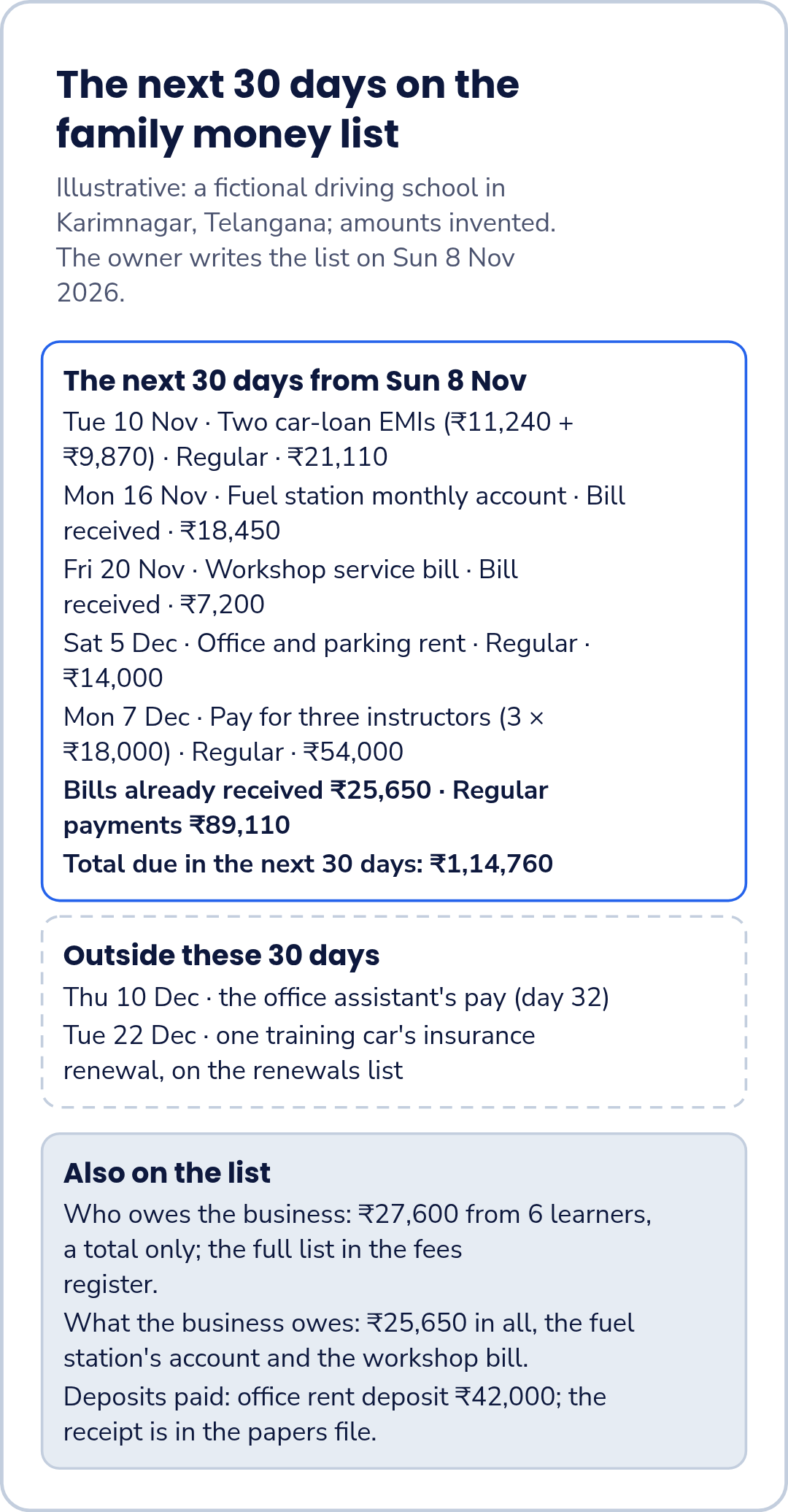
Illustrative example: a fictional business; amounts invented. A driving school in Karimnagar, Telangana: the owner, three instructors and an office assistant, with four training cars, two of them on loans. The owner handles every rupee. He writes the list on Sun 8 Nov 2026.
Who owes the business: ₹27,600 from 6 learners; full names in the fees register, office drawer.
What the business owes: the fuel station's monthly account and a workshop service bill, ₹25,650 in all.
| Date | Payment | Kind | ₹ |
|---|---|---|---|
| Tue 10 Nov | Two car-loan EMIs (₹11,240 + ₹9,870) | Regular | 21,110 |
| Mon 16 Nov | Fuel station monthly account | Bill received | 18,450 |
| Fri 20 Nov | Workshop service bill | Bill received | 7,200 |
| Sat 5 Dec | Office and parking rent | Regular | 14,000 |
| Mon 7 Dec | Pay for three instructors (3 × ₹18,000; the office assistant is paid on Thu 10 Dec, day 32, so outside these 30 days) | Regular | 54,000 |
| Bills already received | 25,650 | ||
| Regular payments | 89,110 | ||
| Total due in the next 30 days | 1,14,760 |
Beyond 30 days: one training car's insurance renewal on Tue 22 Dec, on the renewals list; the papers are in the papers file.
Deposits paid: office rent deposit ₹42,000; the receipt is in the papers file.
What never goes on the list
Never on this list: passwords, PINs or OTPs; card numbers; account numbers, not even part of one; balances.
Who may operate an account or sign for the business if you can't, and anything to do with nominations or what happens legally, are questions for your bank, your CA and your lawyer; this list only helps your family know what exists and whom to call.
Where to keep it, who to tell, when to update
Three things the example's owner does are his choices, not rules or security advice: he keeps the list in one known place, the office cupboard file marked "If I'm away"; he tells two people where it is, his wife and his elder brother; and he looks at it again every three months, or sooner when a loan, an account or a big customer changes. His next look is Sun 7 Feb 2027.
If you do a weekly money look, that is a moment to check the list still matches the registers. A planned handover when a staff member who keeps the accounts leaves is a different case.
A printable blank list
| Line | What to write | Where the full record is |
|---|---|---|
| 1. Bank accounts | Bank, branch, account type or use, branch phone or contact | |
| 2. People to call | CA, banker or branch contact, senior staff, main suppliers | |
| 3. Who owes the business | Total ₹____, from ____ people | |
| 4. What the business owes | Bills received, not paid: ₹____ | |
| 5. Next 30 days | Date, to whom, about how much | |
| 6. Loans and EMIs | Lender, EMI date | |
| 7. Deposits paid | To whom, where the receipt is | |
| 8. Where the papers are | Bills, statements, the CA's monthly records |
Written on ____. Next look on ____. People who know where it is: ____.
Leaving a money list your family could follow?
If you would like to hear about FastComply Books for your business, you can request early access. FastComply Books is in an invitation pilot in India and public sign-up is not open yet.