When the shop or studio is in the family home, make one list of the bills home and business share, write down a basis for each bill's business share, and settle the business share with one transfer between the business and home accounts at month end. The basis is the owner's own choice, written once; it doesn't need to be exact to the rupee.
"It's all family money anyway. Why split it?" Because when each bill is paid from whichever account has money, the business's costs move with the account that paid, and the family can't tell what the business really costs. One written basis per bill and one transfer a month is enough.
Why the business's costs shouldn't depend on which account paid
When the same bill is paid sometimes from the business UPI and sometimes from the home account, the business's costs in its monthly figures rise in a month the business account paid the electricity and fall in a month home paid it. Nothing about the business changed. A fixed basis per bill makes the business's share the same kind of figure every month, so the questions you ask of your monthly profit and loss are about the business, not about which account was fuller.
Splitting a shared bill by floor area, an agreed share or a usage log, and settling shared bills once a month, are already covered in published tax guides and bill-splitting apps. This page gives the home-business version, for planning only: the business share netted once a month against what the business account actually paid.
The shared-bills list
List every bill that home and business both use:
- electricity, if the studio or shop is on the home connection;
- internet and the phone plan the owner uses for both;
- fuel for a car or scooter used for both;
- anything else paid once for both, such as water or building maintenance.
For each one, write who the bill is from, its usual amount, which account pays it now, the basis for the business share, and this month's business and home shares. The list is the family's own planning record; it says nothing about how anyone bills or how anything is taxed.
If one month's electricity bill looks very different from its usual amount, compare it with its own recent months before you split it.
Choosing a basis, and writing it down
Pick one basis per bill and write it on the list with the date you chose it. Look at it again once a year, or when something changes, such as a new machine in the studio.
- Electricity: if the home already has a check meter on the business area, use its reading as a share of the bill's units. If not, agree a fraction.
- Internet and phone: an agreed fraction of use, such as half when the studio uses the line by day and the family in the evening.
- A shared vehicle: kilometres for the business from the vehicle log, as a share of the month's kilometres.
Anything about the electricity connection or a meter is a question for your discom.
Choosing a basis for a shared cost is the same idea as splitting shared costs across outlets; that guide covers how to pick one.
The month-end transfer
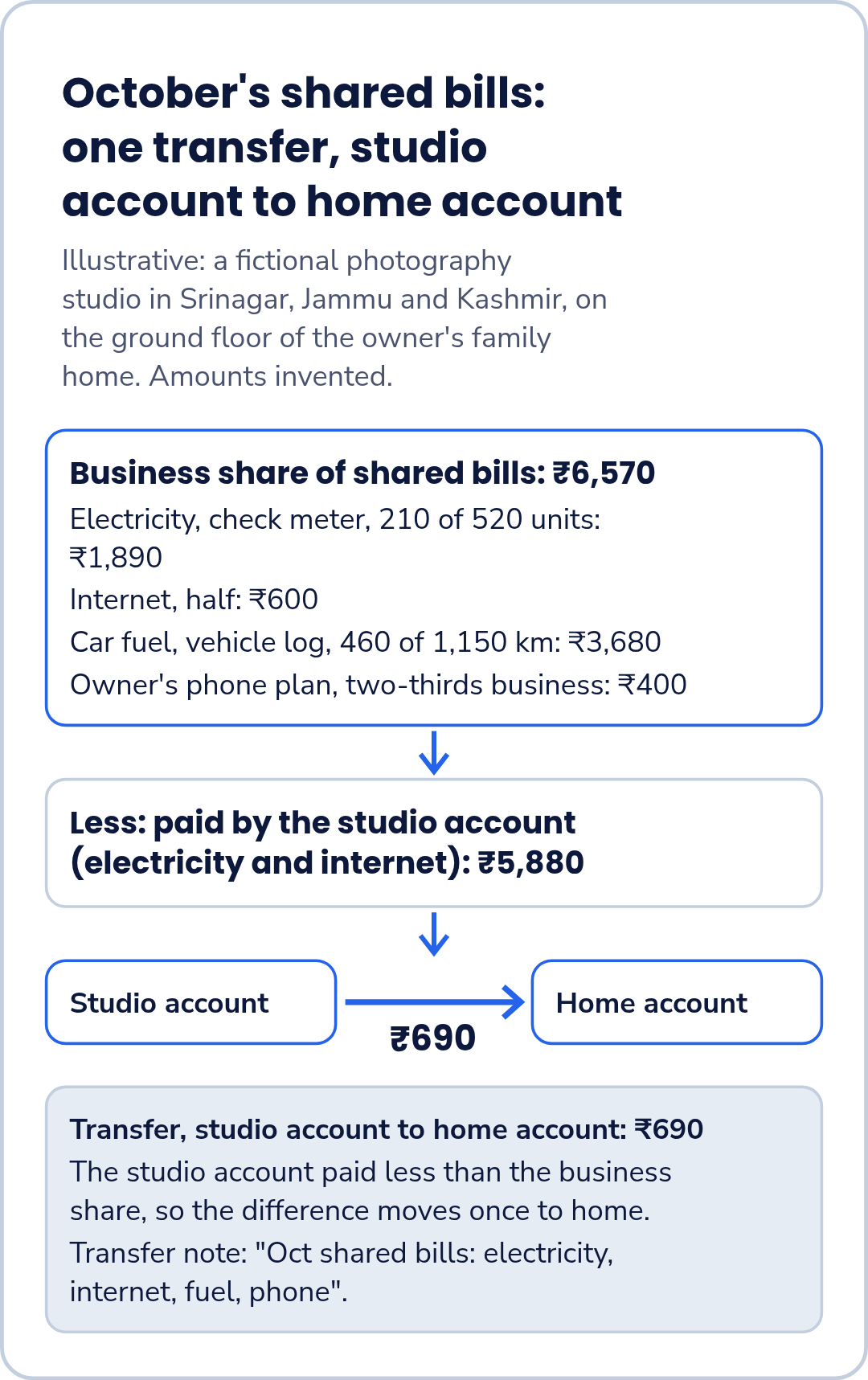
At month end, add up the business share of every shared bill. Subtract what the business account actually paid towards those same bills. The difference moves once, from the business account to home, or from home to the business if the business account paid more than its share. Write a one-line note on the transfer listing the bills it settles.
This transfer is settling shared bills between the separate accounts set up in separating business and personal money. It is not the owner's pay (owner's pay from the shop) and doesn't change it.
How the business share is recorded in the books, and whether any of it counts for tax, is for your CA to decide.
Worked example: a Srinagar photography studio's October bills
Illustrative example: a fictional photography studio in Srinagar, Jammu and Kashmir, on the ground floor of the owner's family home. The owner runs it with his wife, who does the bookings and accounts, and one assistant: portraits and passport photos in the studio, and some shoots outside, which is why the family car is shared. His parents and two children live upstairs with them; his brother's family lives on the second floor. Amounts invented; verify independently.
The owner wrote down four bases. The 210 units are the check-meter reading on the studio line; the 460 km are shoot trips from the vehicle log. "Half" and "two-thirds" are this family's choices, not recommendations.
| Shared bill | October (₹) | Paid from | Basis (written down) | Business share (₹) | Home share (₹) |
|---|---|---|---|---|---|
| Electricity, 520 units | 4,680 | Studio account | Check meter: 210 of 520 units | 1,890 | 2,790 |
| Internet | 1,200 | Studio account | Half | 600 | 600 |
| Car fuel, 1,150 km | 9,200 | Home account | Vehicle log: 460 of 1,150 km | 3,680 | 5,520 |
| Owner's phone plan | 600 | Home account | Two-thirds business | 400 | 200 |
| Total | 15,680 | 6,570 | 9,110 |
| Month-end transfer, October | ₹ |
|---|---|
| Business share of shared bills | 6,570 |
| Less: paid by the studio account (electricity and internet) | 5,880 |
| Transfer, studio account to home account | 690 |
The transfer note reads "Oct shared bills: electricity, internet, fuel, phone". The owner's own monthly amount from the studio is unchanged.
When siblings share a household bill
The same list works between two households in one building. In Srinagar, the building's water and maintenance bill is split between the two flats on a basis the two brothers agreed and wrote down, and settled once a month, the same way as the studio's bills. Keep it on the same list, in its own line, so the studio's home shares stay the owner's household's own.
The home share of each bill is also a line in the family's household budget.
Template
Shared-bills list
| Shared bill | This month (₹) | Paid from | Basis (written down) | Business share (₹) | Home share (₹) |
|---|---|---|---|---|---|
| Total |
Our bases were written on ____ and are looked at again every ____.
Month-end transfer
| Line | ₹ |
|---|---|
| Business share of shared bills | |
| Less: paid by the business account towards those bills | |
| Transfer (direction: business to home / home to business) | |
| Note (bills settled) |
Settling shared bills between home and business?
If you would like to hear about FastComply Books for your business, you can request early access. FastComply Books is in an invitation pilot in India and public sign-up is not open yet.