
To set your own pay from the shop, first add up every way money went home last year. Then test an amount against what the shop had left in its leanest months after its own set-asides. Take that one fixed monthly amount on one date, in a fixed order, and ask the family to fill a slip for anything else they take from the counter or the shop's account.
Why "take it when home needs it" leaves both sides guessing
In many family shops, money goes home when home needs it: a transfer one week, cash from the galla the next, a household bill paid from the shop's account, cash for a function. Nobody knows the real monthly figure, and the shop runs short when it needs season stock.
"It's all my money, so why fix an amount?" The money may all be yours, but the shop can't plan around withdrawals it can't see.
A fixed amount on a fixed date, set a little low, with any extra decided on purpose, goods taken noted, and the amount worked out from twelve months of real figures, the lowest month, rounded down: all of this is common advice. What follows adds four things: totalling every route money went home, testing the amount after the shop's own set-asides, putting those set-asides inside the pay-day order, and a dated family slip.
Step 1: Add up what actually went home last year
Take the last 12 months of the business bank statement and the day-close book or notes. Total each route separately:
- transfers to the personal account;
- household payments made from the shop's UPI or account;
- cash taken from the counter.
Mark months you are unsure of as unknown; don't guess. The total is the starting point, not the answer. In the example below it was higher than the owner had guessed.
Step 2: Test an amount against the shop's lean months
From the same records, pick the shop's three leanest months. For each, work out what was left after rent, wages, that month's supplier dues, and the season-stock and renewals set-asides from step 3.
Choose an amount the shop could have paid in all three months without delaying a supplier or touching set-aside money. Pick a round figure at or below the lowest of the three, not the average: the amount is paid every month, and an average would be more than the shop had in its leanest month. Whether that amount covers the household is a separate question.
In a good month, any extra is decided at the monthly look and written down, never taken from the counter.
Step 3: Pay day, in a fixed order
Moving your own share aside before the rest is spent was popularised in The Richest Man in Babylon by George S. Clason, and applied to business takings in Profit First by Mike Michalowicz. Here it becomes a fixed order for the one date each month, using the single monthly transfer described in separating business and personal money:
- the owner's amount;
- the business's own set-asides, such as money for season stock and for yearly renewals, kept in a separate column in the cash book or in a separate account the business already holds;
- rent and wages;
- what remains carries the month's supplier payments.
If rent, wages or the month's suppliers can't be met in full after the owner's amount, the amount is too high: that month, take less, write the gap down and don't take it from the set-asides; lower the amount at the next monthly look. Rent, wages and suppliers are never cut to protect the owner's amount.
Money your CA has told you to keep for taxes is outside this order; ask your CA how much and where.
Step 4: A slip for anything the family takes from the counter or the shop's account
Anyone in the family who takes cash from the drawer, or pays from the shop's UPI or account for something for home, fills a slip: date, name, what for, amount, and cash or UPI. The owner fills them too. Goods taken from the shelf are written as item and quantity only; their value is for the accountant.
Slips go in one envelope in the drawer. The day close adds the envelope's slips to the day's sheet, and the weekly money look adds up the week's slips. If you keep the crossing log described in separating business and personal money, each slip for a household payment made from the shop's UPI or account goes into it as its own line, with the slip as the evidence; cash slips stay in the envelope and its monthly total.
Slips are on top of the owner's amount. At month end, their total comes out of the next month's household spending; the pay-day transfer does not change. That is a family rule, agreed at home.
Step 5: Look again each month and after each season
Each month, compare the amount, the slips and any written extra. After each busy season, redo step 2 with the new lean months. The pay date and set-asides also belong in a cash flow forecast, and if you are preparing for a bank loan, the record of your pay is one of the papers to have ready.
Worked example: a Vadodara saree shop
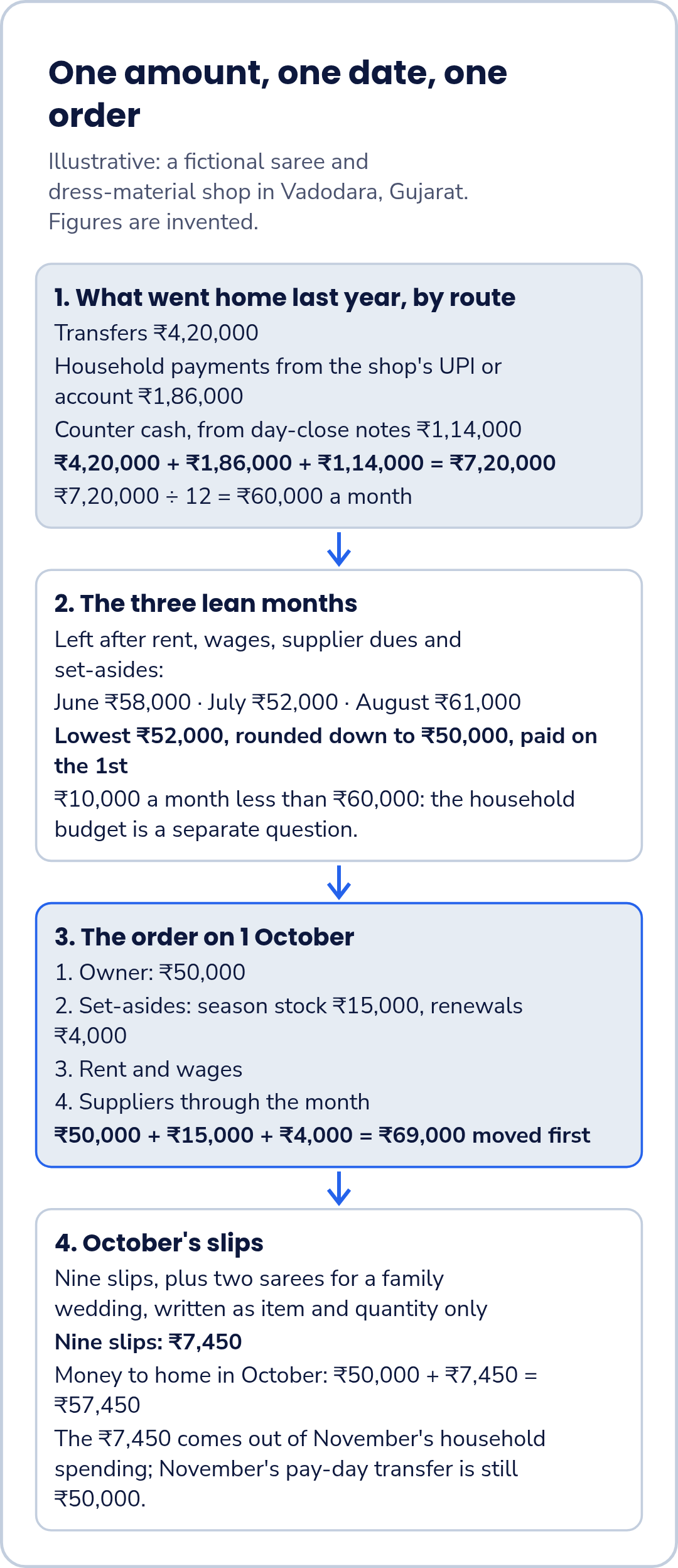
Illustrative example: a fictional saree and dress-material shop in Vadodara, Gujarat, run by the owner with his wife and father and two counter staff. Figures are invented; verify independently.
Step 1, the last 12 months by route:
Transfers ₹4,20,000; household payments made from the shop's UPI or account ₹1,86,000; counter cash, from day-close notes, ₹1,14,000.
₹4,20,000 + ₹1,86,000 + ₹1,14,000 = ₹7,20,000.
₹7,20,000 ÷ 12 = ₹60,000 a month. The owner had guessed lower. The ₹50,000 chosen below is ₹10,000 a month less, which is why step 2 treats the household budget as a separate question.
Step 2, lean months: June, July and August, before the festive season; season stock is bought from July. Left after rent, wages, supplier dues and set-asides: June ₹58,000, July ₹52,000, August ₹61,000. The lowest is ₹52,000, rounded down to ₹50,000, paid on the 1st.
Step 3, the order on 1 October: ₹50,000 to the owner; ₹15,000 season-stock set-aside and ₹4,000 renewals set-aside; then rent and wages; then suppliers through the month.
₹50,000 + ₹15,000 + ₹4,000 = ₹69,000 moved first.
Step 4, October's slips: nine slips, plus two sarees for a family wedding, written as item and quantity only.
₹1,200 + ₹850 + ₹2,000 + ₹400 + ₹600 + ₹1,500 + ₹300 + ₹250 + ₹350 = ₹7,450.
The slips came on top of the ₹50,000, so October's money to home was ₹50,000 + ₹7,450 = ₹57,450. The family agrees that the ₹7,450 comes out of November's household spending; November's pay-day transfer is still ₹50,000.
What to agree with your CA
Whether you call it pay, a "salary" or drawings, how it is recorded is your CA's call. Agree what you will send each month: the pay date and amount, any extra and its date, the slips and the goods-taken list. See agreeing monthly responsibilities with your accountant.
Printable checklist
| Item | Done | Note |
|---|---|---|
| 12-month total by route done (once) | ||
| Three lean months checked; amount ₹____ | ||
| Pay date ____ | ||
| Pay-day order followed: owner, set-asides, rent and wages, suppliers | ||
| Set-asides moved: season stock ₹, renewals ₹ | ||
| Slip envelope totalled ₹____ | ||
| Any extra decided and written | ||
| CA sent this month's pay, extras, slips and goods-taken list | ||
| After the season: step 2 redone |
Taking home one amount on one date?
If you would like to hear about FastComply Books for your business, you can request early access. FastComply Books is in an invitation pilot in India and public sign-up is not open yet.