
A weekly cash check works best when it rides on something you already do: the last day close of your week (Saturday for many shops; whichever night comes before your weekly off). With that day's close done and the week's papers still on the counter, you file the bills and slips, check the week's takings against what reached the bank, list what comes in and goes out next week, note the owner's pay date, and write one action with a date.
Why the weekly look keeps slipping, and why the week's last close fixes it
Most owners mean to sit with the accounts every week. It slips because there is no fixed moment for it, so it happens only when a cheque bounces or a supplier calls twice. But you already stop at the end of the week to close the day; the weekly look uses that stop and the same papers, and ends with one written action.
Attaching a new habit to one you already do was popularised in Atomic Habits by James Clear, who credits the idea to BJ Fogg. Looking once a week, at a fixed time, at everything still open was popularised in Getting Things Done by David Allen. A weekly check of what you have, what is coming in, what is going out and one decision is common practice for small businesses; what follows ties it to the shop's own close and its papers.
Do it in the same place each week, with the same notebook. The aim is a look short enough to finish before you leave, not a full set of accounts.
What to have on the table
- the week's day-close sheets
- the bank app or passbook
- the list of supplier dues
- the cheque register
- the envelope of family slips
- any loose bills from the drawer
The weekly look, step by step
1. File the day's bills and slips
File any loose bills with the rest of the week's purchase bills, as set out in organising purchase bills and expense receipts. Then add up the family slips in the envelope (see the daily steps below) and write the total in the notebook.
2. Takings against the bank
From the day-close sheets, add up the week's UPI and card takings, and compare that total with what reached the bank. If there is a gap, write it down with a day to check it. This step only flags the gap; finding its cause is the job of the bank reconciliation workflow, and the daily match of takings to sales belongs to the shop day close.
3. Money due in next week
List what you expect to receive next week: credit customers whose balances fall due and any payment someone has promised. Read these from your list of customer balances and overdue invoices.
4. Money going out next week
List supplier dues for next week, any cheques you have issued that are dated next week, and rent and wages if they fall in the week. Any payment date your CA has given you goes on the going-out list.
5. The owner's pay date and one household line
Note whether the owner's pay date falls next week, and whether any large home payment, such as school fees, is due soon.
6. Write one action and the date you'll do it
Look at what you have, what is due in and what is going out, and write one action with the day you will do it. If next week's money left is tight, the action is usually to chase one receipt or move one payment to its due date. The next weekly look starts by ticking last week's action.
What to do each day so the weekly look stays short
Four small steps, each done straight after something that already happens in the shop, keep the week's papers in order:
- When a bill arrives, photograph it and put the paper in the bills folder. This feeds step 1.
- When anyone in the family takes cash from the counter, or pays something for home from the shop's UPI or account, they fill a slip and put it in the envelope. This feeds step 1.
- When a cheque is written or received, it goes on the cheque register the same day. This feeds step 4.
- At each day close, write the day's cash, UPI and card totals on the sheet. This feeds step 2.
Worked example: a Hubballi footwear shop
Illustrative example: a fictional footwear shop in Hubballi, Karnataka, with the owner and three counter staff, open Monday to Saturday, which also supplies school shoes on credit to two local schools. Figures are invented; verify independently.
The week's last day close is Saturday.
| Step | What the papers show |
|---|---|
| 1. Bills and slips | Bills filed; 3 family slips: ₹1,200 + ₹650 + ₹500 = ₹2,350 |
| 2. Takings against the bank | Week's takings ₹62,300 cash + ₹1,08,700 UPI + ₹15,400 card = ₹1,86,400. UPI and card expected: ₹1,08,700 + ₹15,400 = ₹1,24,100; reached the bank: ₹1,22,600; gap ₹1,500 |
| 3. Due in next week | One school's balance of ₹40,000 on the school-shoe order |
| 4. Going out next week | Two suppliers, ₹58,000 and ₹38,000 (due Friday), and a post-dated cheque issued for ₹25,000, dated Thursday: ₹58,000 + ₹38,000 + ₹25,000 = ₹1,21,000 |
| 5. Pay date and home | Owner's pay of ₹45,000 falls due next week |
The ₹1,500 matches Saturday's card total, which has not reached the bank yet, so the owner marks it "check Monday".
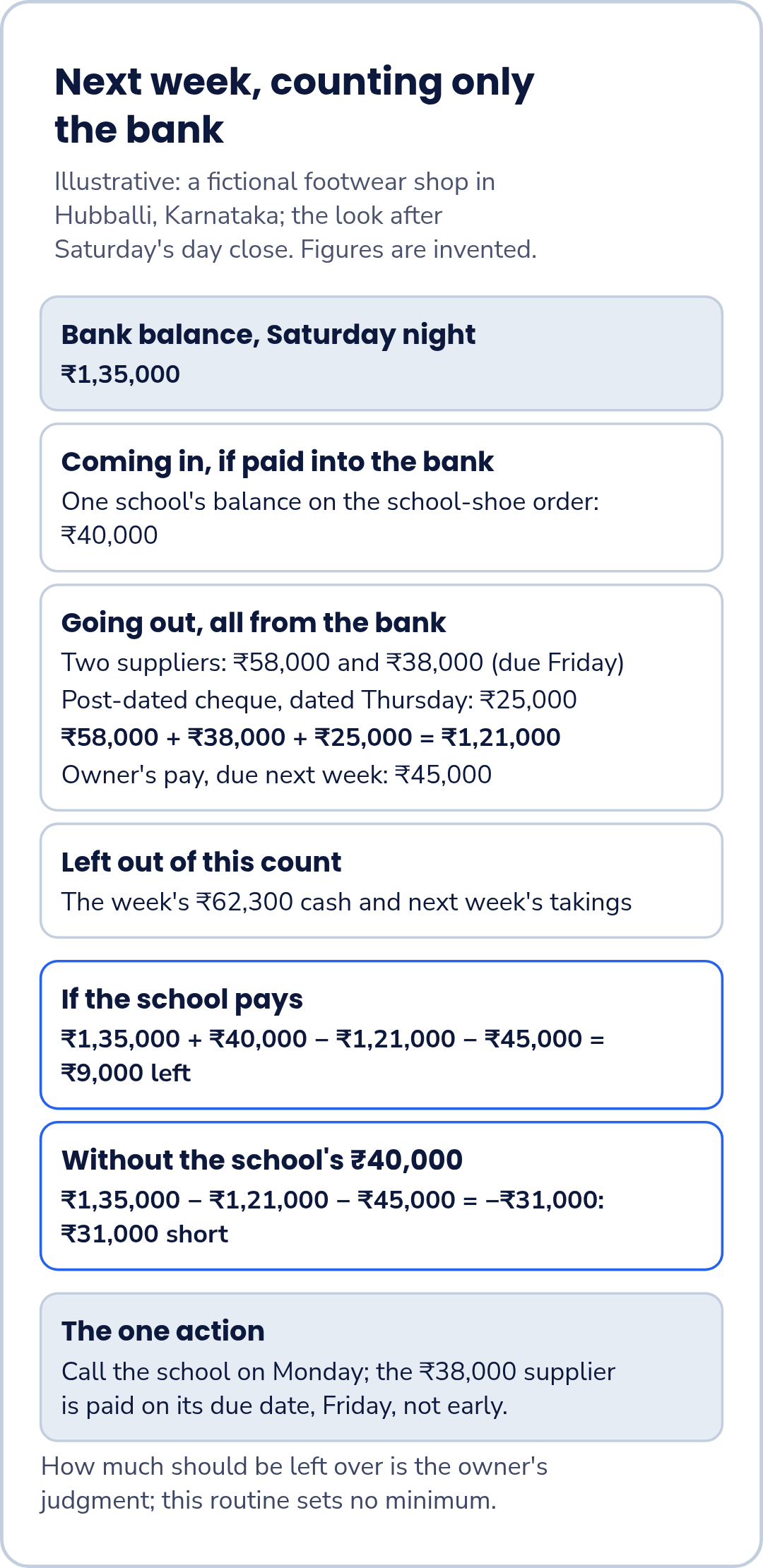
The bank balance on Saturday night is ₹1,35,000. Counting only the bank, before next week's takings: the ₹1,35,000 balance, plus the school's ₹40,000 if it is paid into the bank, less the ₹1,21,000 going out and the ₹45,000 owner's pay, all paid from the bank. The week's ₹62,300 cash and next week's takings are left out.
₹1,35,000 + ₹40,000 − ₹1,21,000 − ₹45,000 = ₹9,000 left if the school pays.
Without the school's ₹40,000, the bank would be ₹31,000 short: ₹1,35,000 − ₹1,21,000 − ₹45,000 = −₹31,000.
That leaves little room if takings are slow, and everything rests on the school, so the one action is to call the school on Monday; the ₹38,000 supplier is paid on its due date, Friday, not early. The ₹2,350 of family slips is noted, to come out of the next month's household spending, as agreed at home.
How much should be left over is the owner's judgment; this routine sets no minimum.
Where to go deeper
- For planning beyond next week, a 13-week cash flow forecast.
- For how the month went against plan, a monthly budget against actual figures.
- If you keep a petty cash float, its weekly count can sit inside step 1.
Printable checklist
Print one page and tick it each week.
| Item | Week of ____ | Note |
|---|---|---|
| Last week's action done? Y/N | ||
| Bills filed | ||
| Family slips added up: ₹____ | ||
| Takings against the bank: gap ₹____, to check on ____ | ||
| Due in next week | ||
| Going out next week (suppliers, cheques, rent, wages) | ||
| Owner's pay date next week? Y/N | ||
| One household payment to plan for | ||
| One action, with its date |
Talk through your books in a demo
If you would like to talk through how your business keeps its books, request a demo and choose "Book a demo" on the form. FastComply Books is in an invitation pilot in India, so the demo is where we confirm what is available for your business.