
A household budget on irregular income works when it is built on what the household must spend every month, not on what the shop paid last month. For a business family, "irregular income" means the money for home changes from month to month: a lot after a good season, little in a slow one. Build the plan on a base month you can see in your own records, put the big yearly bills on one calendar, and keep a lean-month buffer sized from last year's lean months. Then the shop's money stays out of the household's gaps.
"A budget won't work for us. Our income isn't fixed." The budget here isn't built on the income. It rests on the household's base month, which is steady, and the uneven part is handled by a calendar and a buffer that come from the family's own records.
Why a business family's budget breaks
Three things can break it. First, the budget is set in a good month, so the first lean month breaks it. Second, household bills are paid from the shop's UPI, the shop's account or the counter, and if those payments aren't counted as household spending, the real figure is higher than the family thinks. Third, the big yearly bills and the shop's season stock fall due in the same weeks, and one of them takes from the other.
Much of what follows is common practice in irregular-income guides: budgeting essentials on a low month rather than the average, a fixed amount for home on a set date, keeping a good month's extra as a buffer, spreading yearly costs over the months, deciding in advance what happens with a good month's extra (moneycontrol, paisavy, themoneyjournal), a household petty cash book apart from the business, and one-page monthly check-in sheets. Household budgets for families whose business income is seasonal or uneven are published too (homecredit, jaysudha and moneynwealth), and lskhata's page on shop money and house money suggests labelling every till withdrawal as business or personal when it happens. Sizing a business's slow-season buffer from how far last year's slow months fell below a normal month is published too (astutemode).
What this page adds is narrow: a household log with each route money leaves by as its own column, tied to the shop's crossing log and family slips, with a "not written down" line; a buffer worked out as the sum of each lean month's gap below the base month; and the yearly bills calendar laid over the shop's season-stock months.
Step 1: Log one month of household spending, from every route
The idea of writing down every rupee and adding it up under headings you choose yourself was popularised in Your Money or Your Life by Vicki Robin and Joe Dominguez. Here it runs for one full month, to give the budget a starting figure: write each household spend on the day it happens, with each route in its own column:
- the personal bank account;
- UPI from personal apps;
- cash at home;
- household payments made from the shop's UPI or account;
- cash taken from the counter.
The last two columns are the ones a household budget can miss. Groceries paid from the shop's UPI, or school shoes paid with cash from the drawer, are household spending even though the money left from the shop.
Choose your own headings as a family: rent, bills, school, groceries and milk, medicines, travel, clothes, functions, eating out, other.
At month end, check the log against the personal money. Opening balance plus money in, less closing balance, is what the personal money says was spent. If the log adds up to less, write the difference as a "not written down" line. Don't guess it into a heading; it shows how complete next month's log needs to be.
Two lines tie this to the shop's records. Each household payment made from the shop's UPI or account goes into the crossing log in separating business and personal money as its own line, with the UPI receipt as evidence. Cash taken from the counter goes on the family slip in owner's pay from the shop.
Step 2: Find the household's base month
From the month's log, mark every line the family must pay each month: rent, bills, monthly school fees, groceries and milk, regular medicines, fuel and local travel. Ask of each line: "Do we pay this every month, whatever the shop does?", "Did it go out from the shop's side?" and "Could it wait for a good month?" The marked lines add up to the base month. Everything else is flexible.
The base comes from your own log, not from a split into needs and wants or a percentage from a framework. If a line is argued over, leave it out of the base for now and see whether the household misses it.
Step 3: Set the base against the owner's monthly amount
The base month, plus the monthly share of the yearly calendar (Step 4), is the figure the family takes into setting the owner's monthly amount, using the steps in the guide to one amount, one date and one order for taking money home from the shop. If it fits, what is left is the family's flexible money. If it doesn't fit, the household looks again at what is in the base, or the owner revisits the amount at the next monthly look. The gap is never filled from the counter, the shop's UPI or the stock money.
Step 4: Yearly and festival bills on one calendar
From last year's statements and the log, list every large household bill that comes once or twice a year, by month: school annual fees and books, festival clothes and gifts, family weddings and functions, vehicle service, house repairs. Add up the year and divide by 12. That monthly share is put aside on the day the owner's amount arrives.
Then lay the shop's season-stock months on the same calendar. Where a household big bill falls in the weeks the shop is buying or selling its season stock, the family plans to have the household share for that bill aside before the shop starts buying, so neither takes from the other. The shop's side of those months is in the guide to off-season cash and season stock.
While you go through the statements, you may find household autopays running on the business card or UPI. They belong in the annual renewals list for the business, marked to move.
Step 5: A lean-month buffer from your own records
Take last year's totals of what actually reached home, by every route, month by month: the same totals the owner's amount is set from. Pick the leanest months. For each one, note how far it fell below the household's base month. Add those gaps. That total is the buffer figure.
It is a figure from your own year, not a rule and not a number of months. If this year's lean months turn out deeper, redo the figure after the season.
- Built up from good months' extra, at whatever pace the year allows. There is no deadline.
- Where it sits: kept apart from the shop's cash and stock money, in the household's own money.
- Used only when the owner's amount comes in short, and written on the monthly page each time.
- Refilled first from the next good month.
When a good month comes
Write the order down once, as a family: first the buffer back up to its figure, then the calendar share if it is behind, then whatever the family decides together. When the extra arrives, follow the order and write where it went.
When a month comes in short
The owner takes less and writes the gap down, as the short-month rule in owner's pay from the shop says. The household takes the gap from the buffer, writes it on the monthly page, and pauses what can wait.
Each week and each month
The weekly money look after the week's last day close carries one household line: any large home payment due next week. Once a month, on the day the owner's amount moves, the family fills the monthly page below.
The Haldwani family's plan in one table
Illustrative example: a fictional gift, toy and festive-decor shop in Haldwani, Uttarakhand, run by the owner and his wife with two counter staff. The owner's mother and two school-age children live with them. The busy season is the festive months in autumn, and season stock is bought in August and September. Figures are invented; verify independently.
Step 1, August 2026 log. Personal money: opening ₹18,400 plus money in ₹55,000, less closing ₹21,000, is ₹52,400 spent. The log had ₹44,800 from personal money, so ₹7,600 was not written down. Four household payments went from the shop's UPI or account and are now four lines in the crossing log. Three counter slips were filled. The family had guessed August's household spending lower.
| Route | August (₹) |
|---|---|
| Personal money, logged | 44,800 |
| Personal money, not written down | 7,600 |
| Shop's UPI or account (2,400 + 1,800 + 1,450 + 750) | 6,400 |
| Cash from the counter, 3 slips (900 + 700 + 500) | 2,100 |
| Household total (52,400 + 6,400 + 2,100) | 60,900 |
Step 2, base month. Rent ₹12,000; electricity, gas, phone and internet ₹4,200; monthly school fees ₹6,500; groceries and milk ₹14,800; the mother's medicines ₹2,300; fuel and local travel ₹3,700. Base ₹43,500. Flexible in August: ₹60,900 − ₹43,500 = ₹17,400, of which ₹7,600 is still "not written down".
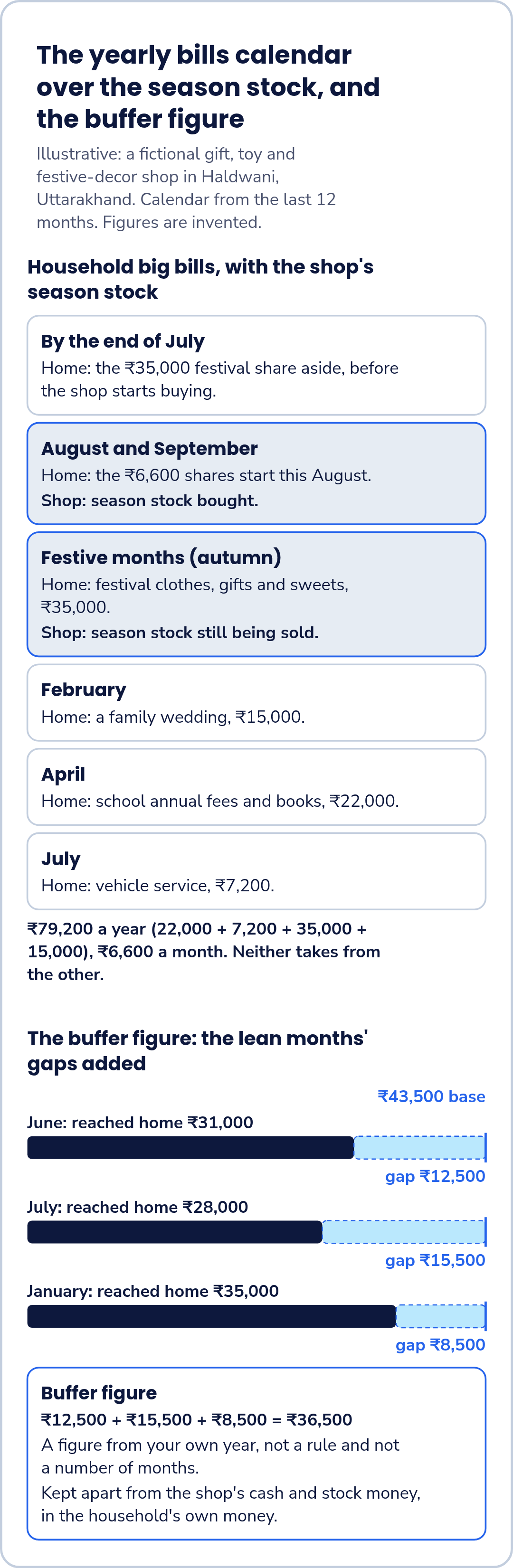
Step 4, calendar (last 12 months). School annual fees and books (April) ₹22,000; vehicle service (July) ₹7,200; festival clothes, gifts and sweets (autumn) ₹35,000; a family wedding (February) ₹15,000. That is ₹79,200 a year (22,000 + 7,200 + 35,000 + 15,000), ₹6,600 a month. The festival bills fall in the festive months, while the shop's season stock (bought in August and September) is still being sold, so the family plans to have the ₹35,000 aside by the end of July. The shares start this August: twelve shares of ₹6,600, from August 2026 to July 2027, less February's ₹15,000, April's ₹22,000 and July's ₹7,200, leave exactly ₹35,000 (79,200 − 44,200). So the calendar is ready for next year's festive season.
Step 3. Base plus calendar share is ₹50,100 a month for home: the figure the family takes into setting the owner's monthly amount. The example does not state the owner's amount; that belongs to the steps for setting it. (₹43,500 + ₹6,600 = ₹50,100.)
Step 5, buffer. Last year's three leanest months, by what reached home by every route: June ₹31,000, July ₹28,000, January ₹35,000. Last year those gaps were filled from the shop's stock money.
| Lean month | Reached home (₹) | Gap below the ₹43,500 base (₹) |
|---|---|---|
| June | 31,000 | 12,500 |
| July | 28,000 | 15,500 |
| January | 35,000 | 8,500 |
| Buffer figure | 36,500 |
Good month. The buffer starts at ₹0 in this example. A written extra of ₹25,000 goes to the buffer first, which then needs ₹36,500 − ₹25,000 = ₹11,500 more.
Short month. Later, with the buffer full, the owner's amount comes in ₹8,000 short. ₹8,000 comes from the buffer, leaving ₹36,500 − ₹8,000 = ₹28,500, refilled from the next written extra.
One page for the family, ticked each month
Print this on one A4 sheet and fill it on the day the owner's amount moves.
| Line | Ticked | Note |
|---|---|---|
| Owner's amount received ₹____ on ____ (any shortfall written ₹____) | ||
| Last month's log totalled; "not written down" ₹____ | ||
| Household payments made from the shop's UPI or account: each in the crossing log | ||
| Counter slips this month ₹____ | ||
| Base month spent ₹____ against ₹____ | ||
| Calendar share put aside ₹____; next big bill ____ in ____ | ||
| Buffer now ₹____ of ₹; used this month ₹ for ____ | ||
| Good month? Extra ₹____ and where it went, in the agreed order | ||
| Shop's season-stock month within the next two months? Household big bills already aside? Y/N | ||
| Crossing log and slips handed to the CA with the month's records |
Where this meets the shop's books
Each part of the household plan touches one of the shop's own routines:
- Separating the accounts and logging each crossing: separating business and personal money.
- Setting the monthly amount for home, its date and the family slip: owner's pay from the shop.
- The weekly look that carries one household line: the weekly money look after the week's last day close.
- The shop's quiet-month gap and season stock: off-season cash and the season stock.
- Money lent to relatives, kept in one record against one limit from household money: money lent to family from the shop.
- Household autopays found on the business card or UPI: the annual renewals list for the business.
How money moving between the shop and home is recorded, and anything to do with tax, is for your CA to advise.
Planning the household on uneven months?
If you would like to hear about FastComply Books for your business, you can request early access. FastComply Books is in an invitation pilot in India and public sign-up is not open yet.