
Keep one record of everything lent to relatives and family friends, whichever pocket it came from. Set one family limit from the household's own money, never the shop's. When an amount does leave from the counter or the shop's UPI or account, write it down the same day.
This is about money handed over, not goods given on credit; customer udhaar is a separate job.
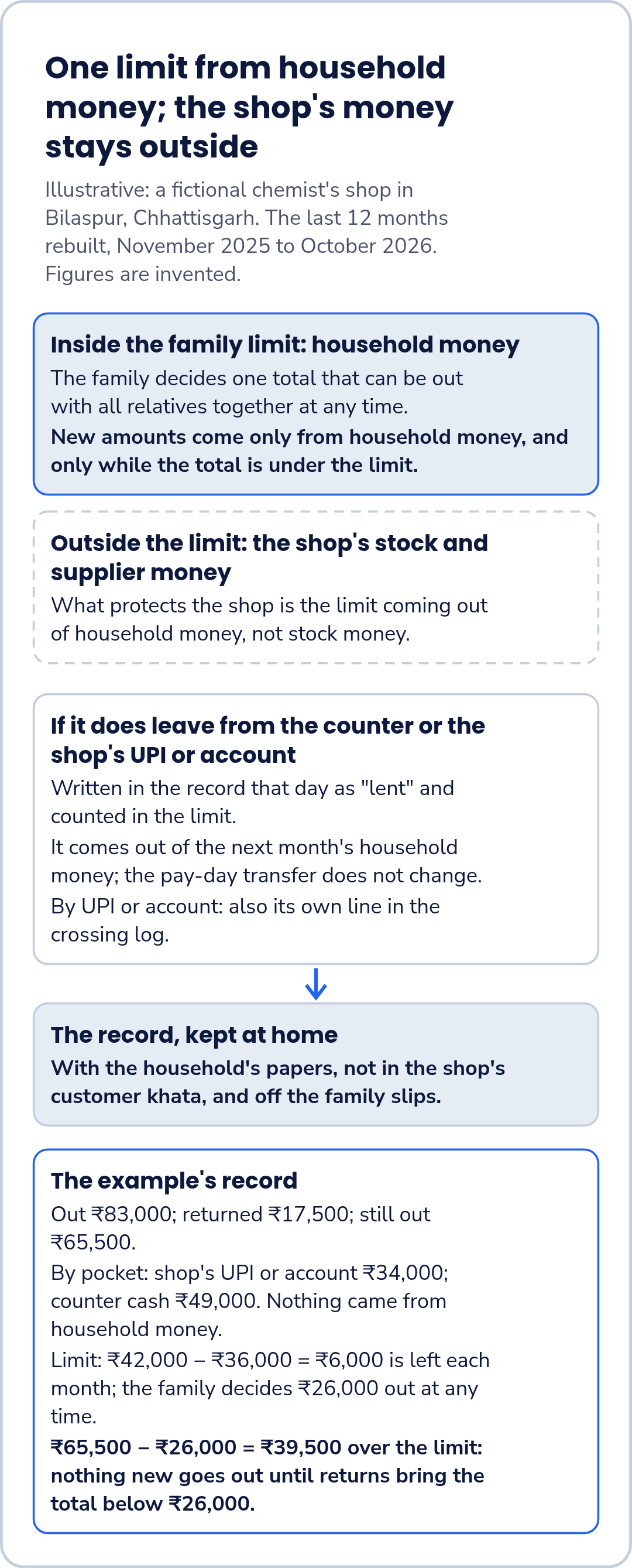
"It's family. Writing it down will insult them." The record is the family's own, kept at home, and mostly about which pocket the money came from. What protects the shop is the limit coming out of household money, not stock money.
Why money lent from the counter goes missing
When it leaves from the nearest pocket, the galla or the shop's UPI, and nothing is written, part repayments are forgotten and nobody can say what is still out. Then the shop can be short when stock or a supplier is due (see the guide to off-season cash and season stock).
Writing money lent to relatives down the same day, keeping it apart from customer udhaar, one family total set in advance with nothing new until something comes back, a monthly look, noting which pocket each amount left from, treating lending as neither spending nor income, labelling till withdrawals, and basing a family-help limit on your own budget are already covered in published guides and khata apps.
This page's part, for a shop owner: the limit comes out of household money, so the shop's stock and supplier money sit outside it, plus two ties to the shop's own records.
Step 1: List the amounts lent so far
From the shop's bank statement, UPI history, day-close notes and memory, write one line per amount handed over: who, when, how much, from which pocket, and anything already returned. Where you are unsure of a date or an amount, write "not sure" rather than guess.
Step 2: One record, kept apart from the shop's khata and the family slips
Keep one record with these columns: date, who, amount, from (counter cash, shop's UPI or account, or household money), what for (in their words), when they said they'd return it (as they said it), returned (date and amount), and still out.
Keep it with the household's papers, not in the shop's customer khata, and off the family slips (the notes family members write when they take cash or pay for something for home from the shop) in owner's pay from the shop: slips are household spending, while money lent is expected back.
Step 3: One family limit, from household money
Look at what is left each month from the owner's monthly amount (the fixed sum the owner takes home from the shop each month) after the household's base month (what the household must spend every month, whatever the shop does) and its monthly share for yearly bills, as worked out in a household budget when the business pays you unevenly. From that, the family decides one total that can be out with all relatives together at any time.
New amounts come only from household money, and only while the total is under the limit. There is no formula; the limit is the family's own decision.
Step 4: When it leaves from, or comes back to, the shop
If an amount does go from the counter or the shop's UPI or account, it is written in the record that day as "lent" and counted in the limit. Like the family slips in owner's pay from the shop, it is on top of the owner's amount and comes out of the next month's household money; the pay-day transfer does not change. That is a family rule, agreed at home.
If it went by UPI or account, it also goes in the crossing log in separating business and personal money as its own line; a repayment received into the shop's UPI or account is its own line too. The crossing log is a list of each time the shop's money pays for something personal, or personal money pays for the shop. Cash lent from the counter goes in this record, not on a family slip.
Step 5: One line each month
Add one line to the family's monthly page: total out against the limit, and anything returned. If a return is expected next week, it is one line in the weekly money look after the week's last day close.
Worked example: a Bilaspur chemist's shop
Illustrative example: a fictional chemist's shop (medicines and daily needs) in Bilaspur, Chhattisgarh, run by the owner with his younger brother and one counter helper. Figures are invented; verify independently.
Step 1, the last 12 months rebuilt (November 2025 to October 2026).
| Who | Out (₹) | From | Returned (₹) | Still out (₹) |
|---|---|---|---|---|
| A family friend (December 2025) | 11,000 | Shop's UPI | 11,000 (January 2026) | 0 |
| A cousin (February 2026) | 23,000 | Shop's account, by UPI | 6,500 (June 2026) | 16,500 |
| The brother-in-law (March 2026) | 18,000 | Counter cash | 0 | 18,000 |
| The brother-in-law (May 2026) | 18,000 | Counter cash | 0 | 18,000 |
| An uncle (August 2026) | 13,000 | Counter cash | 0 | 13,000 |
| Total | 83,000 | 17,500 | 65,500 |
By pocket: shop's UPI or account ₹34,000 (11,000 + 23,000); counter cash ₹49,000 (18,000 + 18,000 + 13,000). Nothing came from household money. The March line is marked "not sure of the exact day".
Step 3, the limit. The owner's monthly amount is ₹42,000 and the household's base month plus its monthly share for yearly bills is ₹36,000, so ₹42,000 − ₹36,000 = ₹6,000 is left each month. The family decides a total of ₹26,000 out at any time. With ₹65,500 out, the record is ₹65,500 − ₹26,000 = ₹39,500 over the family's limit, so under the family's own rule nothing new goes out until returns bring the total below ₹26,000, and then only up to the room left.
Step 4. The two UPI or account amounts (₹11,000 and ₹23,000) and the two UPI repayments (₹11,000 and ₹6,500, both received into the shop's account) are four separate lines in the crossing log.
What to take to your CA or lawyer
Bring the record, the crossing-log lines and the dates. Anything about written agreements, interest, getting money back, or how these amounts are treated in the books or for tax is for your CA or lawyer; ask them.
Printable record
| Date | Who | Amount (₹) | From | What for |
|---|---|---|---|---|
| Date | Who | When they said they'd return it | Returned (date, ₹) | Still out (₹) |
|---|---|---|---|---|
Family limit ₹____ | Total out today ₹____ | Room left ₹____ | Looked at on ____
Writing down money lent to family?
If you would like to hear about FastComply Books for your business, you can request early access. FastComply Books is in an invitation pilot in India and public sign-up is not open yet.