
Take last year's bank statement and takings records and write down, month by month, the money that came in and the money that went out. The months where more came in than went out are your busy months; the ones where more went out are your quiet months. Add up what each quiet month fell short by, and add the stock you bought for the next season before its sales started. That total is what last year's quiet months and the next season's stock needed from the busy months' surplus. It is your own sum, not a rule, and you can adjust it for anything you already know is different this year.
This uses figures you already have. It does not need a sales estimate for the year ahead.
Why the busy season feels richer than it is
In the busy months the bank balance climbs and everything feels comfortable. But rent, salaries and loan instalments carry on through the quiet months at the same level, and stock for the next season may have to be paid for before that season's takings arrive. Part of the busy season's money is already spoken for. The trouble is that nobody can see how much until the quiet months are under way.
Last year, month by month
From last year's bank statement and takings records, make one row per month:
- Money in: takings for the month.
- Fixed money out: rent, salaries, loan instalments and other regular payments.
- Day-to-day stock: the top-ups you buy to keep the shelves going.
- Season stock: the larger purchases for the next season.
Yearly payments such as insurance, maintenance contracts and subscriptions belong in the month they were paid, so a quiet month that also carried a renewal shows up as it was.
The year's shape
For each month, work out:
Surplus or shortfall (before season stock) = money in − fixed money out − day-to-day stock
Mark the months with a surplus as busy and the months with a shortfall as quiet. Keep the season stock on its own line, with the month you started buying it, so a large season order does not make a month look quiet or get counted twice. Seeing the year this way shows you how long the quiet stretch lasts and where the season stock lands in it.
Your carry-through amount
Carry-through amount = the quiet months' shortfalls (before season stock) added up + the season stock bought before the season's sales start
This is not a new idea; it is simply what last year's own months added up to, taken from your bank statement, with no rule or percentage on top. It is what last year needed, not an amount you must keep. Adjust it for what you already know has changed: a rent increase, a new member of staff, a larger season order.
Money held in stock before the season is cash you cannot use for anything else until it sells.
Checking it during the busy months
At each month-end in the busy season, put the bank balance next to the part of the carry-through amount still to come. If the balance is building towards it, carry on. If it is not, you see that while there are still busy months left, not when the quiet months have begun.
To plan cash week by week, see our 13-week cash plan guide.
If the season doesn't cover it
If your carry-through amount is more than the busy season leaves you, that is worth knowing early. Whether to borrow is a conversation with your bank and your accountant. Where to keep surplus cash is outside this page.
Worked example: a woollens shop's year
Illustrative example: a fictional woollen-garments and shawl shop in Shimla; last year's figures.
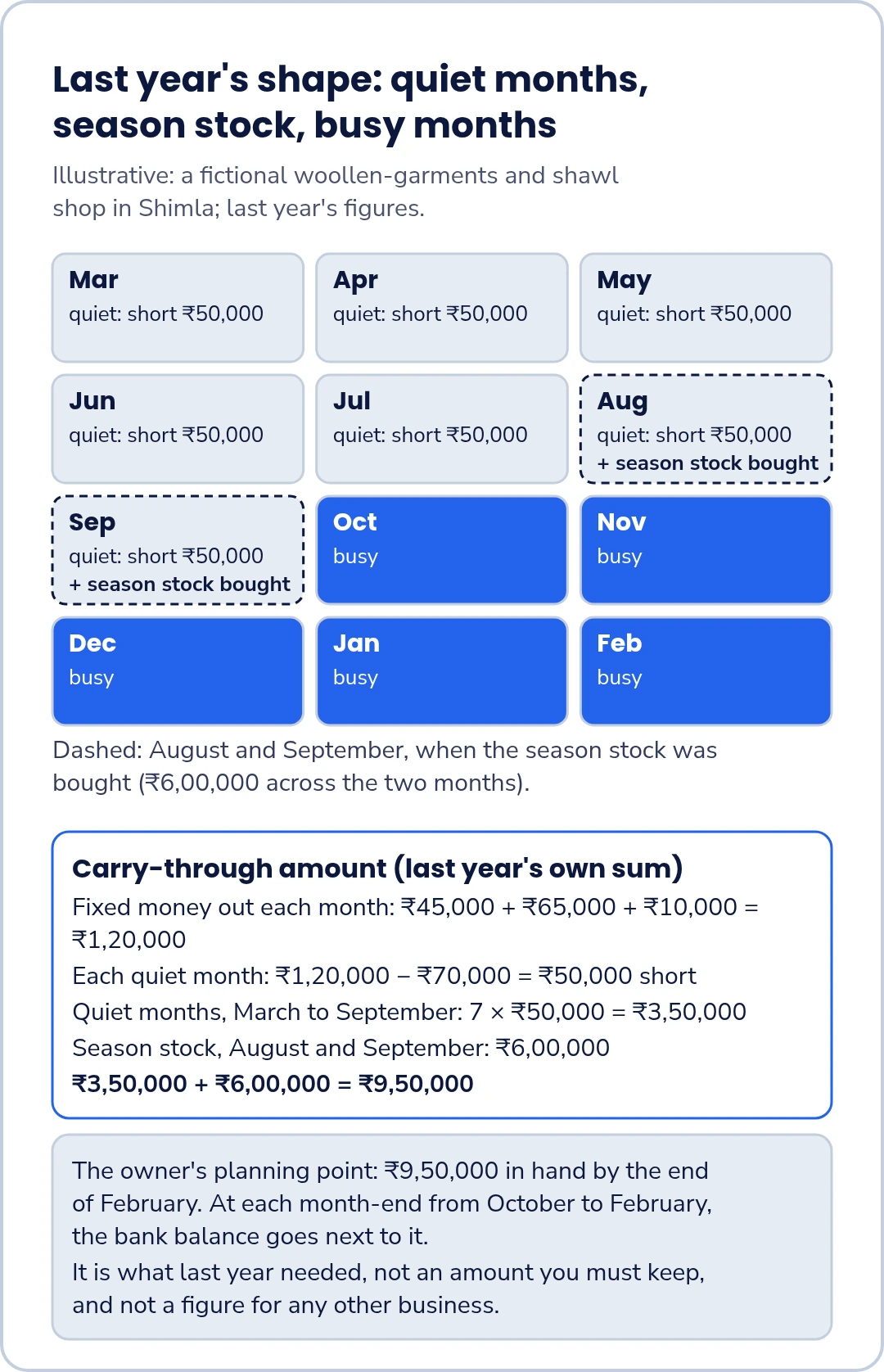
The shop's busiest months run from October to February. From last year's bank statement and takings records, the owner found:
Fixed money out every month: rent ₹45,000 + salaries ₹65,000 + other regular payments ₹10,000 = ₹1,20,000.
Quiet months, March to September (7 months): takings less day-to-day stock top-ups averaged ₹70,000 a month. Each quiet month fell short by ₹1,20,000 − ₹70,000 = ₹50,000. Over seven months, 7 × ₹50,000 = ₹3,50,000.
Season stock: bought in August and September, ₹6,00,000. This is separate from the day-to-day top-ups already taken off the ₹70,000.
Carry-through amount: ₹3,50,000 + ₹6,00,000 = ₹9,50,000.
| Line | Amount |
|---|---|
| Quiet months' shortfalls, March to September (7 × ₹50,000) | ₹3,50,000 |
| Season stock, August and September | ₹6,00,000 |
| Carry-through amount | ₹9,50,000 |
The owner's planning point is to have that ₹9,50,000 in hand by the end of February from the busy months' takings. This is this owner's own sum from last year, not a figure for any other business; at each month-end from October to February, the owner puts the bank balance next to it.
12-month sheet
| Month | Money in | Fixed money out | Day-to-day stock | Surplus or shortfall before season stock (in − fixed − day-to-day) | Busy or quiet | Season stock bought |
|---|---|---|---|---|---|---|
Carry-through box
| Line | Amount |
|---|---|
| Quiet months' shortfalls (before season stock), added up | |
| Season stock bought before the season's sales start | |
| Adjustments you already know about this year | |
| Carry-through amount |
Talk through your books in a demo
If you would like to talk through how your business keeps its books, request a demo and choose "Book a demo" on the form. FastComply Books is in an invitation pilot in India, so the demo is where we confirm what is available for your business.