Keep a list of every business loan, keep each lender's repayment schedule, and download the loan statement regularly. Once a month, check each loan in four lines: the opening balance the lender shows, the EMI that left your bank, the principal and interest split as the lender's statement shows it, and the closing balance the lender shows. Compare that closing balance with the loan balance in your books. If they differ, find the reason from a short list and send it to your accountant with the lender's statement attached.
This article covers loans from banks and other lenders; money lent by the owner or family is a separate topic for your accountant.
When your loan balance doesn't match the lender's loan statement
An EMI is usually the same amount every month, but what it is made of is not. Part of each EMI pays interest and part reduces the loan, and the split between the two can change from one EMI to the next. Only the lender's repayment schedule and loan statement say how much of a given EMI went to each.
If the whole EMI is recorded against the loan, or an auto-debit is entered twice, or the lender adds a charge to the loan, the balance in your books drifts away from the lender's figure. A month at a time, the gap is easy to explain. Left until the year end, it means going back through every EMI.
Make a loan list
Add one row per loan:
| Lender | Loan / account no. | Type | Amount taken | Date taken | EMI | EMI date | Schedule and statements kept at | End date |
|---|---|---|---|---|---|---|---|---|
| Term / vehicle / machinery / other |
Put overdraft or cash-credit facilities on the list too, so you can see everything you owe in one place. Their balance is checked against the bank statement rather than with the monthly loan check below.
Keep the repayment schedule and the loan statement
- Repayment schedule. Keep the schedule the lender gave you when the loan was sanctioned or disbursed. It shows the planned EMIs and how each is expected to split.
- Loan statement. Download the lender's loan statement each month if your lender provides one. If it only comes quarterly, ask the lender whether a monthly statement is available; if not, run the check below for each quarter when the statement arrives. The schedule is a plan; the statement is what actually happened.
- If the rate changes, ask the lender for a revised repayment schedule.
The monthly loan check
For each loan, fill in four lines and compare:
| Line | Source |
|---|---|
| 1. Opening outstanding | Lender's loan statement |
| 2. EMI paid | Your bank statement |
| 3. Principal and interest in that EMI | Lender's loan statement |
| 4. Closing outstanding | Lender's loan statement |
| Loan balance in your books | Your books |
| Difference | The lender's closing outstanding (line 4) minus the loan balance in your books |
If the difference is zero, the two agree. If it is more than zero, your books show less owed than the lender does; if it is less than zero, your books show more.
Never work out the split yourself. Take both figures from the lender's statement.
Why the two figures differ
| Cause | What you see |
|---|---|
| Whole EMI recorded against the loan | Books lower than the lender by the interest |
| EMI not entered in the books | Books higher than the lender |
| EMI entered twice, for example an auto-debit plus a manual entry | Books lower than the lender |
| EMI bounced, with charges | An extra charge on the loan statement, or a missing EMI |
| Fees, insurance or charges added to the loan by the lender | Lender's balance higher than the books |
| Rate change | The split differs from the original schedule |
| Prepayment recorded only in the bank | Lender's balance lower than the books |
How each of these is recorded is your accountant's decision. Ask your accountant how loan interest, fees and charges are recorded.
Who does what
The bookkeeper does the monthly check. Any difference goes to the accountant with the lender's loan statement attached, and stays on the list of open questions until it is answered.
For planning future EMIs, include them as a fixed line in your 13-week cash flow forecast.
Worked example: a pest-control company in Lucknow
Illustrative example: a fictional pest-control services company in Lucknow; figures taken from an illustrative lender schedule. All details are invented.
The company has about 20 technicians and office staff, a term loan for its spraying and fogging equipment and a vehicle loan for a service van. The bookkeeper runs the monthly check.
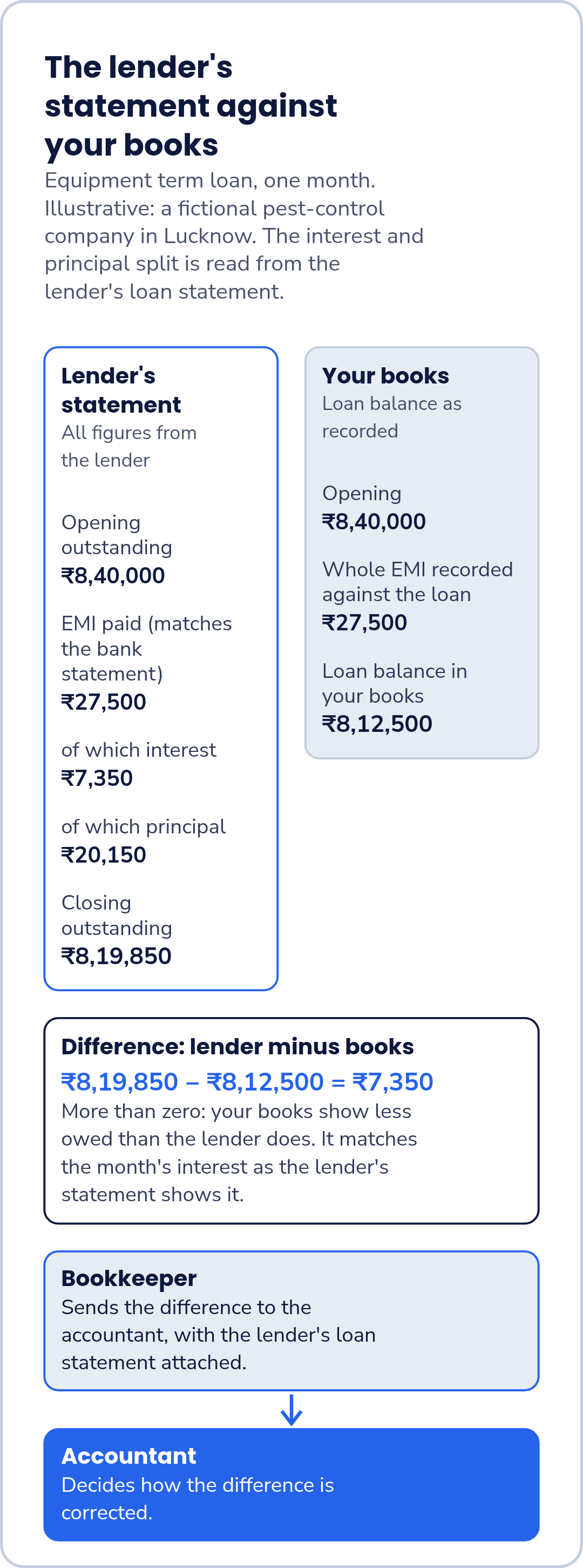
Equipment term loan. The lender's loan statement shows:
| Line | Lender's figure |
|---|---|
| Opening outstanding | ₹8,40,000 |
| EMI paid (matches the bank statement) | ₹27,500 |
| of which interest | ₹7,350 |
| of which principal | ₹20,150 |
| Closing outstanding | ₹8,19,850 |
₹7,350 + ₹20,150 = ₹27,500, and ₹8,40,000 − ₹20,150 = ₹8,19,850.
The books show the loan at ₹8,12,500. That is ₹8,40,000 − ₹27,500: the whole EMI was recorded against the loan. The difference is ₹8,19,850 − ₹8,12,500 = ₹7,350, which matches the month's interest as the lender's statement shows it. The bookkeeper sends the difference to the accountant with the lender's loan statement attached. How it is corrected is the accountant's decision.
Service-van loan. The lender's closing outstanding is ₹3,26,400 and the books show ₹3,26,400. Nothing to do.
Templates
Loan list: as shown above.
Monthly loan check (one block per loan):
| Loan | Opening (lender) | EMI paid (bank) | Interest (lender) | Principal (lender) | Closing (lender) | Books | Difference | Cause | Sent to accountant on |
|---|---|---|---|---|---|---|---|---|---|
Keeping your loan records in step?
If you would like to hear about FastComply Books for your business, you can request early access. FastComply Books is in an invitation pilot in India and public sign-up is not open yet.