A wastage log for a shop or kitchen is one line for each item thrown away, written at the bin when it is binned: what it was, how much, what it cost the shop, why, and who binned it. At month end, total it by item and reason, pick the top five by value with one change each, and hand the month's figure to your accountant.
Why the bin doesn't get smaller: nobody knows which items
In a sweet shop, bakery, café or grocery that keeps no wastage log, leftovers are binned at closing, a dropped tray is swept up, a kitchen batch that went wrong is thrown out, and none of it is written down. At month end the owner knows a lot went in the bin, but not which items, what it cost, or whether this month was worse than last.
"Some wastage is normal with fresh sweets; writing it down won't change anything." Some will always go. The log shows which items and why, so the owner can change the one or two that cost the most. In the example below, five items made up about 90% of the month's wastage.
Logging at the bin as it happens, a short fixed list of reasons, costing at what the item cost rather than its selling price, a name on each line (with a second signature on some), samples and staff food as reasons of their own, weekly or monthly totals by item and reason with the biggest fixed first, and changing batch sizes from the log are all common practice in wastage templates and bakery software. So is the point that waste nobody logs turns up later as a stock-count shortfall. This page is the plain paper routine for a small shop with a back kitchen.
The log
One line per item thrown away:
- date
- item, quantity and unit
- cost per unit: what it cost the shop, from the kitchen's costing or the purchase bill
- value
- reason: unsold at close, spoiled before sale, dropped or damaged, kitchen batch failed, or tasting, samples and staff
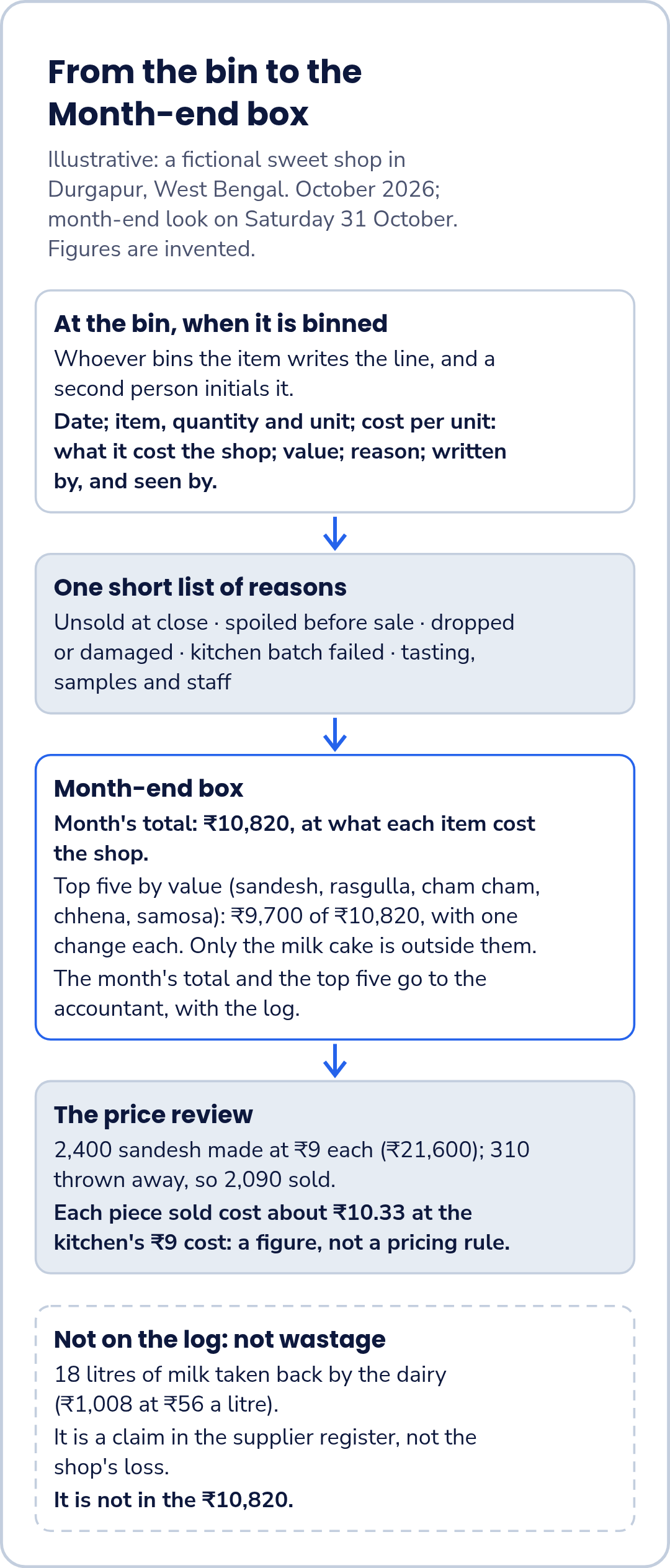
- written by, and seen by
Print the reason list at the top of the sheet so everyone uses the same words. The log records what was thrown away; it never decides whether something should be.
Whoever bins it writes it
The sheet hangs by the bin, not in the office. Whoever bins the item writes the line, and a second person initials it, as published templates also suggest.
What doesn't go on the log
Goods a supplier takes back are not the shop's own loss, so they stay off this log: sour milk returned to the dairy, or a damaged carton the distributor replaces. They go in the supplier claims register instead. Customer returns are a separate matter. Stock sold at a markdown isn't wastage either; a published bakery guide already makes that point.
The month-end look
On the last working day of the month, the owner and the kitchen head total the sheets by item and by reason. Take the top five items by value and write one change beside each for next month: batch size, display or handling. (The timing is the example shop's own choice.)
Two neighbouring jobs use the same figures. Wastage is one reason a monthly stock count comes up short, and an item that keeps spoiling is one to stop reordering at the same level.
Two places the figure goes
The accountant. The month's total, the top five and the sheets go into the monthly records pack for your accountant, along with one question: ask your accountant how wastage is recorded in the books. Some bakery software exports wastage records for the accountant, and a published waste-log template notes that written-off stock reaches the cost of goods sold; the paper version stops at handing the figure over.
The price review. When some pieces of an item are thrown away, each piece sold carries their cost too, so it costs more per piece sold than per piece made. Work that figure out for the item and take it to your yearly price-list review as a figure, not a pricing rule. Some software puts wastage into a product's margin for the same reason: a loss nobody records never reaches the price.
Worked example: a Durgapur sweet shop's October
Illustrative example: a fictional sweet shop in Durgapur, West Bengal, with the owner and seven staff (three in the back kitchen, four at the counter), making sandesh, rasgulla, cham cham, milk cake and samosas in its own kitchen and selling them over its own counter. October 2026; month-end look on Saturday 31 October. Figures are invented; verify independently.
| Item | Thrown away | Cost per unit (₹) | Value (₹) | Main reason |
|---|---|---|---|---|
| Sandesh | 310 pcs | 9 | 2,790 | Unsold at close |
| Rasgulla | 420 pcs | 6 | 2,520 | Spoiled before sale (chiller off in a power cut, Thu 22 Oct) |
| Cham cham | 150 pcs | 11 | 1,650 | 90 unsold at close; 60 dropped (a tray, Tue 27 Oct) |
| Chhena (kitchen) | 6 kg | 240 | 1,440 | Kitchen batch failed (Tue 13 Oct) |
| Samosa | 260 pcs | 5 | 1,300 | Unsold at close |
| Milk cake | 4 kg | 280 | 1,120 | Dropped or damaged (a tray, Tue 6 Oct) |
| Total | 10,820 |
Each value is the quantity times the cost per unit (310 × ₹9 = ₹2,790, and so on).
By reason:
| Reason | ₹ | Made up of |
|---|---|---|
| Unsold at close | 5,080 | sandesh 2,790 + samosa 1,300 + 90 cham cham 990 |
| Spoiled before sale | 2,520 | rasgulla |
| Dropped or damaged | 1,780 | 60 cham cham 660 + milk cake 1,120 |
| Kitchen batch failed | 1,440 | chhena |
| Total | 10,820 |
Top five by value (sandesh, rasgulla, cham cham, chhena, samosa): ₹9,700 of ₹10,820 (89.6%). Only the milk cake is outside them.
Not on the log: 18 litres of milk that arrived sour on Fri 16 Oct and was taken back by the dairy (₹1,008 at ₹56 a litre). It is a claim in the supplier register, not the shop's loss. It is not in the ₹10,820.
Price review line: 2,400 sandesh were made in October at ₹9 each (₹21,600); 310 were thrown away, so 2,090 were sold, and each piece sold cost about ₹10.33 at the kitchen's ₹9 cost (₹21,600 ÷ 2,090). That figure goes to the price review; this page does not say what the price should be.
The owner's notes for November (this shop's own decisions): smaller weekday sandesh batches; a question to the electrician about keeping the chiller running in a power cut; the chhena failure noted for the kitchen head.
Template
Wastage log (reasons: unsold at close / spoiled before sale / dropped or damaged / kitchen batch failed / tasting, samples and staff)
| Date | Item | Qty and unit | Cost per unit (₹) | Value (₹) |
|---|---|---|---|---|
| Date | Item | Reason | Written by | Seen by |
|---|---|---|---|---|
Not on this log: anything the supplier took back goes to the supplier claims register.
Month-end box
- Month's total: ₹___
- Top five by value, with one change each: 1. ___ 2. ___ 3. ___ 4. ___ 5. ___
- Sent to accountant on ___
Writing down what goes to waste?
If you would like to hear about FastComply Books for your business, you can request early access. FastComply Books is in an invitation pilot in India and public sign-up is not open yet.