Once a year, in a month you choose, go through your price list one item at a time. For each item, write down four figures: the price you charge now, what the item cost you when you set that price, what it costs you on the latest bill, and when the price was last changed. Work out the margin with the old cost and with today's cost, side by side. Then write a decision against each item in your own words. The review does not tell you to raise anything. It shows you how much of each price is left after what you pay today, so whatever you decide, you decide on purpose.
If you already update a price whenever a supplier's bill goes up, this yearly sweep catches what bill-by-bill updates miss: the prices nobody touched, whose costs moved in small steps that never seemed worth acting on.
Items with a printed MRP have their own rules; this page does not cover them.
How small cost rises go unnoticed
A supplier's rate goes up a little. A few months later, another one does. Each change is too small to rewrite the rate board for, so the list stays as it was. Sales look steady, but less is left at the end of the month, and nobody can point to the item where it went. A price list that was last set a year or two ago is built on costs that may no longer be true.
Once a year, item by item
Pick one month for the review. A quieter month makes it easier to sit with the list for an evening or two. Take every item on the price list, rate board or rate card, including services such as repairs or fixed-rate jobs, not only goods.
Four figures per item
- Selling price now: what is on the list today.
- Cost when that price was set: from the bill or your own costing at that time, if you have it.
- Cost now: from the latest bill, or your current costing for a service.
- Date the price was last changed.
If you do not have the old cost for an item, leave it blank this year and fill in today's cost. Next year you will have both.
Margin then and now
For each item, work out the margin with each cost:
Margin = (price − cost) ÷ price
Margin here is worked on the price, not the cost.
Put the two margins next to each other. The gap between them shows how far each item has moved since its price was set.
The decision column
Against each item, write what you will do and why, in your own words. For example: keep the price, change it from a date, talk to the supplier first, or stop offering the item. No target margin is suggested here; how much margin each item should carry is your judgement, made with what you know about your customers and your costs.
If some customers are on agreed rates of their own, those are checked separately against what was agreed.
Worked example: a bicycle shop's repair counter
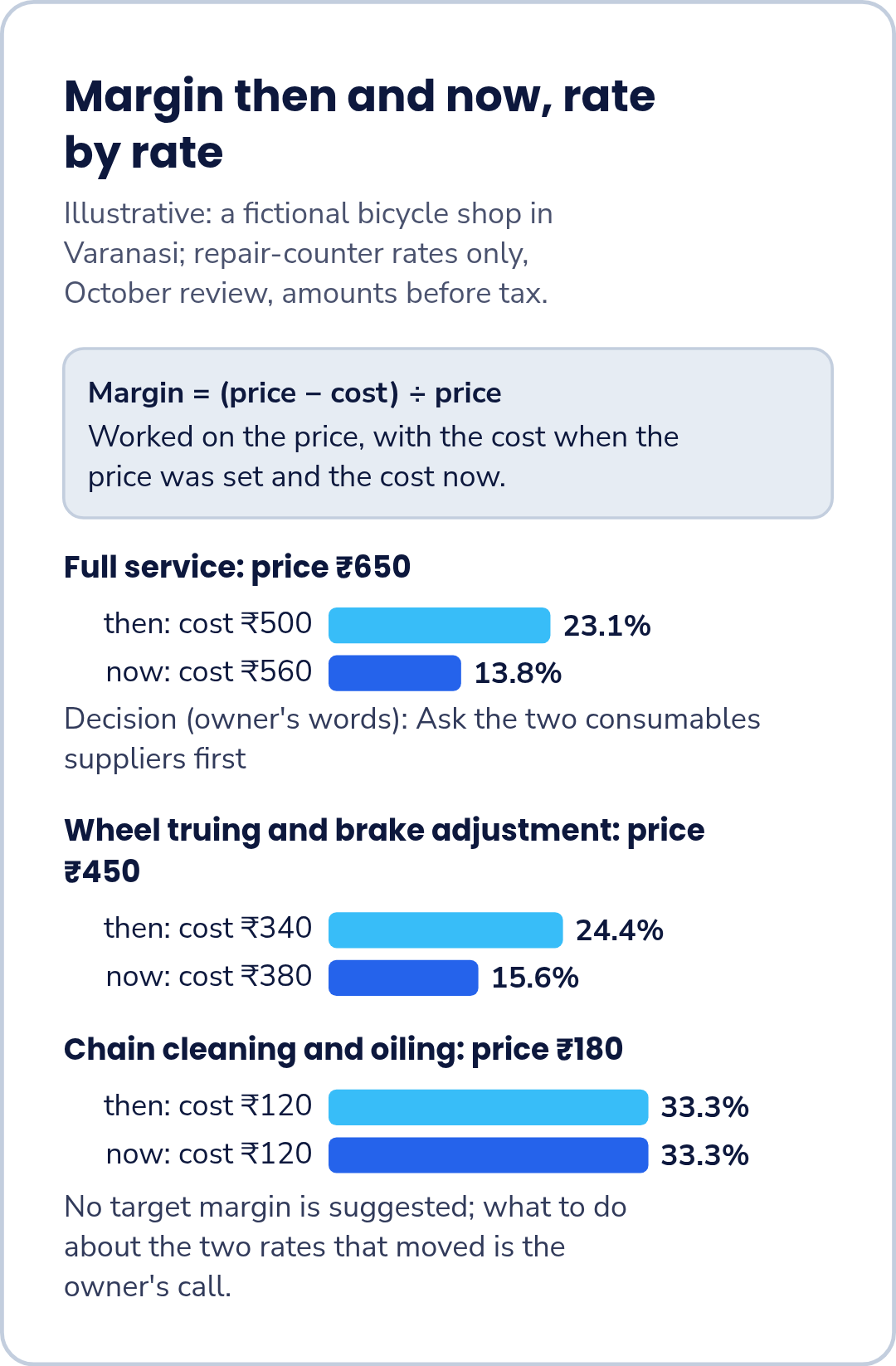
Illustrative example: a fictional bicycle and spare-parts shop in Varanasi; repair-counter rates, October review, amounts before tax. Repair rates are used, with no parts sold, so that no packaged item with a printed MRP is in the example.
The owner reviews three rates from the repair counter's rate list:
- Full service (the mechanic's time and workshop consumables such as grease, oil and cleaner): price ₹650; cost then ₹500 → margin 23.1% (150 ÷ 650); cost now ₹560 → 13.8% (90 ÷ 650).
- Wheel truing and brake adjustment (the mechanic's time and workshop consumables): price ₹450; cost then ₹340 → 24.4% (110 ÷ 450); cost now ₹380 → 15.6% (70 ÷ 450).
- Chain cleaning and oiling (the mechanic's time and workshop consumables): price ₹180; cost then and now ₹120 → 33.3% (60 ÷ 180), unchanged.
Working: ₹650 − ₹500 = ₹150 and ₹650 − ₹560 = ₹90; ₹450 − ₹340 = ₹110 and ₹450 − ₹380 = ₹70; ₹180 − ₹120 = ₹60.
| Item | Price | Cost then | Margin then | Cost now | Margin now | Decision (owner's words) |
|---|---|---|---|---|---|---|
| Full service | ₹650 | ₹500 | 23.1% | ₹560 | 13.8% | Ask the two consumables suppliers first |
| Wheel truing and brake adjustment | ₹450 | ₹340 | 24.4% | ₹380 | 15.6% | |
| Chain cleaning and oiling | ₹180 | ₹120 | 33.3% | ₹120 | 33.3% |
The owner writes each decision in the last column. The two rates that moved stand out next to the one that did not; what to do about them is the owner's call.
Review sheet
| Item | Selling price now | Cost when price was set | Margin then | Cost now (latest bill or costing) | Margin now | Price last changed | Decision and reason |
|---|---|---|---|---|---|---|---|
Talk through your books in a demo
If you would like to talk through how your business keeps its books, request a demo and choose "Book a demo" on the form. FastComply Books is in an invitation pilot in India, so the demo is where we confirm what is available for your business.