Replacement and warranty claims on faulty or defective goods sent back to suppliers are easy to lose track of. Keep one register row per claim, listing each unit's serial number, write it before the units leave, follow up on fixed dates, and count a credit only once it shows on the supplier's statement.
Why returned goods get forgotten
A showroom or small trader sends units back to its distributors all the time: a unit dead out of the carton, or one a customer returned within days that the shop exchanged from its own stock. Someone says "replacement next week", and three months later nobody knows which units are still with which supplier, which credits came, or which customer is still waiting.
"The distributor's salesman is honest; he always sorts it out eventually." Usually he does. The register isn't about trust. With four suppliers and units going back every week, nobody can remember which ones are still out. One line per claim, with each unit's serial number, and a look every fortnight is enough.
Tracking each return through to a replacement or a credit, with photos, serial numbers and proof of purchase, and a view of what is still out with each supplier, is common practice in returns software. Some of it also ties a return to the supplier's statement, or links a customer's claim to what is recovered from the supplier. This page is the manual version for a shop without it.
The claims register
One row per claim, with these columns:
- claim number and date sent
- supplier, item, quantity and the serial number of each unit
- purchase bill number and cost (₹, at what you paid, not the selling price)
- why it went back: faulty on arrival, or returned by a customer
- customer waiting? (name and phone)
- how it went: salesman's name, or courier and docket number
- what you asked for: replacement, repair or credit
- the supplier's reference
- next follow-up date
- outcome: replaced on __, credit seen on statement dated __, or refused (reason copied as written)
- closed date
At a stock count, list the units that are out with suppliers, so the count doesn't miss them.
Before a unit leaves
Nothing leaves without its line. Before the units go, write the claim row, check each serial number against its unit, and have the person taking them sign, or keep a photo of what they signed.
If a unit goes to the brand's service centre instead of back to the distributor, write in the same row where it went and the job or reference number it was given.
This register starts once a unit is sent back. Shortages and damage found when goods arrive are held against the bill at delivery, as set out in matching orders, deliveries and bills; a loss claimed from an insurer belongs in an insurance claim file.
When a customer is waiting for a replacement
When a customer's own unit is in a claim, give that row a shorter follow-up date, and call the customer with an update on that date, whatever the supplier has said. That call is a courtesy the shop chooses to make.
The fortnightly follow-up and the written-reminder rule
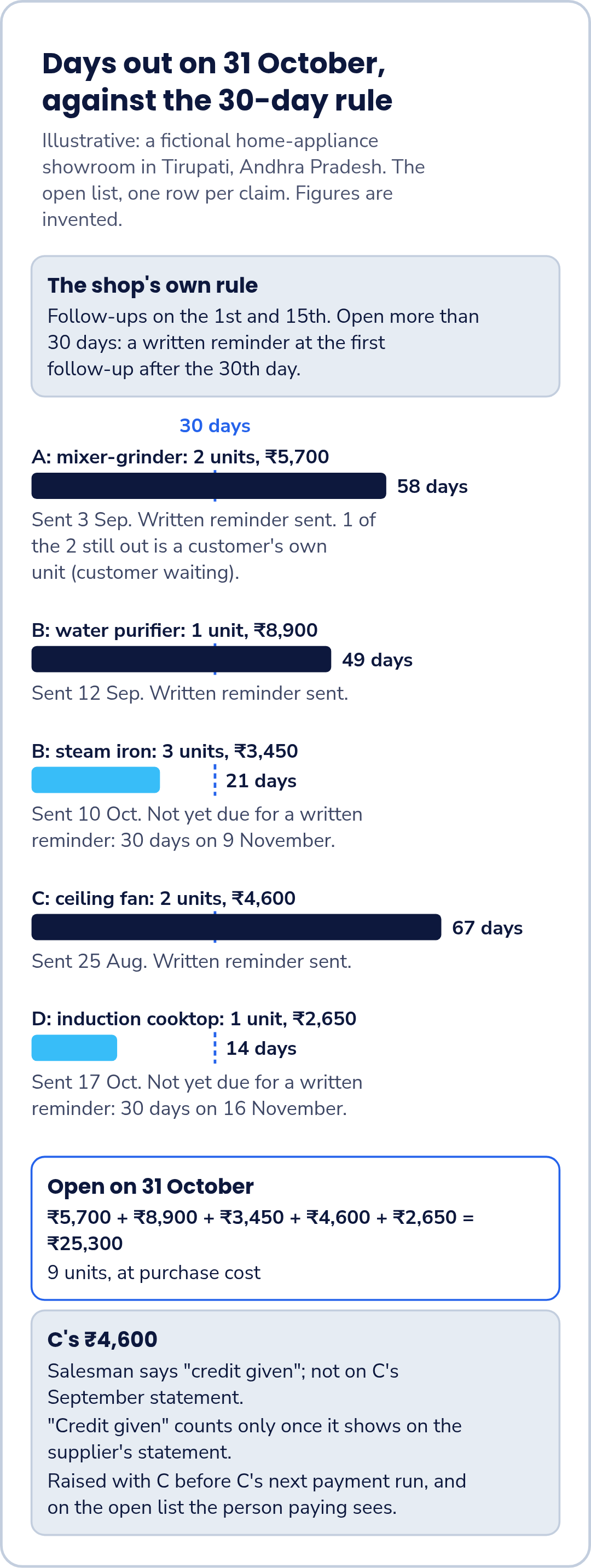
In the example below, the shop's own rule is the 1st and 15th of each month: every open row gets a call or message to the supplier, and the reply is written in the row. Its written-reminder rule is that anything open more than 30 days gets a written reminder, sent at the first follow-up after the 30th day, listing the units and their serial numbers. These are the example's rules, not a standard.
Checking credits against the supplier's statement, and the payment run
"Credit given" counts only once it shows on the supplier's statement. Once a month, check the open list against each supplier's statement, as part of checking a supplier's statement against your books. Take the open list to the payment run too, so the person paying knows what is still owed back.
When a claim is refused
Copy the supplier's reason into the row exactly as written; the owner decides what to do next. Ask your accountant what paperwork should go with goods sent back, and how a return or a refused claim is recorded. What a supplier must replace depends on your terms with them and the maker's warranty; read those, and ask your lawyer if it matters.
Worked example: a Tirupati appliance showroom
Illustrative example: a fictional home-appliance showroom in Tirupati, Andhra Pradesh, with the owner and 5 staff, selling mixer-grinders, irons, fans, water purifiers and induction cooktops bought from four distributors, A, B, C and D. Figures are invented; verify independently.
The open list as at 31 October, one row per claim:
| Claim | Units | Cost (₹, at purchase cost) | Sent | Days out (31 Oct) |
|---|---|---|---|---|
| A: mixer-grinder | 2 | 5,700 (2 × 2,850) | 3 Sep | 58 |
| B: water purifier | 1 | 8,900 | 12 Sep | 49 |
| B: steam iron | 3 | 3,450 (3 × 1,150) | 10 Oct | 21 |
| C: ceiling fan | 2 | 4,600 (2 × 2,300) | 25 Aug | 67 |
| D: induction cooktop | 1 | 2,650 | 17 Oct | 14 |
| Open | 9 | 25,300 |
| Claim | Note |
|---|---|
| A: mixer-grinder | 4-unit claim: the other 2 were replaced 20 Oct; 1 of the 2 still out is a customer's own unit (customer waiting) |
| B: water purifier | Supplier asked for photos twice |
| B: steam iron | Not yet due for a written reminder |
| C: ceiling fan | Salesman says "credit given"; not on C's September statement |
| D: induction cooktop | Not yet due for a written reminder |
Three claims (A at 58 days, B's purifier at 49 and C at 67) passed 30 days before the 15 October follow-up, so written reminders have gone out. B's irons reach 30 days on 9 November and D's cooktop on 16 November, so each gets its written reminder at the first follow-up after that. C's ₹4,600 is raised with C, with C's September statement, before C's next payment run, and it is on the open list the person paying sees at that run.
Closed in October: A's 2 mixer-grinders replaced; a table fan's ₹1,900 credit seen on B's statement; and one steam iron bought from D (a separate claim, not one of B's three) refused by D, reason copied as written: "physical damage, not covered".
Template
Claims register
What went back:
| Claim no. | Date sent | Supplier | Item | Qty | Serial no. of each unit |
|---|---|---|---|---|---|
Why, and how:
| Claim no. | Bill no. | Cost (₹) | Why sent back | Customer waiting? (name, phone) | How it went |
|---|---|---|---|---|---|
Follow-up and outcome:
| Claim no. | Asked for | Supplier's ref. | Next follow-up | Outcome | Closed |
|---|---|---|---|---|---|
Follow-up line: claim __, called __, reply __, next date __.
Keeping each supplier claim on one page?
If you would like to hear about FastComply Books for your business, you can request early access. FastComply Books is in an invitation pilot in India and public sign-up is not open yet.