Give each collector one handover slip a day, listing every payment against its invoice and receipt number, with totals by mode. Count the cash together and both sign. Check UPI payments in the bank app; only cash is counted. Put post-dated cheques straight into your post-dated cheque register. Check that every receipt number used that day is on the slip or cancelled with all its copies. Write any difference on the slip with the collector's reason, have someone other than the collector update the books from the slip the same day, and once a week read back to three customers what the books show they paid.
Why a single total at the end of the day isn't enough
When a collector comes back from the route and hands over a bag with one figure, "₹1,02,000 today", nobody can tell which dealer paid what, against which invoice, or in which mode. A difference found later cannot be traced to a customer. A payment entered against the wrong dealer shows up only when that dealer disputes a reminder.
Much of what follows is common practice: invoice-wise collection slips are standard in distributor software; counting together, keeping UPI separate, writing shortages down and settling the same evening are widely recommended; and checking receipt numbers and calling a few customers each week to read back what they paid are common checks. This page puts them into one paper routine for a small distributor without a collection app, with post-dated cheques going straight into the cheque register and the books updated the same day by someone other than the collector.
The handover slip for salesman / collection staff
One slip per collector per day, with one line per payment: customer, invoice number(s), receipt number, mode (cash, UPI or cheque) and amount. At the bottom: the total for each mode, the first and last receipt numbers used, any difference and its reason, and two signatures: the collector's and the person receiving.
Count the cash together, with the collector, before either of you signs.
UPI and cheques: check them, don't count them
Check UPI payments in the bank app; only cash is counted.
Every cheque goes on the slip. Post-dated cheques also go straight into your post-dated cheque register, with the place each one is kept, and from then on follow that register's statuses: held, deposited, cleared, came back, or replaced or cancelled. A cheque dated that day or earlier goes to the bank with the day's deposit.
The receipt-book number check
On the slip, write the first and last receipt numbers used that day. Every number in between should be either on the slip or a cancelled receipt with all its copies attached. The next day starts from the next number.
A receipt can cover more than one invoice, and one customer can get two receipts, so the number of receipts need not match the number of customers or invoices.
When the cash doesn't match
If the cash counted differs from the slip, write the difference on the slip with the reason the collector gives (for example an expense paid from the bag without a bill), and both sign. If money is found short, talk to your accountant before deciding anything about the person.
Expenses paid from the collection bag are written on the slip, not in the shop's petty cash book.
Ask your accountant about any limits on taking payments in cash.
Books updated by someone else, the same day
Someone other than the collector updates the books from the slip, the same day. Each payment goes to the customer and invoice shown on the slip.
The weekly customer read-back
Once a week, for example on Friday, the owner picks three customers from different routes and reads back to each what the books show they paid that week. If a customer's figure differs, trace it to the slip and the receipt copy.
Worked example: a feed distributor in Cuttack
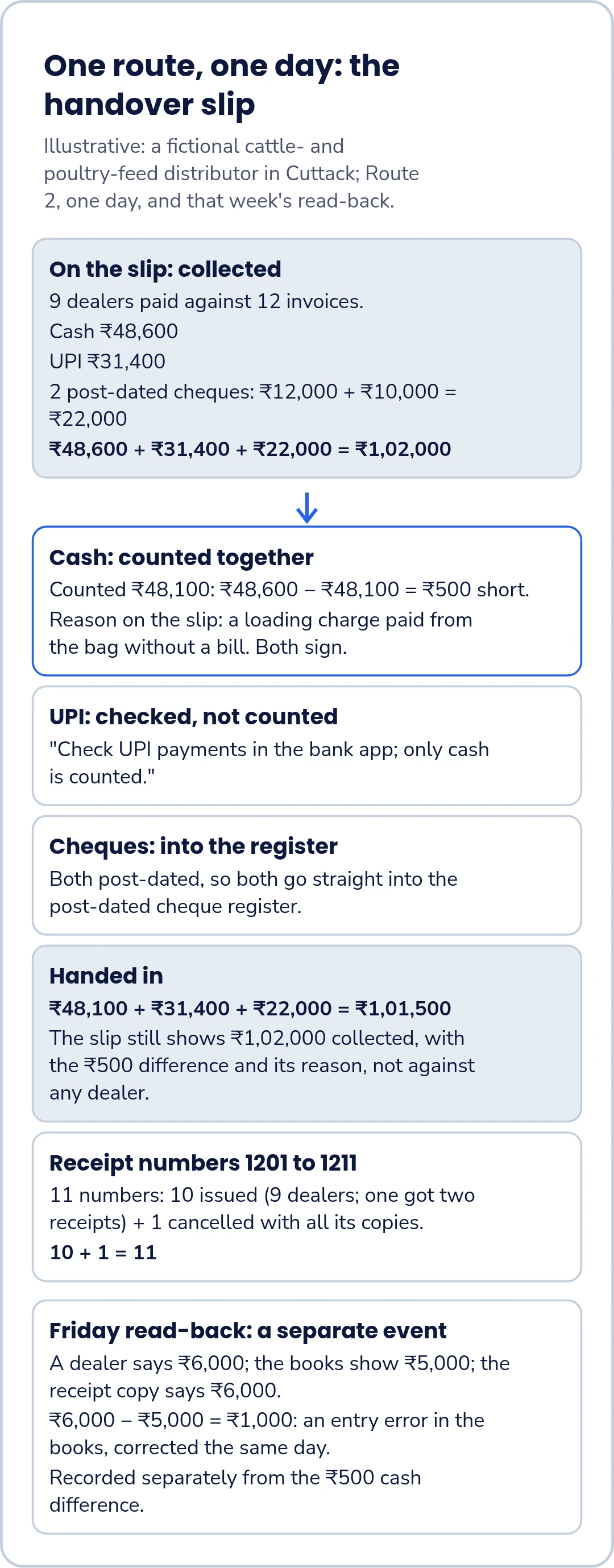
Illustrative example: a fictional cattle- and poultry-feed distributor in Cuttack; Route 2, one day, and that week's read-back; verify independently. The business has 12 staff and three routes covering about 60 village dealers, served by two collection staff and one van driver who also collects. All details are invented.
Route 2 slip. 9 dealers paid against 12 invoices.
| Mode | Amount (₹) |
|---|---|
| Cash | 48,600 |
| UPI (checked in the bank app) | 31,400 |
| 2 post-dated cheques (12,000 and 10,000, into the post-dated cheque register) | 22,000 |
| Collected | 1,02,000 |
₹12,000 + ₹10,000 = ₹22,000; ₹48,600 + ₹31,400 + ₹22,000 = ₹1,02,000.
Cash counted together: ₹48,100. The cash is ₹500 short: the collector paid a loading charge from the bag without a bill. The difference and the reason are written on the slip, and both sign.
₹48,600 − ₹48,100 = ₹500.
Handed in: ₹48,100 cash + ₹31,400 UPI + ₹22,000 cheques = ₹1,01,500. The slip still shows ₹1,02,000 collected, with the ₹500 difference and its reason. Each dealer is still shown in the books as having paid what the slip says; the ₹500 stays as a difference on the slip, not against any dealer.
Receipt numbers: 1201 to 1211, 11 numbers. Ten were issued: 9 dealers paid, and one of them paid two invoices separately and got two receipts. One was cancelled with all its copies attached.
10 + 1 = 11.
Friday read-back (a separate check, later that week). Of the three dealers called, one says he paid ₹6,000. The books show ₹5,000; the receipt copy says ₹6,000. The ₹1,000 is an entry error in the books, corrected the same day.
₹6,000 − ₹5,000 = ₹1,000.
The ₹1,000 entry error and the ₹500 cash difference are separate events and are recorded separately.
Templates
Daily handover slip:
Collector: ______ Route: ______ Date: ______
| Customer | Invoice no(s). | Receipt no. | Mode (cash / UPI / cheque) | Amount (₹) |
|---|---|---|---|---|
Totals: Cash ₹______ UPI ₹______ Cheques ₹______ Total ₹______ First receipt no. ______ Last receipt no. ______ Cancelled (copies attached): ______ Cash counted ₹______ Difference ₹______ Reason: ______ Signed (collector): ______ Signed (received by): ______
Weekly read-back:
| Date | Customer | Books show paid this week (₹) | Customer says (₹) | Matches? |
|---|---|---|---|---|
Also note on each line: the route, and the slip and receipt copy you traced any difference to.
Talk through your books in a demo
If you would like to talk through how your business keeps its books, request a demo and choose "Book a demo" on the form. FastComply Books is in an invitation pilot in India, so the demo is where we confirm what is available for your business.