Keep one list of every contract you bill: monthly retainers, quarterly bills, yearly contracts. Once a month, write down every contract with a bill due that month, then look for each one in the invoices actually raised. Anything you can't find goes on a "to invoice" list for the owner the same day.
"Our regular clients get invoiced on the 1st. Everyone knows the list." The regular invoices may well go out on time, but a new contract that started mid-month, a quarterly bill or a contract that ended while the work carried on can be missed, and it may not be noticed until a client asks or the year's figures look short.
Which invoices slip
Three kinds of bill are easy to miss:
- the new contract that started mid-month and was never added to the list;
- the quarterly or yearly bill that falls in this month but not in the last two;
- the contract that has ended while the service carries on, with the client's boxes or files still with you.
Seeing a missed retainer invoice as lost income, checking each cycle's invoice before it goes out, a monthly pass through the client list for retainer fees with no invoice, and watching mid-month starts and ended engagements are already published by enlivy, invoicera, iota-finance, lynnsolutions and metiva; shilplabs covers the same problem for equipment maintenance contracts that have expired. What this page adds is narrow: the plain version for an Indian office-based retainer business with no billing software, with quarterly and yearly bills against the month they fall in, ended contracts copied as a fact for the owner, and rate-revision dates copied, never applied.
The billing list
One row per contract you bill. Contracts the business pays belong in the annual renewals list, not here. Each row carries:
- contract number and client;
- what is billed: a storage retainer, an indexing contract, an annual maintenance contract (AMC) or other;
- amount per bill, before tax, copied as written in the agreement;
- frequency (monthly, quarterly or yearly) and bill day;
- start date and end date, as written;
- rate-revision date, copied as written, or "none written";
- the last month invoiced, and notes.
The list records what the agreement says; it doesn't interpret it.
The monthly tick: from the list to the invoices
- From the billing list, write down every contract with a bill due this month, including the quarterly and yearly ones.
- Open the month's invoice list (the invoices actually raised, not the billing list) and find each one.
- Anything not found goes on the "to invoice" list for the owner that day.
- Anything invoiced that isn't on the billing list means the list is missing a row: add it.
Then three more checks. Is every contract signed since the last tick on the list, with its start date and first bill day? Is any contract ending within the next 30 days? Has any contract ended while the service carries on?
When an invoice must be dated and what a clause in the agreement means are questions for your accountant and the agreement itself.
Contracts ending soon, and contracts that have ended
A contract whose end date falls within the next 30 days is flagged for the owner to talk to the client before it ends. A contract that has ended while the service is still being given is flagged as a fact, such as "ended 30 Sep; 140 boxes still on our racks", and the owner reads the agreement and speaks to the client. The list takes no view on what the agreement means after its end date.
Rate-revision dates: copy them, flag them
If an agreement has a rate-revision date, copy it into the list as written. When the date is reached, flag the row "revision date reached: owner to read the agreement". Don't work out a revised amount on the list, and don't assume a revision applies; the bill amount stays as written until the owner decides.
Worked example: a New Delhi records-storage firm's October tick
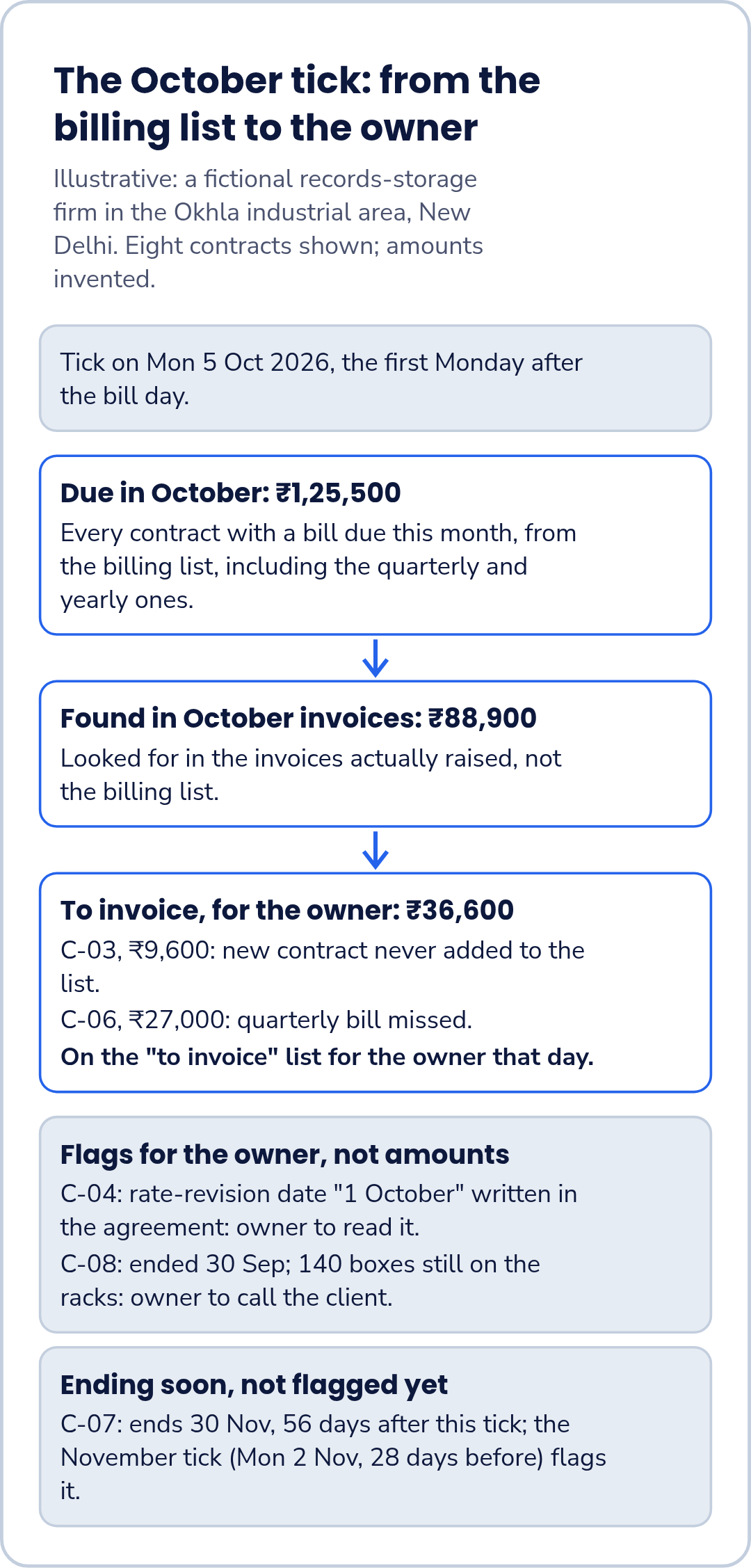
Illustrative example: a fictional records-storage and document-archiving firm in the Okhla industrial area, New Delhi, with the owner and 8 staff, one warehouse with racks and a small scanning room. About 30 business clients pay a monthly storage retainer, and a few have yearly indexing contracts billed quarterly. Eight contracts are shown; the other rows matched with nothing to report. Amounts before tax; invented; verify independently. The firm's own rule is a tick on the first Monday after the bill day, so October's tick was on Mon 5 Oct 2026.
| Contract | Client | Billed | Amount per bill (₹) | Frequency, bill day |
|---|---|---|---|---|
| C-01 | Law firm | Storage retainer | 18,500 | Monthly, 1st |
| C-02 | Insurance broker | Storage retainer | 12,000 | Monthly, 1st |
| C-03 | Export house | Storage retainer | 9,600 | Monthly, 1st (started 15 Sep) |
| C-04 | Housing society office | Storage retainer | 22,400 | Monthly, 1st |
| C-05 | Freight forwarder | Indexing contract | 36,000 | Quarterly, 1 Oct / Jan / Apr / Jul |
| C-06 | Travel company | Indexing contract | 27,000 | Quarterly, 1 Oct / Jan / Apr / Jul |
| C-07 | Chartered surveyors | Indexing contract, ₹1,26,000 a year | 31,500 | Quarterly, 1 Sep / Dec / Mar / Jun |
| C-08 | Garment exporter | Storage retainer | 7,800 | Monthly, 1st; ended 30 Sep |
| Contract | Due in October (₹) | Found in October invoices (₹) | To invoice (₹) | Flag |
|---|---|---|---|---|
| C-01 | 18,500 | 18,500 | – | – |
| C-02 | 12,000 | 12,000 | – | – |
| C-03 | 9,600 | – | 9,600 | New contract never added to the list (the article takes no view on any part of September) |
| C-04 | 22,400 | 22,400 | – | Rate-revision date "1 October" written in the agreement: owner to read it |
| C-05 | 36,000 | 36,000 | – | – |
| C-06 | 27,000 | – | 27,000 | Quarterly bill missed |
| C-07 | Not due | – | – | Ends 30 Nov, 56 days after this tick: not flagged yet; the November tick (Mon 2 Nov, 28 days before) flags it |
| C-08 | Not due | – | – | 140 boxes still on the racks: owner to call the client |
| Total | 1,25,500 | 88,900 | 36,600 |
C-03 and C-06 had no invoice yet and went on the "to invoice" list for the owner on 5 October. C-07's ₹31,500 is a quarter of its ₹1,26,000 a year; its last bill before the 30 Nov end date was on 1 Sep, so no later bill is on the list, and what follows the end date is for the owner and the client. C-04 and C-08 are flags for the owner, not amounts: no new rate and no charge for the boxes is worked out here.
After the invoice
Once an invoice exists, collecting it belongs to the customer receivables follow-up list. A client's question about an invoice goes in the customer invoice query log. Whether the rate on the invoice matches the agreed rate is covered in checking agreed rates before invoices go out. One-off jobs billed by job card are a separate routine.
Template
Billing list: the contract
| Contract no. | Client | What is billed | Amount per bill (₹, before tax) | Frequency | Bill day |
|---|---|---|---|---|---|
Billing list: the dates
| Contract no. | Start date | End date | Rate-revision date (as written) | Last month invoiced | Notes |
|---|---|---|---|---|---|
Monthly tick
| Line | Entry |
|---|---|
| Due this month (₹) | |
| Found in the invoice list (₹) | |
| To invoice, for the owner (₹) | |
| New contracts added | |
| Ending within 30 days | |
| Ended but still serving | |
| Revision dates reached | |
| Ticked by, on |
Talk through your books in a demo
If you would like to talk through how your business keeps its books, request a demo and choose "Book a demo" on the form. FastComply Books is in an invitation pilot in India, so the demo is where we confirm what is available for your business.