Keep one register for every post-dated cheque the business holds or has given: who, which cheque, its date, its amount, and where it is physically kept. Each week, look four weeks ahead at the customer cheques due for deposit and the cheques you have given that will be presented, and make sure the account can meet your own cheques without counting on customer cheques clearing in time. Before a bundle goes to the bank, check each cheque's date against the register. Once a month, count the cheques you hold, wherever the register says they are kept, against the register.
Why the drawer isn't a system
In a distribution business, customers hand over post-dated cheques against credit sales, and the business gives post-dated cheques to some of its own suppliers. The cheques sit in a drawer or a file. Some get deposited before their date, some are forgotten past it, and an issued cheque is presented in a week when the account is short.
The dates are written on the cheques, but nobody looks at all of them together.
A single register for cheques in both directions, with a status for each, is a common setup. What this page adds is three habits around it: a four-week look-ahead, a date check before banking, and a monthly count of the cheques held.
One register for cheques in and out
One row per cheque:
- in or out;
- party (customer or supplier);
- cheque number;
- bank, as printed on the cheque;
- cheque date;
- amount;
- against (invoice or bill number);
- where kept (envelope or file number);
- deposited or handed over on;
- status.
The "where kept" column is what makes the monthly count possible.
Statuses
Cheques received:
- held: received, date not reached;
- deposited;
- cleared: seen on the bank statement;
- came back;
- replaced or cancelled: with the row number of the replacement.
Cheques you give:
- given;
- presented;
- cleared.
Once a cheque is cleared, it is matched on the bank statement with the rest of the account.
If a cheque comes back. The register only records that it came back, with the date. If a cheque comes back unpaid, speak to your accountant or lawyer before doing anything else.
The Monday look-ahead
Once a week, for example every Monday, look at the next four weeks. For each week, list:
- the customer cheques due for deposit on or after their date;
- the cheques you have given that are due to be presented.
Make sure the account can meet the cheques you have given without counting on customer cheques clearing in time: count a customer cheque only once it shows as cleared. For each week, the amount to arrange is the cheques you have given, less the bank balance, if that is above zero.
The look-ahead covers cheques only. Your other supplier payments belong in your payment schedule, and the whole cash picture in a cash flow forecast.
Before cheques go to the bank
Before a bundle of cheques goes for deposit: compare each cheque's date with the register; any cheque dated later goes back to the envelope. Your bank decides how long a cheque can be deposited and how long it takes to clear.
The monthly envelope count
Once a month, for example at month end, count the cheques physically held, in the envelope and anywhere else the "where kept" column names, and add up their amounts. The count and the total should equal the register's rows marked held. If they differ, find the difference before the month is closed.
It is best if whoever holds the cheque envelope is not also the person who keeps the register.
Worked example: a paint distributor in Warangal
Illustrative example: a fictional paint distributor in Warangal; first week of November; verify independently. The business has 8 staff and supplies about 40 hardware shops and painting contractors. About 15 of them pay by post-dated cheque, and the distributor gives post-dated cheques to two suppliers. All details are invented.
Envelope count, 31 October. The register shows 14 cheques held; the envelope has 13.
14 − 13 = 1.
The missing cheque, for ₹31,000, is found clipped to a delivery file. Its row now says where it is kept.
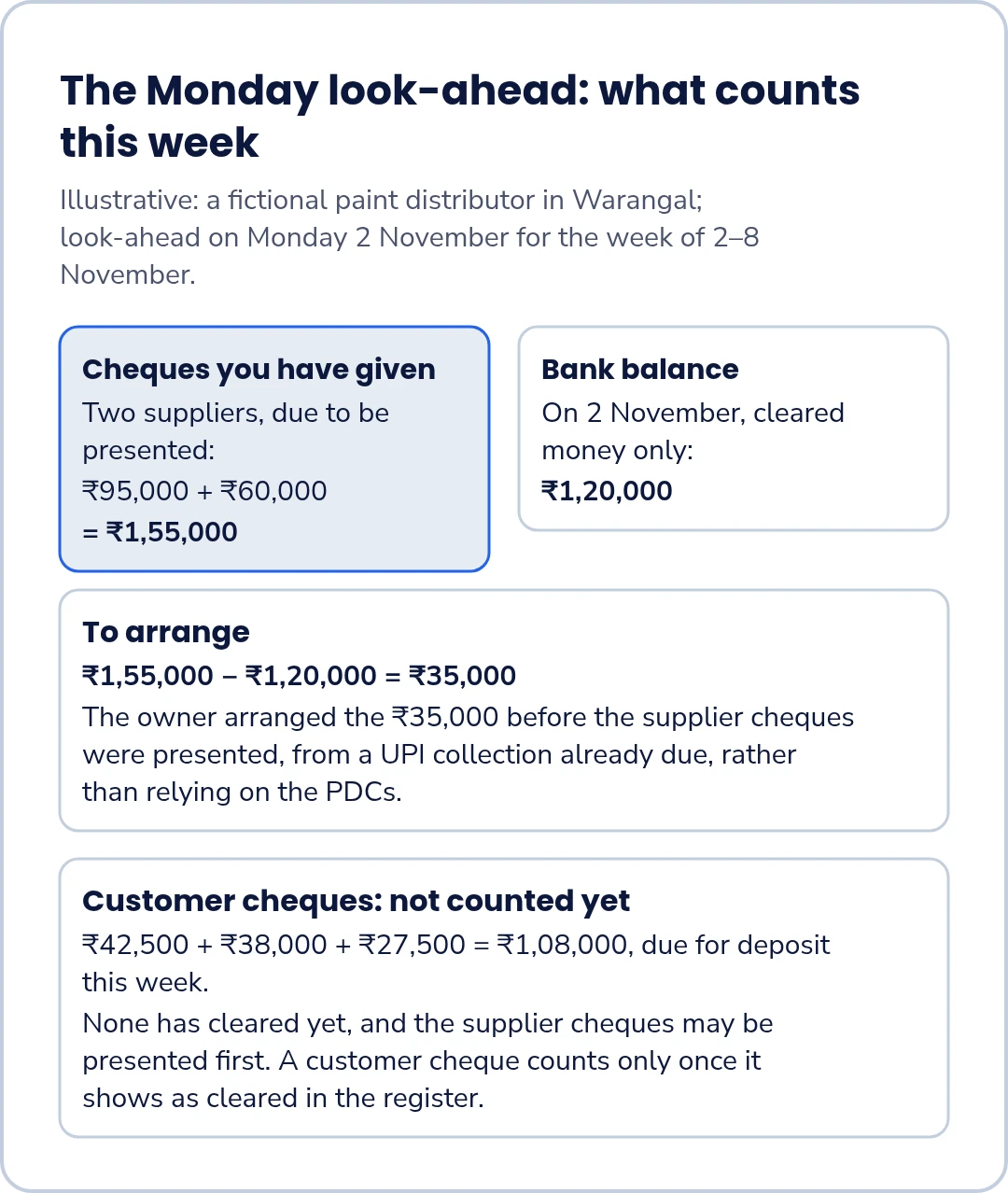
Monday look-ahead, 2 November. For the week of 2–8 November:
| Cheques | Total | |
|---|---|---|
| Customer cheques due for deposit | ₹42,500, ₹38,000, ₹27,500 | ₹1,08,000 |
| Cheques given to two suppliers, due to be presented | ₹95,000, ₹60,000 | ₹1,55,000 |
₹42,500 + ₹38,000 + ₹27,500 = ₹1,08,000. ₹95,000 + ₹60,000 = ₹1,55,000.
The bank balance on 2 November is ₹1,20,000. The customer cheques are not counted, because none has cleared yet and the supplier cheques may be presented first. Against the ₹1,55,000 of supplier cheques, the account is short by ₹35,000.
₹1,55,000 − ₹1,20,000 = ₹35,000.
The owner arranged the ₹35,000 before the supplier cheques were presented, from a UPI collection already due, rather than relying on the PDCs.
If the customer cheques were counted, the week would look comfortable: ₹1,20,000 + ₹1,08,000 − ₹1,55,000 = ₹73,000 to spare. That is the figure the look-ahead deliberately leaves out until they clear.
Deposit check, 5 November. One cheque in the bundle is dated 12 November. It goes back to the envelope.
Templates
Cheque register:
| In / out | Party | Cheque date | Amount (₹) | Where kept | Status |
|---|---|---|---|---|---|
Also record on each row: cheque number, bank (as printed), against (invoice or bill), and the date it was deposited or handed over.
Four-week look-ahead:
| Week | Customer cheques due for deposit (₹) | Cheques given, due to be presented (₹) | Bank balance, cleared money only (₹) | To arrange (₹) |
|---|---|---|---|---|
Monthly envelope count:
Date: ______ Cheques held (envelope and every other place in the "where kept" column): ______ Total ₹______ Register rows held: ______ Total ₹______ Difference: ______ Found: ______
Keeping every cheque in view?
If you would like to hear about FastComply Books for your business, you can request early access. FastComply Books is in an invitation pilot in India and public sign-up is not open yet.