While an insurance claim is open, keep one claim file with four parts: a contact log of every message with the insurer and surveyor; a list of the damaged items taken from records you already keep; a list of what you spent because of the loss, each with a bill; and, when the settlement comes, a sheet showing each line you listed, what was paid, and the insurer's reason copied word for word. Before throwing anything away or repairing it permanently, ask the insurer in writing and file the reply.
Why your own file matters
Opening a claim file and keeping every message is standard advice (insurers' and brokers' guides, such as policy99's claim manual). The insurer tells you which papers it needs. Your own file is for you: weeks pass between the loss and the settlement, papers spread across WhatsApp, email and a folder, and by the end nobody can say exactly what was lost, what was spent to clean up, or what the insurer asked for.
Comparing the settlement with your claim line by line, and building the list of damaged items from purchase records and stock counts you already have, are common advice too. This page adds a four-column sheet that sets each line of the settlement beside your claim, with the insurer's reasons copied word for word.
Your policy and your insurer decide what is covered and how it is valued. For help with the claim itself, ask your insurer, the surveyor or an adviser.
The four parts of the claim file
- Contact log: every call, visit, email and message about the claim.
- Damaged-items list: what was lost or damaged, from your own records.
- Spent-because-of-the-loss list: what you paid out because of the loss.
- Listed-vs-paid sheet: filled in when the settlement arrives.
The contact log. One line per contact: the date, who it was with (insurer, surveyor or other), what you asked or were asked, what you sent, and whether the reply is filed. If you ask the insurer about something, keep the question short and neutral, for example "which clause does this refer to?", and log it with its date.
Building the damaged-items list from records you already keep
For each damaged item, write:
- the item and the quantity;
- the cost shown in your records;
- the record it came from: the last stock count sheet, the asset register entry, or the purchase bill number;
- a photo reference.
The list states only what your records show. It does not say what anything is worth for the claim.
What you spend because of the loss
List every payment the loss caused: cleaning, temporary repairs, extra storage, transport. Each line gets the date, what it was for, the amount and the bill. Keep the bills in the claim file, not mixed in with the month's other bills.
Before you throw anything away or repair it
Before throwing anything away or repairing it permanently, ask the insurer in writing and file the reply. Note the request and the reply in the contact log.
At settlement: listed vs paid
When the settlement arrives, make one row for each line you listed, with four columns:
- the line;
- the amount listed;
- the amount paid;
- the insurer's reason for any difference, copied word for word from the settlement letter.
Copy the reason exactly. Do not shorten it, explain it or replace it with your own words. If the letter gives no reason for a line, write "no reason given".
The sheet holds only the insurer's words. If you ask the insurer about a line, the question and the reply go in the contact log, with the date and the line's name, so each line on the sheet can be matched to what was asked about it.
Worked example: a furnishing store in Jamshedpur
Illustrative example: a fictional home-furnishing and mattress store in Jamshedpur; the insurer's reasons are fictional and copied as written; verify independently. The store has 7 staff, one showroom and one godown. In August, an overhead water tank burst over the godown. All details are invented.
Damaged-items list (cost as shown on purchase bills and the July count):
| Item | Quantity | Cost each (₹) | Cost in records (₹) | Source |
|---|---|---|---|---|
| Foam mattresses | 12 | 7,500 | 90,000 | Purchase bills, July count |
| Spring mattresses | 6 | 14,000 | 84,000 | Purchase bills, July count |
| Curtain lengths | 40 | 600 | 24,000 | Purchase bills, July count |
| Total | 1,98,000 |
12 × ₹7,500 = ₹90,000; 6 × ₹14,000 = ₹84,000; 40 × ₹600 = ₹24,000; ₹90,000 + ₹84,000 + ₹24,000 = ₹1,98,000.
Spent because of the loss:
| What for | Amount (₹) |
|---|---|
| Water removal and cleaning | 6,500 |
| Plumber's temporary repair | 3,200 |
| Hired storage for undamaged stock | 4,300 |
| Total | 14,000 |
₹6,500 + ₹3,200 + ₹4,300 = ₹14,000.
Listed in all: ₹1,98,000 + ₹14,000 = ₹2,12,000. Paid: ₹1,61,500.
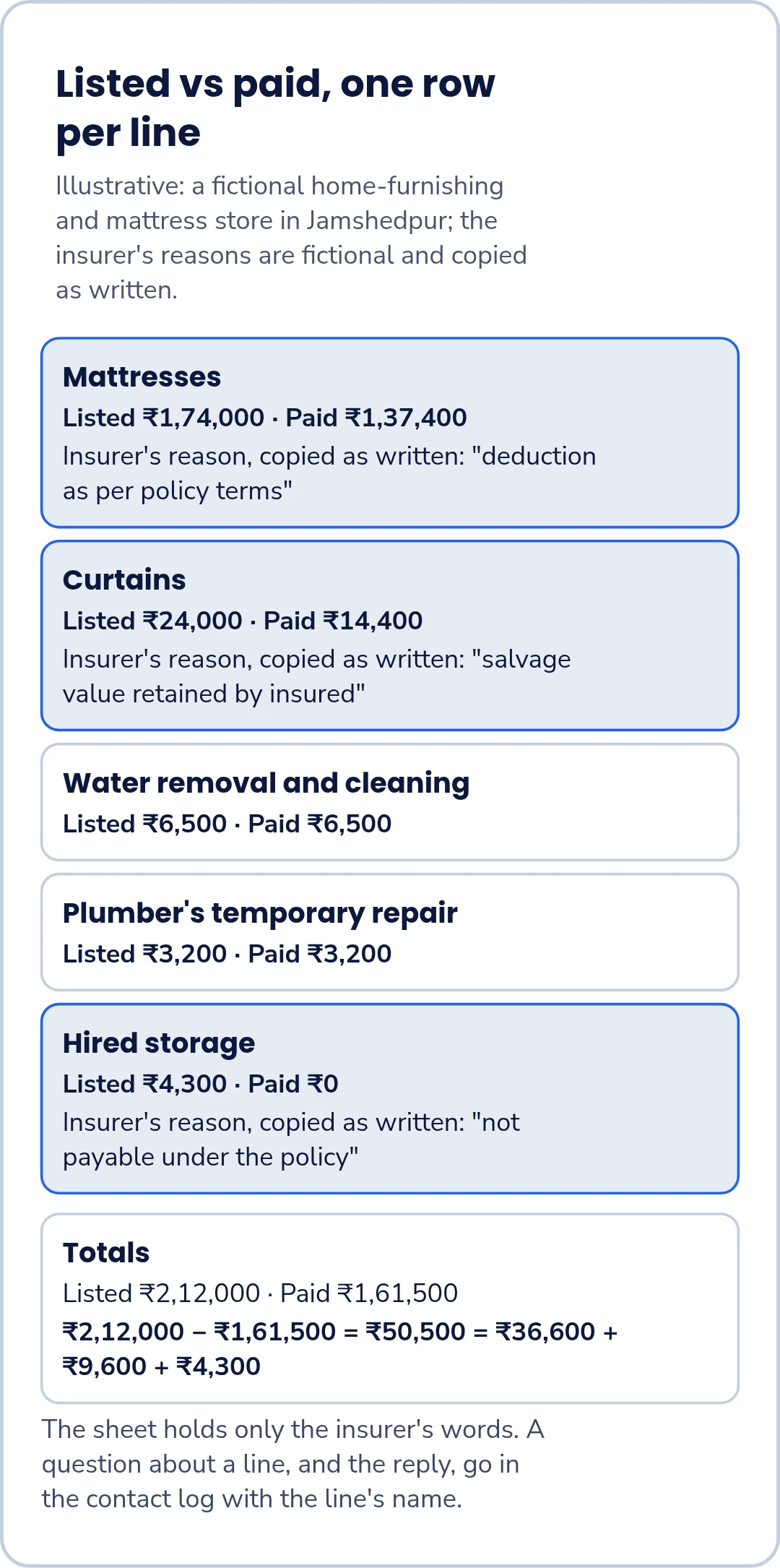
The settlement letter shows three differences, set out line by line below: mattresses ₹36,600 less, curtains ₹9,600 less and hired storage ₹4,300 not paid.
Listed-vs-paid sheet:
| Line | Listed (₹) | Paid (₹) | Insurer's reason, copied as written |
|---|---|---|---|
| Mattresses | 1,74,000 | 1,37,400 | "deduction as per policy terms" |
| Curtains | 24,000 | 14,400 | "salvage value retained by insured" |
| Water removal and cleaning | 6,500 | 6,500 | |
| Plumber's temporary repair | 3,200 | 3,200 | |
| Hired storage | 4,300 | 0 | "not payable under the policy" |
| Total | 2,12,000 | 1,61,500 |
Mattresses: ₹90,000 + ₹84,000 = ₹1,74,000 listed; ₹1,74,000 − ₹36,600 = ₹1,37,400 paid. Curtains: ₹24,000 − ₹9,600 = ₹14,400. Paid total: ₹1,37,400 + ₹14,400 + ₹6,500 + ₹3,200 + ₹0 = ₹1,61,500. Difference: ₹2,12,000 − ₹1,61,500 = ₹50,500 = ₹36,600 + ₹9,600 + ₹4,300.
The sheet is filed with the insurer's settlement letter.
After the money arrives
Give the claim file, the payment advice and the bank entry to your accountant together. Ask your accountant how the loss and the claim money are recorded.
Then update your own records: mark the damaged items in the asset register and the stock records, so the next count starts from what is actually there. Note the policy's renewal date on your renewals list too.
Templates
Listed-vs-paid sheet:
| Line | Amount listed (₹) | Amount paid (₹) | Reason, copied word for word |
|---|---|---|---|
Contact log:
| Date | With (insurer / surveyor / other) | We asked or were asked | We sent | Reply filed (yes / no) |
|---|---|---|---|---|
Damaged-items list:
| Item | Quantity | Cost in your records (₹) | Source record | Photo ref. |
|---|---|---|---|---|
Spent-because-of-the-loss list:
| Date | What for | Bill no. | Amount (₹) |
|---|---|---|---|
Putting your records in order after a loss?
If you would like to hear about FastComply Books for your business, you can request early access. FastComply Books is in an invitation pilot in India and public sign-up is not open yet.