Recording every discount given at the counter takes one line per discount: the list price, the price given, the reason, who gave it and who approved it. Put everyone's discounts in, the owner's and family's too, along with round-offs and anything given at no charge. Then look at the week's lines once a week, by person and by reason.
Why takings are lower than expected
In a shop where staff bargain with customers and round off bills, and the owner and family give something off to regulars and friends, discounts come from three places. When the bill book or billing screen shows only the final price, none of them is recorded: at month end the takings are lower than the owner expected, and nobody can say how much was given away, by whom or why.
"Bargaining is normal here; if I stop staff giving discounts, I lose sales." The log doesn't stop discounts, or the mol-bhav that goes with them; it shows them. Staff keep bargaining within the shop's own limit. The owner sees the week's total by person and by reason and decides what to change.
A reason on every discount, a limit with approval above it, recording who gave and who approved, a weekly report by person and by reason, each person's discount as a share of their own sales, listing sales below a set price, showing the regular price beside the price charged, keeping scheme discounts apart from counter decisions, and logging items given on the house, even for the owner's guests, are all common practice in billing and POS software, and one billing app's guide already reads an item that keeps going below its lowest price as a sign that price may be wrong. This page's own part is narrow: a paper routine for a shop whose billing does none of that, with both prices on the bill copy so the weekly look finds bills sold below list price with no line, the owner's own counter discounts in the same weekly total as everyone else's, and round-offs as a reason line of their own.
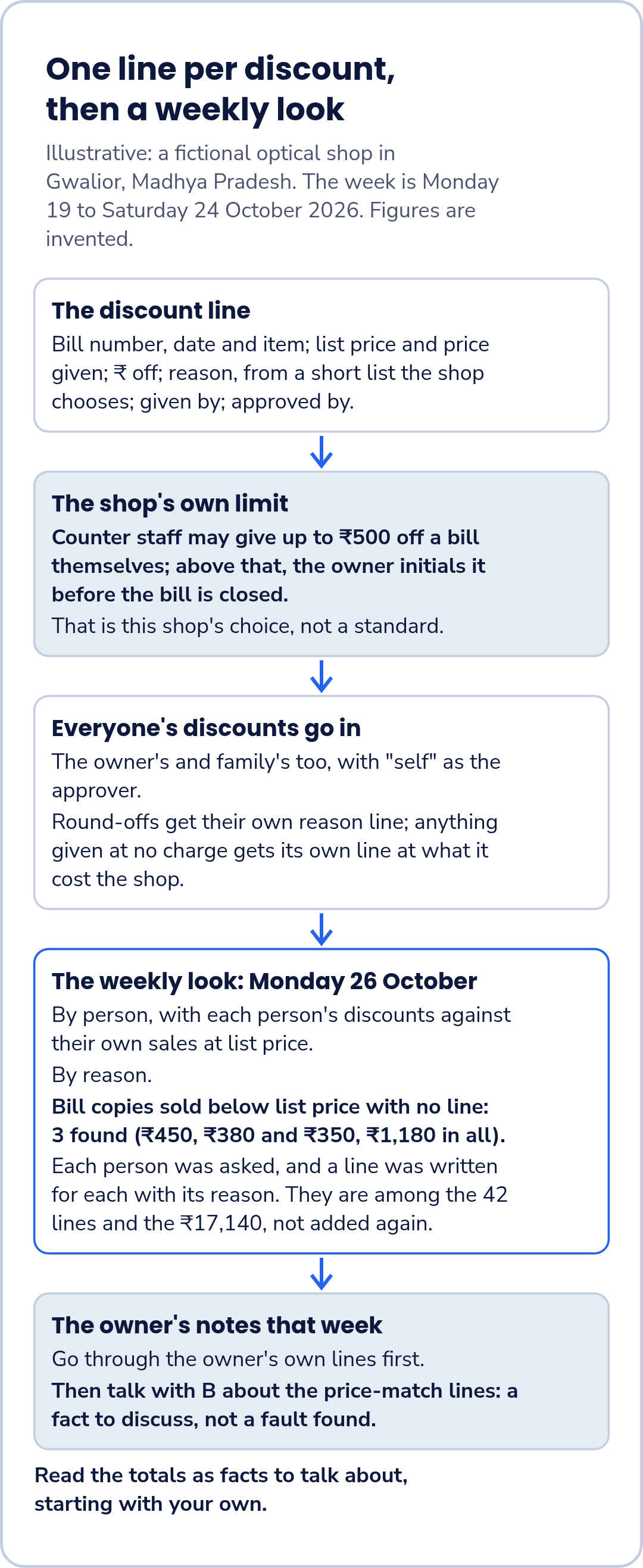
The discount line
Write one line per discount on the bill copy, or on a one-page daily sheet beside the bill book:
- bill number, date and item
- list price and price given
- ₹ off
- reason, from a short list the shop chooses
- given by (initials)
- approved by (initials, or "self" for the owner)
Anything given to a customer at no charge (a case, a bottle of cleaning solution) gets its own line at what it cost the shop. How a discount should be shown on the bill and in the books is for your accountant to decide.
The shop's own limit
Write the limit down once, so staff know where their own decision ends. In the example below, the shop's rule is that counter staff may give up to ₹500 off a bill themselves; above that, the owner initials it before the bill is closed. That is this shop's choice, not a standard, and no percentage is right for every shop.
Everyone's discounts go in
The owner's and family's discounts go in the log like anyone else's, with "self" as the approver. Round-offs get their own reason line. Without these lines, the weekly total is only part of what the shop gave away.
The weekly look
Once a week, before opening, the owner totals the week's lines:
- by person, with each person's discounts against their own sales at list price;
- by reason;
- and the bill copies sold below list price that have no line. Each one is added, and the person who gave it is asked for the reason.
Read the totals as facts to talk about, starting with your own.
What the totals point to
If one reason keeps coming up, it points somewhere else. Lines that are mostly "matched another shop's price" or "old-model frame" point to the item's price, which belongs in a yearly price-list review. Differences between the day's takings and sales belong to the shop day close. Who may approve what belongs to simple financial controls for a small team.
Worked example: a Gwalior optical shop's week
Illustrative example: a fictional optical shop in Gwalior, Madhya Pradesh, with the owner and three counter staff (A, B and C), selling spectacle frames, lenses, sunglasses and contact-lens solutions to walk-in customers, Monday to Saturday. The week is Monday 19 to Saturday 24 October 2026; the weekly look is on Monday 26 October. Figures are invented; verify independently.
By person
| Who gave it | Sales at list price (₹) | Discounts (₹) | Price given (₹) | Discount as % of own sales | Lines |
|---|---|---|---|---|---|
| Owner | 96,400 | 7,850 | 88,550 | 8.1% | 12 |
| Counter staff A | 72,500 | 2,900 | 69,600 | 4.0% | 11 |
| Counter staff B | 64,300 | 5,140 | 59,160 | 8.0% | 14 |
| Counter staff C | 41,600 | 1,250 | 40,350 | 3.0% | 5 |
| Total | 2,74,800 | 17,140 | 2,57,660 | 6.2% | 42 |
Price given is sales at list less every discount line, including the free items at what they cost the shop (₹380). The free items were on no bill, so the bills themselves add up to ₹380 more than this column.
₹2,74,800 − ₹17,140 = ₹2,57,660, and ₹17,140 ÷ ₹2,74,800 = 6.2% of the week's sales at list price. Each person's rate is their own discounts divided by their own sales at list.
By reason
| Reason | Lines | ₹ |
|---|---|---|
| Regular customer | 6 | 4,350 |
| Owner's family or friends | 5 | 3,600 |
| Matched another shop's price | 7 | 4,280 |
| Old-model or display frame | 9 | 4,010 |
| Rounded off the bill | 12 | 520 |
| Free item given (case, cleaning solution; at cost) | 3 | 380 |
| Total | 42 | 17,140 |
The owner's own discounts were ₹7,850 of ₹17,140 (45.8%), the largest single share; before the log, none of them was counted.
On Monday 26 October the owner found 3 bill copies sold below list price with no line (₹450, ₹380 and ₹350, ₹1,180 in all). Each person was asked, and a line was written for each with its reason; those 3 lines are among the 42 lines and the ₹17,140 above, under the person and the reason each one was given, and are not added again. Each was under the ₹500 limit.
The owner's own rate (8.1%) was the highest of the four; B's (8.0%) is about twice A's (4.0%). The owner's notes that week: go through the owner's own lines first, then talk with B about the price-match lines (a fact to discuss, not a fault found).
Template
Discount line (on the bill copy or the daily sheet)
| Bill no. | Date | Item | List price (₹) | Price given (₹) |
|---|---|---|---|---|
| Bill no. | ₹ off | Reason | Given by | Approved by |
|---|---|---|---|---|
The shop's limit: staff may give up to ₹___ off a bill; above that, ___ initials.
Weekly summary
- By person: sales at list ₹, discounts ₹, lines ___ (one row each, owner included)
- By reason: lines , ₹ (one row each)
- Bills below list price with no line found: , ₹, added and asked
Talk through your books in a demo
If you would like to talk through how your business keeps its books, request a demo and choose "Book a demo" on the form. FastComply Books is in an invitation pilot in India, so the demo is where we confirm what is available for your business.