Give every job its own card, filled in on site: what was reported, what was done, time on site, and the parts issued from the store, used on the job and returned. Each evening, the office puts every card into one of three states: closed (ready to invoice), open (revisit booked), or no charge (reason and who approved written on the card). Invoice only from closed cards, and write the card number on the invoice. At month end, match closed cards against invoices raised, so every job is billed once and every invoice line comes from a job.
Where billable work goes missing
In a repair, maintenance or installation business, the work is done at the customer's place and the person who raises the invoice was not there. What reaches the office arrives second-hand: a call from the technician, a message in a group chat, or whatever is remembered at the end of a long day. A part issued from the store can be fitted and left off the bill. A return visit to finish a job can look like the same job, so nobody charges for it. A small extra job the customer asks for while the technician is already there may never be mentioned at all. No account shows these as losses, because nothing was recorded in the first place. The work simply never turns into an invoice.
The fix is a record made where the work happens, and two checks that every record reaches an invoice.
One card per job
Paper or phone, the card has the same fields every time:
- card number and date;
- customer and site;
- what the customer reported;
- what was done;
- technician;
- time on site (start and finish), for the job and the invoice only;
- parts issued from the store, parts used on the job, parts returned to the store;
- revisit needed: yes or no;
- customer signature or a photo of the completed work.
Parts: issued, used, returned
For every part on the card:
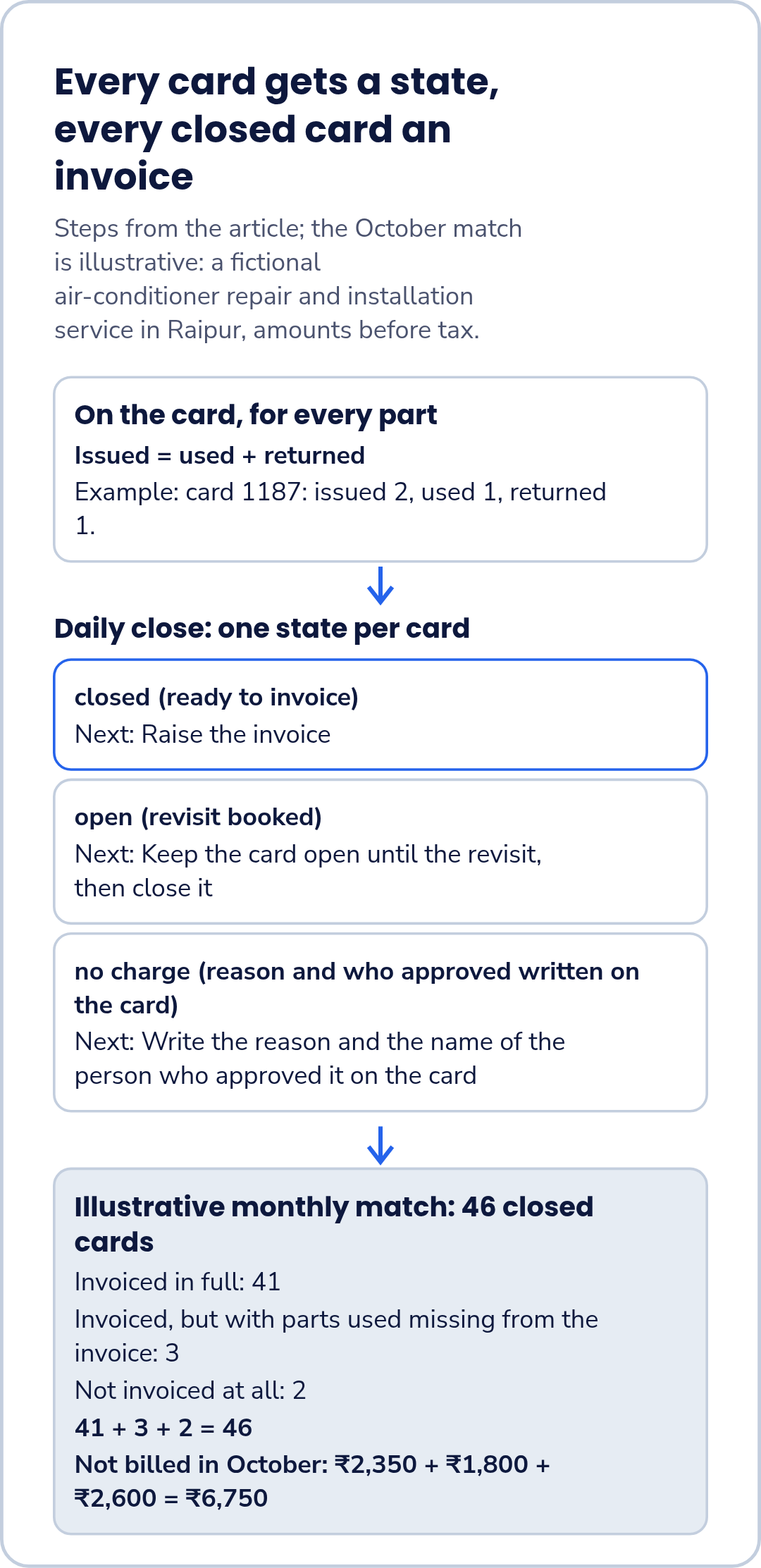
Issued = used + returned.
If the numbers do not balance, the gap is explained on the card the same day: a part left in the van, a part that failed and was replaced, a part used on another job. A gap found the same day is easy to explain; a gap found at a stock count weeks later is much harder to trace.
For example: card 1187: issued 2, used 1, returned 1.
The daily close
At the end of each day, someone in the office goes through every card from that day and marks one state:
| State | Meaning | Next step |
|---|---|---|
| closed (ready to invoice) | The job is finished | Raise the invoice |
| open (revisit booked) | The job needs another visit, and it is booked | Keep the card open until the revisit, then close it |
| no charge (reason and who approved written on the card) | No invoice will be raised | Write the reason and the name of the person who approved it on the card |
No card is left without a state at the end of the day.
Invoice from the card
Every billable line on an invoice comes from a closed card, and the card number goes on the invoice. Rates come from your own price list. Ask your accountant what your invoices must show.
The monthly match
At month end, list the closed cards and the invoices raised side by side:
- a closed card with no invoice: raise the invoice;
- an invoice with a missing line from its card: correct the invoice, as your accountant advises;
- an invoice with no card: find out what job it was for.
Use the cards when you quote
Over time, the cards show how long each type of job actually takes and which parts it uses. Use those actuals when you price similar jobs.
Worked example: an AC service business in Raipur
Illustrative example: a fictional air-conditioner repair and installation service in Raipur; October, amounts before tax. The business has 12 technicians and 2 office staff. All details are invented.
At the end of October the office matches 46 closed cards against the month's invoices:
| Result | Cards |
|---|---|
| Invoiced in full | 41 |
| Invoiced, but with parts used missing from the invoice | 3 |
| Not invoiced at all | 2 |
| Closed cards | 46 |
41 + 3 + 2 = 46.
The parts used but missing from the 3 invoices come to ₹2,350. The 2 jobs that were never invoiced were for ₹1,800 and ₹2,600. Not billed in October: ₹2,350 + ₹1,800 + ₹2,600 = ₹6,750.
The office raises invoices for the 2 jobs and corrects the 3 invoices as the accountant advises. In each case the card already held what was needed: the parts used and the work done.
Templates
Job card:
Card no.: [ ]        Date: [ ]        Technician: [ ]
Customer and site: [ ]
Reported: [ ]
Done: [ ]
Time on site (for the job and the invoice only): start [ ]  finish [ ]

Part            Issued   Used   Returned   Gap explained
[ ]             [ ]      [ ]    [ ]        [ ]

Revisit needed: Yes / No
State: closed (ready to invoice) / open (revisit booked) /
       no charge (reason and who approved written on the card): [ ]
Signature or photo: [ ]
Monthly match sheet:
| Card no. | State | Invoice no. | All card lines on invoice? | Action | Done on |
|---|---|---|---|---|---|
| Yes / No |
Talk through your books in a demo
If you would like to talk through how your business keeps its books, request a demo and choose "Book a demo" on the form. FastComply Books is in an invitation pilot in India, so the demo is where we confirm what is available for your business.