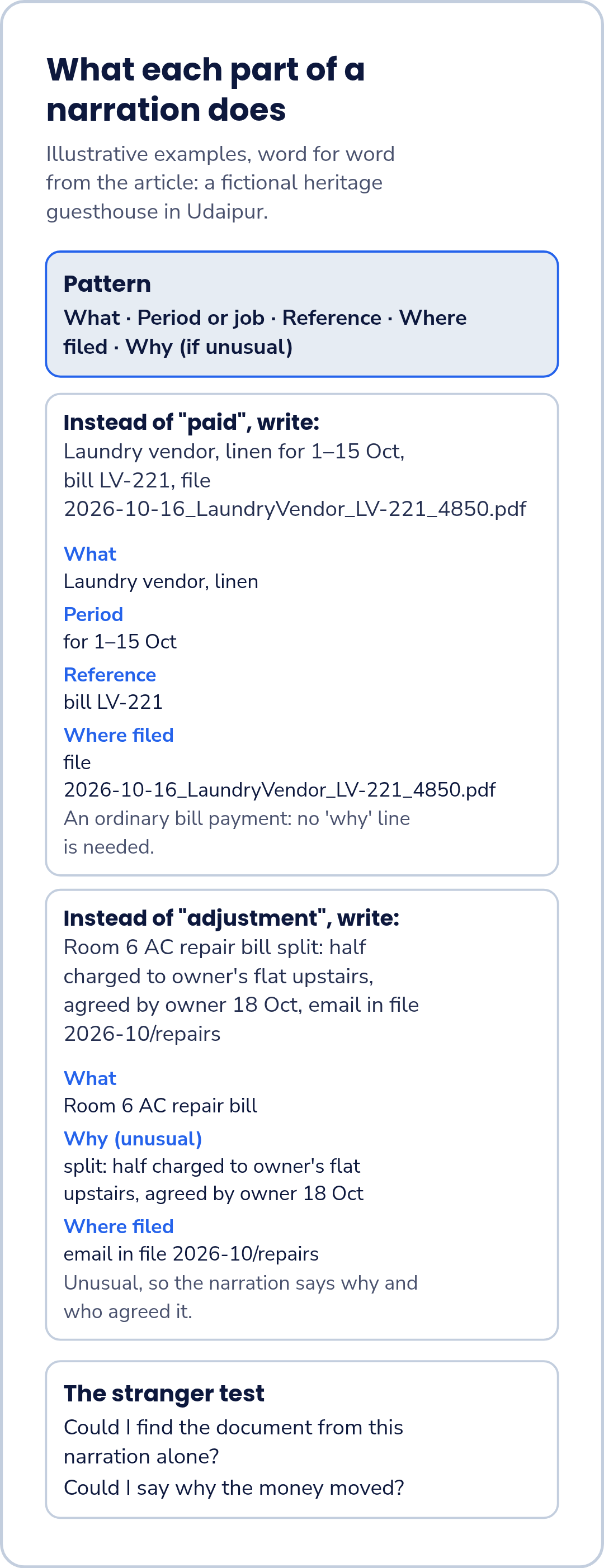
A useful narration answers four things: what the entry was, which period or job it covers, which document backs it, and, if the entry is unusual, why. Add one more: where that document is filed, using the same name the file has in your folders. Then test each narration as a stranger would. Could someone who has never seen your business find the paper and say why the money moved, using only the narration? If not, rewrite it. Once a month, or as often as suits your accountant, check ten entries this way.
This works in any accounting software, and in a cash book or ledger kept by hand.
Why "as per bill" fails later
"As per bill", "paid", "received", "adjustment" and blank narrations all make sense on the day they are written, because the person writing them has the bill in front of them. Months later, when your accountant asks what an entry was for, the bill may be in a different folder, renamed, or never attached. A ledger or list of entries shows the narration, not the paper. If the narration names the document, the period and where the document is filed, anyone can find the paper and understand the entry without asking you.
Four things every narration answers
- What it was: the supplier, customer or person, and what was bought, sold or paid for.
- For which period or job: the dates covered, the booking, or the job.
- The document reference: bill number, booking ID, payment reference, voucher numbers.
- Why, if it is unusual: a split, an advance, a one-off arrangement, and who agreed it.
None of this is new advice. The habit that makes it work is writing all four every time, so a narration never relies on the person who wrote it.
Add where the paper is filed
If your bills and receipts are filed under a fixed naming rule, put the file name, or the folder, in the narration. The entry then points to the paper, and the paper's name points back to the entry: same date, same supplier, same bill number.
The stranger test
Read the narration as if you had never seen the business. Ask two questions:
- Could I find the document from this narration alone?
- Could I say why the money moved?
If either answer is no, the narration needs more. Look first for a missing reference or a missing "why".
Examples from one guesthouse's month
Illustrative examples: a fictional heritage guesthouse in Udaipur. Names, references and files are invented.
| Instead of | Write |
|---|---|
| paid | Laundry vendor, linen for 1–15 Oct, bill LV-221, file 2026-10-16_LaundryVendor_LV-221_4850.pdf |
| received | Advance from guest R. Mehta for 3 nights 12–15 Nov, booking 4417, UPI ref on bank line |
| booking site | Booking-site payout for stays 1–7 Oct, payout statement 07-Oct, file 2026-10/payouts |
| adjustment | Room 6 AC repair bill split: half charged to owner's flat upstairs, agreed by owner 18 Oct, email in file 2026-10/repairs |
| cash | Petty cash top-up for kitchen, vouchers 31–44, see petty-cash sheet Oct |
Each rewrite is still one line. The "adjustment" example records what was agreed and where the agreement is; how a split between the business and the owner is recorded is your accountant's decision.
Corrections: use the correction note
When an entry corrects an earlier one, the narration should point to the correction note that explains it, rather than trying to explain everything in one line.
The monthly ten-entry spot check
Once a month, or at whatever interval suits how often your accountant sees your books, pick ten entries at random and apply the stranger test to each. Rewrite any that fail, and note the pattern: if most failures are the same kind of entry, that is the one to fix at the source.
Ask your accountant whether they want anything specific in narrations for your business.
Worked example: the guesthouse's October check
Illustrative example: a fictional heritage guesthouse in Udaipur. The business and entries are invented.
The guesthouse's accountant picks ten October entries at random. Seven pass the stranger test. Three fail:
- two supplier payments with the narration "as per bill"
- one transfer between the guesthouse's bank accounts with no narration at all
That is 7 + 3 = 10 entries checked. The accounts assistant rewrites all three using the four-part pattern: for the two payments, the supplier, what was bought, the period, the bill number and the file name; for the transfer, what it was for, who agreed it and where the email confirming it is filed. Two of the three failures were payments where the bill was in hand, so the assistant starts adding the file name at the time of entry for every bill payment.
Pattern card and spot-check sheet
Narration pattern card
What · Period or job · Reference · Where filed · Why (if unusual)
Ten-entry spot check
| # | Entry date | Narration as written | Can a stranger find the paper? | Can a stranger say why? | Pass / rewrite | Rewritten narration |
|---|---|---|---|---|---|---|
| 1 | ||||||
| 2 | ||||||
| 3 | ||||||
| 4 | ||||||
| 5 | ||||||
| 6 | ||||||
| 7 | ||||||
| 8 | ||||||
| 9 | ||||||
| 10 |
The same habit helps twice more: the monthly pack for your accountant is easier to follow, and so is any handover to a new accounts person.
Talk through your books in a demo
If you would like to talk through how your business keeps its books, request a demo and choose "Book a demo" on the form. FastComply Books is in an invitation pilot in India, so the demo is where we confirm what is available for your business.