
Before you quote a fixed price, work out what the job will cost you. Take last year's books and divide the crew's wages and allowances by the crew-days actually worked: that is your cost per crew-day. Do the same with the overheads that no single job carries, so each crew-day also carries its share of the office, the van and the supervisor. For each job, add crew-days, materials, any hire or travel, and overheads per crew-day on one worksheet, writing down what you assumed. Then set the price from that cost with the margin you choose. After the job, compare the actuals with the worksheet and update your crew-day cost.
Why "what we charged last time" goes wrong
Last time's price was set against last time's costs, and it may not have covered them. Wages change, materials change, a job takes a day longer than expected, and the van costs more to run. A price that feels familiar can still leave nothing, and you only find out after the job is done.
You may still decide to match a market price. The worksheet tells you what the job costs you, so you know before you say yes whether matching leaves a margin, breaks even or loses money.
What a crew-day costs you
From last year's books:
Crew cost per crew-day = the crew's wages and allowances for the year ÷ crew-days actually worked
Use the days the crew actually worked on jobs, not the days in the year. If you work with more than one crew of different sizes, work this out for each.
Your overheads per crew-day
Some costs are not tied to any one job: the office, a supervisor, running the van, phones, insurance. Rather than adding these as a percentage on top, charge them per crew-day:
Overheads per crew-day = yearly overheads not tied to one job ÷ crew-days worked by all crews
Ask your accountant which costs to include.
The one-job worksheet
| Line | Quantity | Rate (₹) | Amount (₹) | What we assumed |
|---|---|---|---|---|
| Crew | crew-days | crew cost per crew-day | ||
| Materials | from supplier quotes | |||
| Job-specific hire or travel | ||||
| Overheads | crew-days | overheads per crew-day | ||
| Job cost | crew + materials + hire or travel + overheads |
Fill in "what we assumed" on every line: how many days, which supplier quote, which site conditions. When the job runs differently, that column shows which assumption changed.
From cost to price: margin, not markup
If you want a given share of the price left after costs, divide the job cost by one minus that share: price = job cost ÷ (1 − margin). Adding the same percentage on top of cost, a markup, leaves a smaller share of the price, as the example below shows. The margin is yours to choose; this article does not recommend one.
All amounts in this article are before tax. Ask your accountant how tax applies to your quotes.
Before you send the quote
Write on the quote what it includes and excludes, how many visits it covers, and what happens if the scope grows, on your own terms.
After the job: check and update
When the job is done, compare actual crew-days and materials with the worksheet, line by line. Where an assumption was wrong, note it, and at the year end use the year's actuals to update your crew-day cost and overheads per crew-day.
Worked example: a landscaping contractor in Panaji
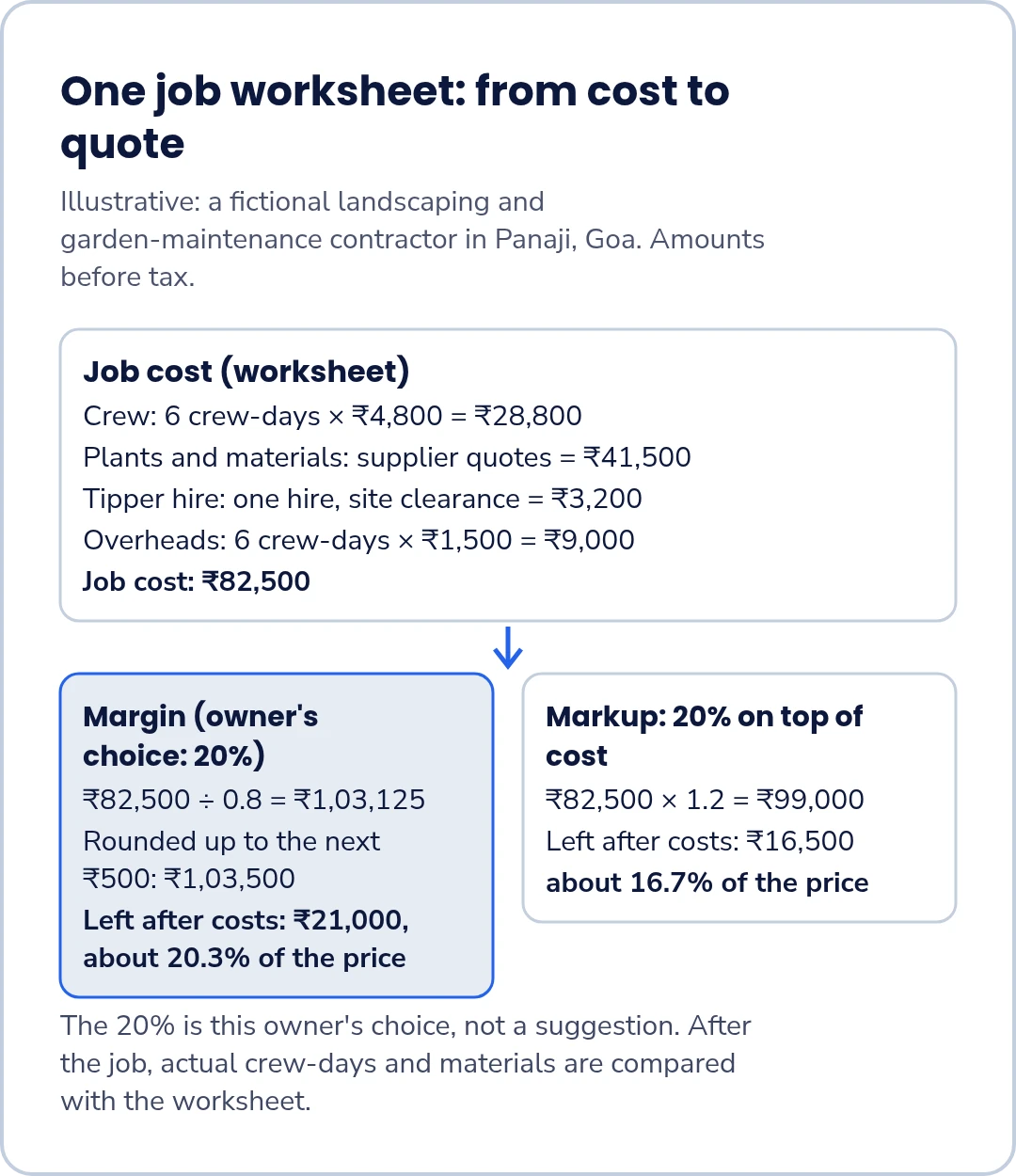
Illustrative example: a fictional landscaping and garden-maintenance contractor in Panaji, Goa; amounts before tax. The business has about 10 staff working as two site crews. All details are invented.
Crew cost per crew-day. From last year's books, the owner works out a figure of ₹4,800 per crew-day for a three-person crew.
Overheads per crew-day. Yearly overheads not tied to one job are ₹7,20,000. The two crews worked 240 days each: 2 × 240 = 480 crew-days. ₹7,20,000 ÷ 480 = ₹1,500 per crew-day.
The job: a new villa garden.
| Line | Quantity | Rate (₹) | Amount (₹) | What we assumed |
|---|---|---|---|---|
| Crew | 6 crew-days | 4,800 | 28,800 | One three-person crew, 6 days |
| Plants and materials | supplier quotes | 41,500 | Current supplier quotes | |
| Tipper hire | 3,200 | One hire for site clearance | ||
| Overheads | 6 crew-days | 1,500 | 9,000 | Same 6 crew-days |
| Job cost | 82,500 |
6 × ₹4,800 = ₹28,800; 6 × ₹1,500 = ₹9,000; ₹28,800 + ₹41,500 + ₹3,200 + ₹9,000 = ₹82,500.
The price. For this example, the owner chooses a 20% margin; that is this owner's choice, not a suggestion. ₹82,500 ÷ (1 − 0.20) = ₹82,500 ÷ 0.8 = ₹1,03,125.
The owner rounds the quote up to the next ₹500, ₹1,03,500. The extra ₹375 lifts the margin slightly: (1,03,500 − 82,500) ÷ 1,03,500 = 21,000 ÷ 1,03,500, about 20.3% of the quoted price.
The markup trap. Had the owner added 20% on top of cost instead, the quote would have been ₹82,500 × 1.2 = ₹99,000. That leaves ₹99,000 − ₹82,500 = ₹16,500, which is only 16,500 ÷ 99,000, about 16.7% of the price.
Worksheet template
Crew cost per crew-day: crew wages and allowances for the year ₹______ ÷ crew-days worked ______ = ₹______
Overheads per crew-day: yearly overheads not tied to one job ₹______ ÷ crew-days worked by all crews ______ = ₹______
| Line | Quantity | Rate (₹) | Amount (₹) | What we assumed |
|---|---|---|---|---|
| Crew | ||||
| Materials | ||||
| Job-specific hire or travel | ||||
| Overheads | ||||
| Job cost | ||||
| Margin you choose | ||||
| Price = job cost ÷ (1 − margin) |
Quoting from your real costs?
If you would like to hear about FastComply Books for your business, you can request early access. FastComply Books is in an invitation pilot in India and public sign-up is not open yet.